Celine Song’s first film follows two childhood friends from Seoul across twenty-four years and two continents, and it is quiet, exact and moving without once raising its voice. The husband is drawn a shade too kindly, and the middle stretch runs long.
It opens on three people at a bar in New York: a Korean woman, a Korean man, a white American man, and two voices off screen trying to work out who they are to each other. Celine Song, writing and directing her first film, spends the next hour and a half going back twenty-four years to answer the question, and by the time she returns to the bar we know what every glance costs. It is a fine piece of work, quiet and precise, and we recommend it with one reservation we will come to.
Twenty-four years earlier, Na Young and Hae Sung are twelve and at school together in Seoul. Her parents are emigrating, and on the last day her mother arranges an outing so the two can say goodbye. Moon Seung-ah and Leem Seung-min play the children without a false note, and Shabier Kirchner ends the section with a wide shot of the walk home: the road forks, she climbs a flight of steps to the left, he carries on along the flat to the right, and the camera does not move. That shot got us, and we were slightly embarrassed by how fast. Nothing has happened. Two children have gone home.
Twelve years later she is Nora (Greta Lee), a writer in New York, and he (Teo Yoo) is in Seoul, and they find each other online. Keith Fraase cuts this stretch as a run of video calls: faces freezing mid-sentence, the connection dropping at the wrong moment, daylight in one window and night in the other. Daniel Rossen and Christopher Bear score it with a few notes of piano and guitar. The calls are meant to feel repetitive, and after the fourth or fifth we were waiting for the next title card. It arrives, and another twelve years go with it.
The New York section is where the film lives. Nora is married to Arthur (John Magaro), a novelist, and Grace Yun has given them a small flat with books on every surface, so that two people in it are close and three are crowded. Hae Sung flies in for a week. Katina Danabassis puts him in a neat jacket and a rucksack, dressed for an interview rather than a holiday, and Teo Yoo plays him with a politeness so complete it becomes painful: he does not know where to put his hands, and he looks at Nora as though checking she is still there. Greta Lee has the harder job. Nora has to be pleased to see him and irritated by what he brings back, often in the same shot, and Lee does both without appearing to do anything.
Our reservation is Arthur. Magaro is good, and the scene in bed where he tells Nora that she dreams in Korean and he cannot follow her there is the best-written in the film. But Song has made him the most understanding husband we can remember. He jokes about being the white American standing in the way of fate, and he is never once unfair. That keeps the film civilised and it also keeps it safe: a triangle needs three sides, and this one has two and a witness. One dissenting review called the whole thing calculated. We would not go that far. The twelve-year intervals and the matched shots are a plan, and the plan shows, but the feeling underneath is not faked.
There is a scene late on, back at that bar, where the three of them sit together and Nora has to translate. Arthur listens to a conversation he cannot follow, and Kirchner keeps him at the edge of the frame. We will say no more, except that the whole film has been built to reach it and it earns the build.
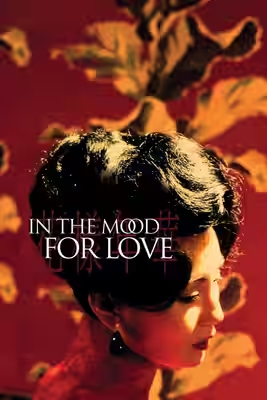
Others have reached for Brief Encounter and In the Mood for Love, and Song’s film is quieter than either: nobody here is tempted into anything they would have to hide. Early on, Nora explains to Arthur the Korean idea of in-yun, a tie between people who brushed past each other in a previous life, and adds that it is mostly something Koreans say to get someone into bed. It runs 106 minutes. Watch it with the person you chose, and do not plan on talking straight after.