Joachim Trier’s twelve-chapter portrait of a woman who cannot settle, in work or in love, is funny, quick and sadder than it first lets on. Renate Reinsve holds it together when the film’s own cleverness threatens not to.
Julie is nearly thirty, and the film gets through her twenties in a few minutes: medicine, then psychology, then photography, a new haircut and a new boyfriend with each, a narrator explaining her reasoning in the same even tone whether or not the reasoning is any good. Then she meets Aksel (Anders Danielsen Lie), who is older and surer of himself, and the film slows down and gives her a prologue, twelve chapters and an epilogue in which to work out what she wants. Joachim Trier, writing again with Eskil Vogt, has set two earlier films in this city, both with Danielsen Lie in them, and this is the warmest of the three by some distance. It is also the one fondest of its own devices. The verdict first, though: it is a good film, we recommend it, and the person who makes it good is Renate Reinsve.
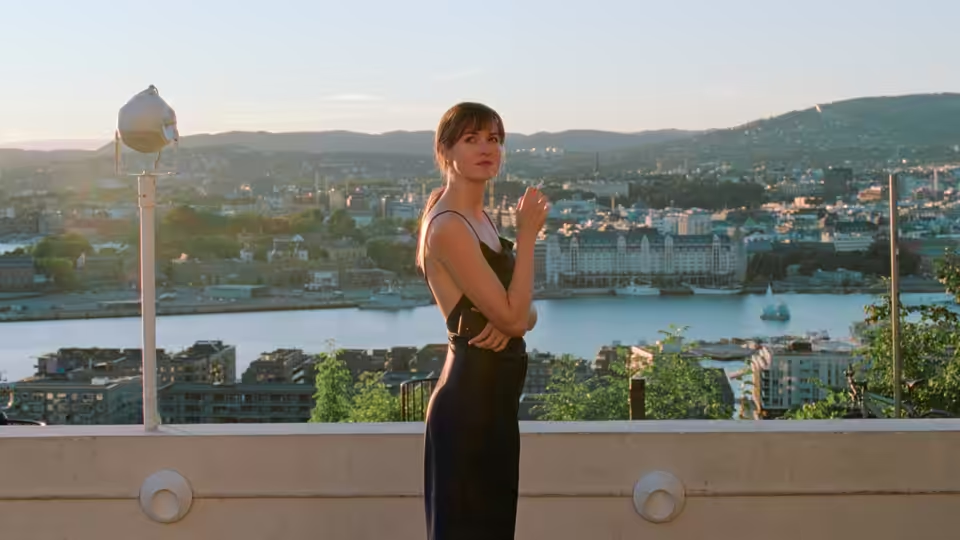
She plays Julie as someone always slightly ahead of the conversation she is in and slightly behind her own life. Watch her at the cabin weekend, among Aksel’s friends and their toddlers, deciding halfway through a sentence that she is bored of the woman she can hear talking. Watch her at the wedding party she walks into uninvited, laying out for Eivind (Herbert Nordrum) the rules of the game they are about to play, and enjoying the rules more than the game. Reinsve does not ask us to forgive Julie and does not apologise for her. The title is a joke Julie would make about herself, and Reinsve plays it as a joke with something underneath.
Kasper Andersen shoots Oslo in long, pale summer evenings, the kind of light in which nobody wants to go home, and he keeps the camera close enough to Reinsve’s face that we can watch her change her mind. Roger Rosenberg gives Aksel a flat with books to the ceiling and a drawing board by the window, the home of a man whose life is furnished, and gives Eivind almost nothing, which is the point. Olivier Bugge Coutté cuts the early chapters fast, on the beat of the narration, and then lets scenes run once Julie has somewhere to stay.
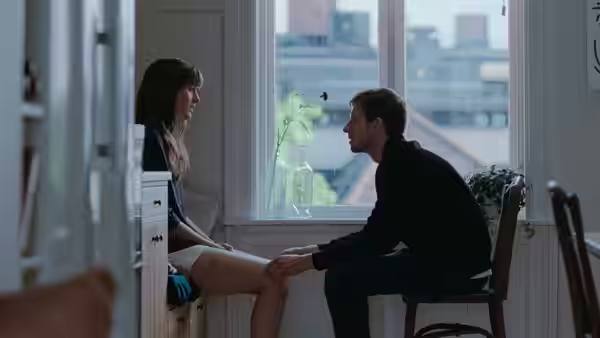
The second half takes a turn we will not describe. What we can say is that Danielsen Lie plays a man who is sure of his opinions and is starting to suspect that certainty was not the achievement he took it for. The late conversations between Aksel and Julie moved us more than anything else in the film, and more than we expected from a film this pleased with its own jokes. They are shot plainly, two people sitting and talking about what they were to each other, and Bugge Coutté lets them run without cutting for reaction. Reinsve listens in these scenes as well as she talks, which is rarer than it sounds.
Not all of it works. There is a chapter in which Julie takes mushrooms and the film takes them with her, and what follows is the one stretch where Trier’s imagination and Julie’s part company: rubbery bodies, an appearance by her father Per Harald (Vidar Sandem), jokes landing at half strength. It is the only sequence that feels made to be described afterwards. The chapter title cards, wry at first, become a tic by the ninth. And the film is softer on Julie than its title pretends. Her carelessness costs other people more than it costs her, and Trier is more interested in how she feels about that than in how they do. Sunniva (Maria Grazia Di Meo), Eivind’s girlfriend, gets one funny paragraph of narration about her yoga and her recycling and is then put away. The epilogue is tidier than the twelve chapters that earned it.
Most critics have been warmer than we are, and a few have found the whole thing cold, a romance about someone who cannot commit, made by someone who will not commit to a view of her. We understand the complaint without sharing it. Trier is counting what Julie’s indecision costs, in Ola Fløttum’s spare piano and in Andersen’s light going from summer to something greyer, and he lets her notice the bill late, which is when most of us do.
It is a 15 certificate and 128 minutes, and the minutes go quickly. See it with someone you have been with long enough to argue about it afterwards. You will, and Julie will come out of the argument about as well as she comes out of the film.