Film review

Minari

2021 · Directed by Lee Isaac Chung · 1h 55m · MPA PG-13

In a sentenceGrandma won’t bake cookies, Dad won’t listen to the dowser, and the house is on wheels

Drama

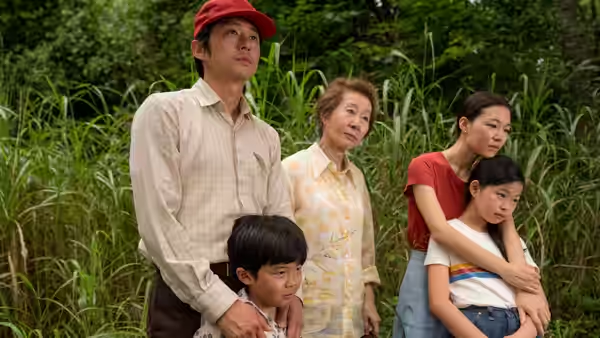
In the 1980s, Jacob Yi (Steven Yeun) moves his family from California to a plot of Arkansas farmland and a mobile home on wheels. He means to grow Korean vegetables and sell them to the grocers in Dallas. His wife Monica (Han Ye-ri) wanted a house with a foundation and a hospital within reach, because their son David (Alan Kim) has a heart murmur and is not allowed to run. By day both parents sort chicks at a hatchery. Jacob refuses to pay a dowser and digs his own well, and a neighbour, Paul (Will Patton), a Korean War veteran who carries a cross along the road on Sundays, comes to work the field. Then Monica’s mother Soonja (Youn Yuh-jung) arrives from Korea to mind David and his sister Anne (Noel Kate Cho), and David decides she is not a real grandmother.

Plays from YouTube when you press play; nothing loads from them until then.

Fi1m review

Lee Isaac Chung’s story of a Korean family farming in 1980s Arkansas is patient, exact and kind to everyone in it. Youn Yuh-jung’s grandmother is the reason to see it; a hurried last half hour keeps it just short of the top.

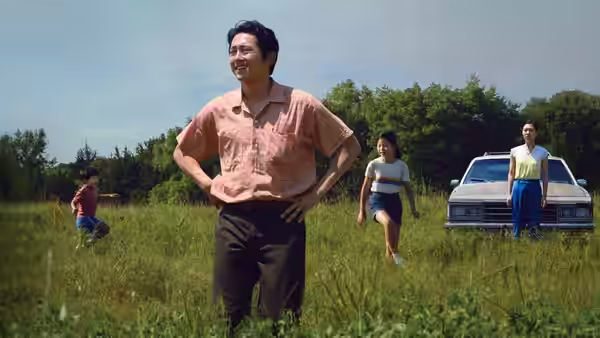
Jacob Yi (Steven Yeun) has moved his wife and two children from California to a stretch of Arkansas in the 1980s, where a mobile home on wheels waits at the end of a dirt track. He wants to grow Korean vegetables and sell them to the Korean grocers in Dallas. Monica (Han Ye-ri) wanted a house with a foundation. Lee Isaac Chung, who wrote and directed, grew up in something like this, and the film has the feel of memory: the small things remembered exactly, the big things seen from a child’s height.

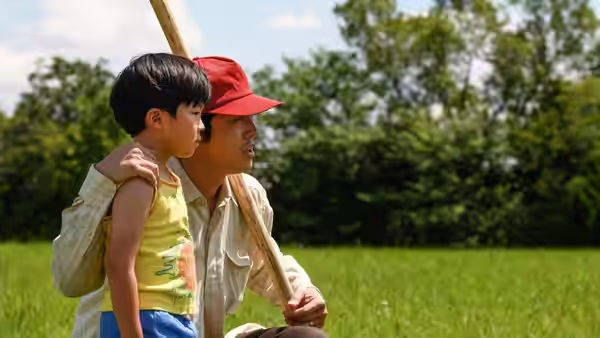
The child is David (Alan Kim), who has a heart murmur and orders not to run, and most of Minari is his. His parents spend their days at a hatchery sorting chicks, and Jacob explains to him that the males are no use and are thrown away, so a man must make himself useful. That is the whole of Jacob in one line, and Yeun plays it straight: proud, stubborn, and mostly wrong about water. Han Ye-ri gives Monica a tired watchfulness; she is the one counting the money. Their rows happen in the kitchen while David and Anne (Noel Kate Cho) fold paper aeroplanes with “Don’t fight” written on the wings and launch them down the hall.

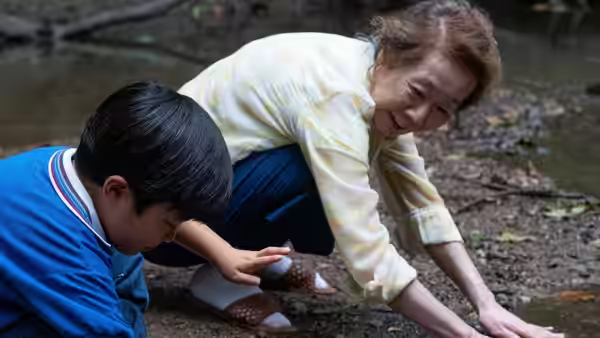
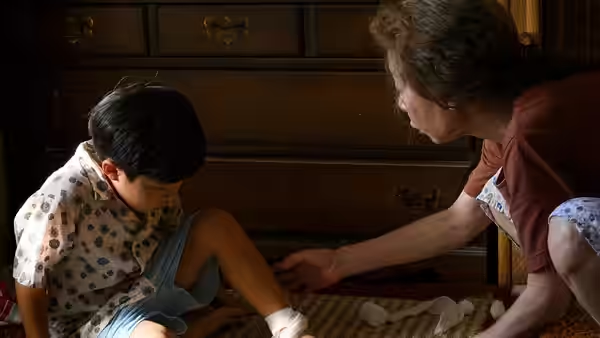
Then the grandmother arrives. Soonja (Youn Yuh-jung) comes from Korea with chilli powder and dried anchovies in her luggage, swears at the wrestling on television, plays cards for money with the children and does not bake anything. David, who has been told on good authority what grandmothers are, is appalled. Youn plays her with no bid for our affection at all, which is why we gave it. The film is funniest when the two of them are stuck in a room together, and it is best when she takes him down to the creek and plants minari seeds along the bank, telling him it grows anywhere and that rich and poor eat it alike. It moved us more than we expected, and what did it was how little Chung does: no swell of music, no cut to a meaningful face, just an old woman crouched in the mud and a boy pretending not to be interested.

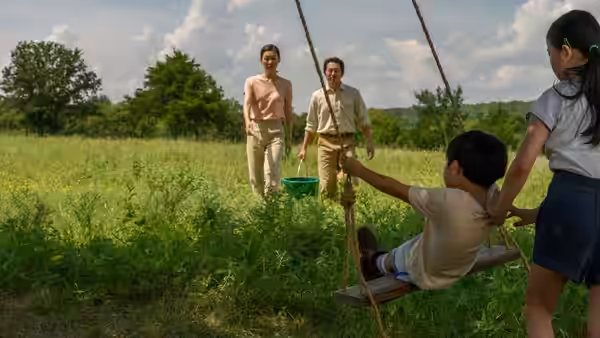
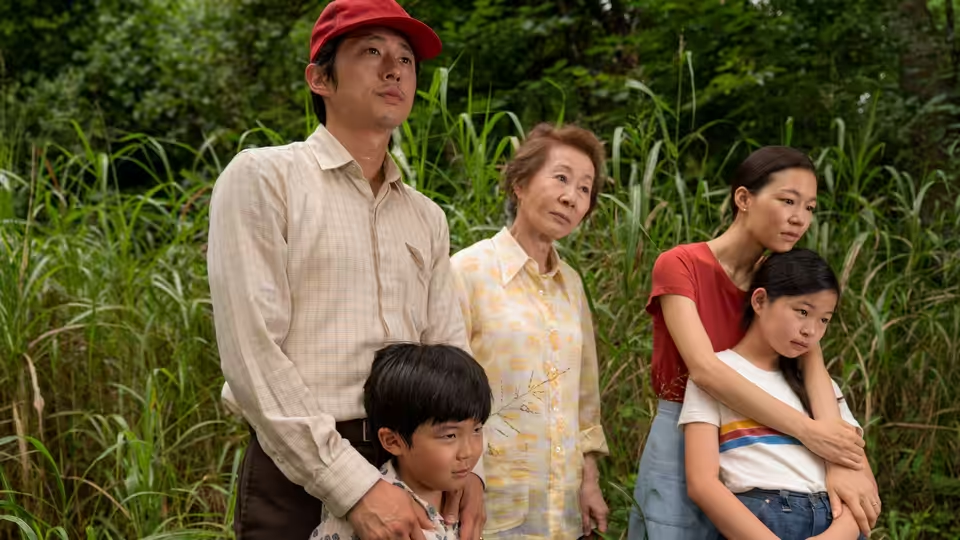
Lachlan Milne shoots the land in late afternoon light, the grass chest-high on the children, and keeps the camera low so the field and the sky both look too big for the people standing in them. Lee Yong-ok’s production design gives the trailer a set of wooden steps that sit loose on the grass, and Monica’s face on first seeing them saves the script a page. Emile Mosseri’s score is piano and a wordless voice that drifts in over the fields and stays out of the trailer, which is the right way round. Harry Yoon cuts slowly and holds on Jacob standing over a dry ditch long enough for us to work out exactly how much he has bet on it.

Will Patton’s Paul is the one figure who could have gone wrong. He prays over the crops, points out demons in the corners and hauls a cross along the road on Sundays, and Patton keeps him a real man rather than a local colour. The church the Yis attend is handled the same way: the congregation stare, a boy asks David why his face is flat, and nobody is a villain. Susanna Song dresses the family a shade too formally for a room full of shirtsleeves, and that is the scene.

Our reservation is the last half hour. After ninety minutes of letting things happen at the speed of weather, Chung stacks trouble in the field and trouble in the trailer on the same evening, and we will not say what. It is written to arrive on time, and you can feel the furniture being moved. Monica, who has been the sharpest pair of eyes in the film, is handed a speech to explain a decision we had already understood from her face. Most critics wave this through on the way to calling the film a classic. We think the first ninety minutes are as good as they say and the last twenty-five are merely good.

It is a 12 certificate and runs 115 minutes. See it with your parents if you still have them, or with children who will grumble about the subtitles and then go quiet the moment the grandmother sits down to cards.

Critical consensus AI synthesised

83
Positive
23
Mixed
1
Negative
1

The reviews are strongly favourable, with twenty-three of twenty-five positive. Most critics call it gentle, tender and truthful: a portrait of a Korean immigrant family on an Arkansas farm in the 1980s, drawn from Lee Isaac Chung’s own childhood, and they credit that footing for its specificity. Praise clusters on the acting, and on Youn Yuh-jung’s grandmother above all; her scenes with young Alan Kim are singled out repeatedly as the film’s comic and emotional centre. Chung’s writing and unhurried direction come a close second.

The spread is narrow. Where reservations appear they concern the plotting: several critics find the late run of incidents piled up or too neatly resolved. The Hollywood Reporter feels the third-act crisis is not properly worked through, and Slant Magazine argues the tidiness undercuts the mess of the family’s situation. The lone hostile voice is The New Yorker, which finds the storytelling conventional and the technique impersonal, so that personal memory is flattened into familiar drama.

Little White Lies
30 March 2021 · 4/5/4 · Kambole Campbell
100

The critic finds it a gorgeous semi-memoir of immigrant resilience and the pains of assimilation in 1980s Arkansas. Praise is given to Chung’s writing and direction plus the lively grandmother performance that anchors the family’s emotional core.

Read the full review →
The Independent
10 February 2021 · ★★★★/4 · Lindsey Bahr
100

The critic calls it an essential, universal portrait of a Korean-American immigrant family based on the director’s childhood. It praises the specificity of the delicate tale that makes viewers fall in love with the Yi family immediately.

Read the full review →
Time Out
1 April 2021 · ★★★★★ · Phil de Semlyen
100

The critic calls it an irresistible delight and a beguiling family drama of heartache and hope. They single out the elemental performances, especially Yuh-jung Youn’s force-of-nature grandmother, and the film’s Malick-like exploration of land and connection.

Read the full review →
Empire
30 March 2021 · Terri White
90*

The critic calls it a profound, detail-perfect and soulful slice of American family life with some of the year’s most sincere performances. It praises the lightness of touch in familial scenes, the autobiographical elements, and the confident, unmanipulative pacing.

Read the full review →
Evening Standard
6 April 2021 · Charlotte O'Sullivan
90*

The critic calls it the most consistently entrancing drama of 2021 and one of the cheapest Oscar contenders. It singles out the script’s unflinching yet compassionate handling of family pain and flawed characters, especially the mother.

Read the full review →
IndieWire
27 January 2020 · festival review · David Ehrlich
90*

The review highlights the film's gentle and sweet tone alongside its staggeringly powerful depiction of an immigrant family's pursuit of the American Dream.

Read the full review →

Cast

Awards

Academy Awards, 2021

Nominated
Best Picture

Medal from the Circle of Cinematographic Writers for the best foreign film, 2021

Nominated
Medal from the Circle of Cinematographic Writers for the best foreign film

Sundance Audience Award: U.S. Dramatic, 2020

Won
Sundance Audience Award: U.S. Dramatic

Sundance Film Festival U.S. Dramatic Grand Jury Prize Award, 2020

Won
Sundance Film Festival U.S. Dramatic Grand Jury Prize Award

If you liked this, try…