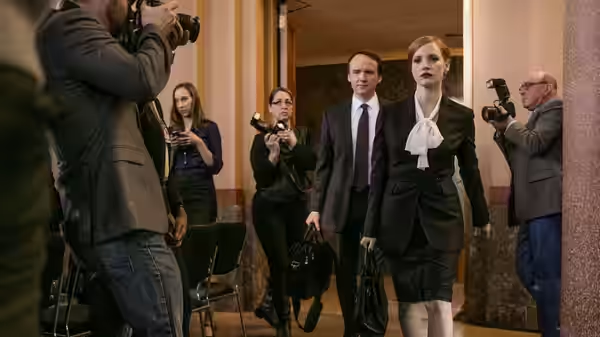
John Madden’s lobbying thriller is quick, talkative and better company than it has any right to be, with Jessica Chastain at full tilt in nearly every scene. The final twenty minutes pull a stunt that costs it most of what it earned.
Sloane tells us in the first minute what the film will do to us. Lobbying, she says to camera, is about foresight: anticipate your opponent’s moves, devise countermeasures, play your trump card just after they have played theirs. Make sure you surprise them. John Madden’s film spends 133 minutes doing as she says, and for about 110 of them it is a brisk, talkative, enjoyable thriller about a woman who is better than anyone at a job nobody admires. Then it plays its trump card, and it is a cheat.
Jessica Chastain plays Sloane as a machine that has stopped pretending otherwise. She does not sleep, keeps upright on pills, and pays a man (Jake Lacy’s Forde) by the hour so as not to need a private life. She talks faster than anyone else on screen and listens faster too, and Chastain lets us see the half-second in which Sloane has won before the other person has finished the sentence. Jonathan Perera’s script gives her almost no inner life; she builds one anyway, mostly in Forde’s hotel room, where she is briefly allowed to be tired.
Madden has cast actors who can hold a long sentence. Mark Strong’s Rodolfo Vittorio Schmidt runs the smaller firm she defects to, and Strong plays him as a decent man who has hired a weapon and keeps checking which way it is pointing. Gugu Mbatha-Raw’s Esme Manucharian is the colleague whose past Sloane will find a use for, and Mbatha-Raw is the only person on screen who feels things at an ordinary speed. Michael Stuhlbarg’s Pat Connors, the old boss, sneers well. Alison Pill’s Jane Molloy, the protégée left behind, is given less than she deserves.
Sebastian Blenkov shoots Washington as glass and grey: see-through office walls, corridors lit by the city outside. Matthew Davies builds the two firms so one cut tells you where you are, dark wood and long tables at the old one, smaller and brighter at the new. Georgina Yarhi keeps Sloane in black and white with hard shoulders, and gives her one red dress for the night she means to be looked at. Max Richter’s score is a low pulse of piano and strings, and never tells us when to be excited. Alexander Berner cuts the first act tight and drops the Senate hearing in at intervals, so it keeps interrupting the story.
The script has one voice, and it is hers. Everyone speaks in finished paragraphs with the comeback already loaded, and after an hour it feels like one clever person arguing with herself. The film is built around a bill to tighten background checks on gun sales and is not interested in guns. The bill is there to give Sloane something to win; when the film needs her on the right side of it, somebody says so and we move on. Fine for a thriller. Not fine for a film that keeps asking whether its heroine has a conscience.
For two hours we were enjoying ourselves, the slightly guilty enjoyment of watching somebody be ruthless with people who had it coming, and a sequence in which Sloane ambushes the other side with something they believed was secret had us leaning forward. Then the last act arrived and we felt that we had been played rather than surprised. Sloane told us at the start that the trick is to anticipate. The film’s own trick depends on our not having been given anything to anticipate with. We will not say what it is. We will say it made the previous two hours smaller.
Madden made Shakespeare in Love (1998) and The Best Exotic Marigold Hotel (2011), and he is a director of actors rather than arguments, which suits this. Set against Michael Clayton (2007) it is quicker and shallower: Gilroy let his fixer be ashamed and did not rescue him; Perera lets Sloane be tired and then wins the case for her. Watch it at home, with somebody who likes a fast talker. When the hearing calls its witness back for the last time you will know the moment. We did not think what follows was fair, and we were still glad of the evening.