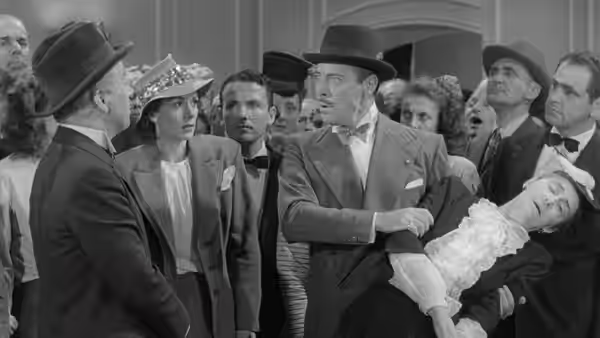
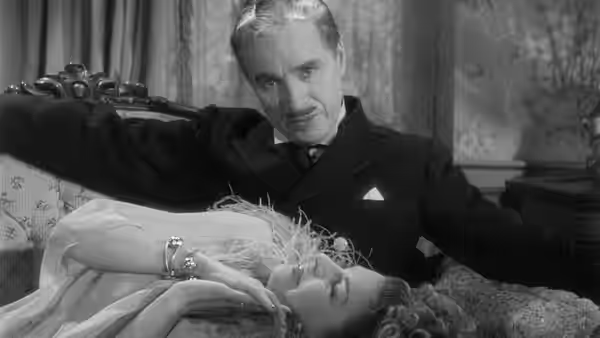
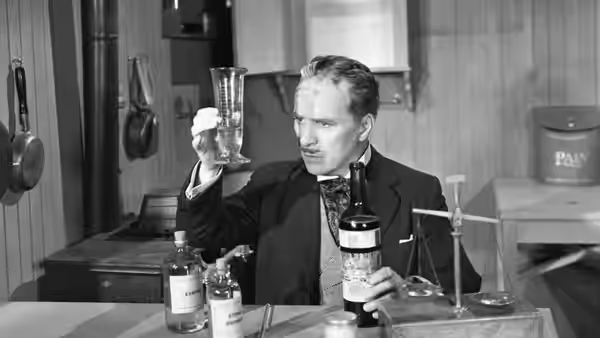
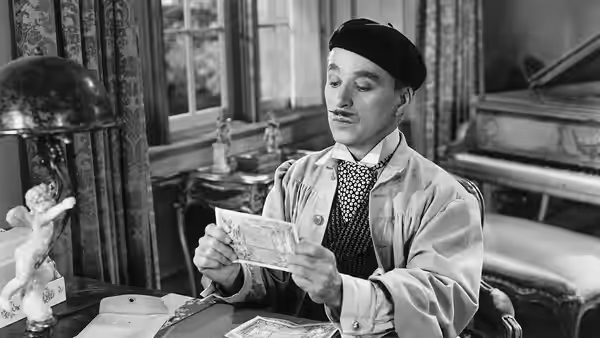
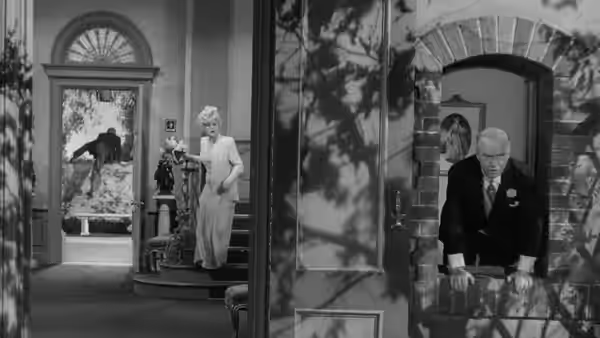
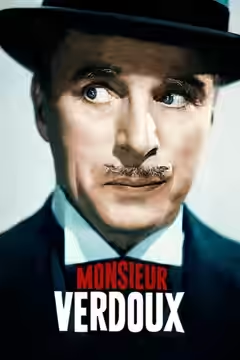
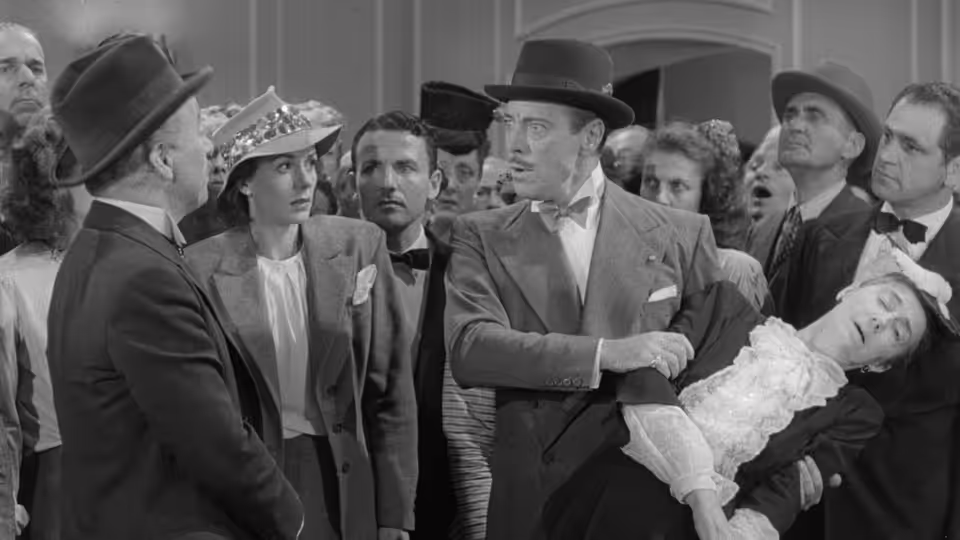
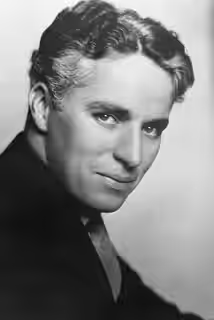
Henri Verdoux (Charlie Chaplin) carries an unconscious woman among formally dressed guests
Film review

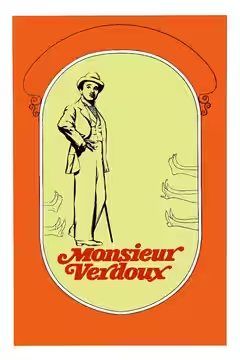
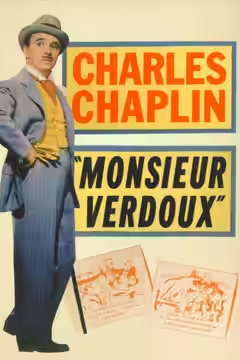
Monsieur Verdoux

1947 · Directed by Charlie Chaplin · 2h 04m

In a sentenceChaplin is so polite about murder that we briefly forget to object

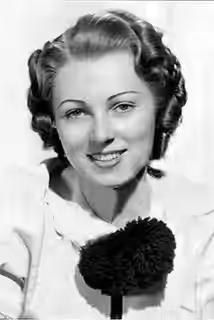
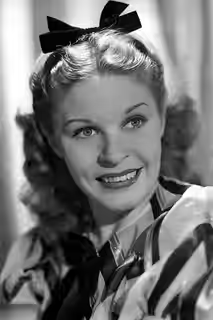
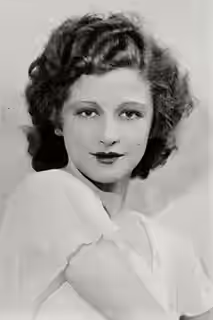
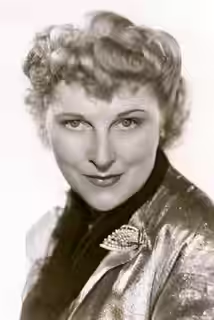
Henri Verdoux (Charlie Chaplin) seeks wealthy women to marry, with murder behind his attentions. He presents himself as a man of refinement, approaching courtship with the care of someone conducting business. Marie Grosnay (Isobel Elsom) and Lydia Floray (Margaret Hoffman) are among the women drawn into his dealings. Money is his object, and polite behaviour is his means of getting close enough to obtain it. He needs to remain convincing as a husband while keeping his murderous purpose out of sight, treating each marriage as another opportunity to make a living.

Fi1m review

Charlie Chaplin makes a murderer’s good manners alarmingly funny, with Martha Raye giving his precision something to contend with. The comedy is sharp enough to recommend warmly, though the political explanations can become a lecture.

Monsieur Verdoux is a sharp, disquieting comedy with a weakness for explaining itself. Charlie Chaplin plays Henri Verdoux, a man who marries wealthy women and treats murder as a practical means of making money. Chaplin asks us to enjoy the man’s composure while keeping his purpose in view, a difficult arrangement which works because the performance is so exact. Its political talk grows heavy, but Chaplin’s timing keeps earning our attention.

The unsettling thing about Chaplin here is the courtesy. Verdoux’s refinement gives him a way to make appalling intentions appear almost reasonable, and Chaplin does not keep signalling that we ought to recoil. We laughed at Verdoux’s elaborate courtesy, then felt uncomfortable about how easily it had worked on us. His careful manners encourage us to appreciate the effort he puts into charming women, although we know why he wants their confidence.

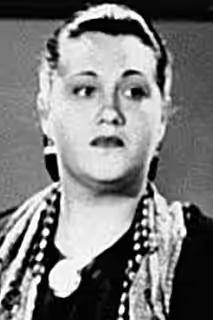
Martha Raye, as Annabella Bonheur, is the welcome disturbance in all this careful behaviour. Her scenes give Chaplin’s visual comedy room to develop, and the pleasure comes from watching his assurance become harder work. Raye has enough comic force to make his attempts to control a scene look faintly ridiculous, which saves the film from becoming too pleased with its clever leading man. The gags are carefully worked out, but the performers make the difficulties between them feel spontaneous.

Roland Totheroh and Curt Courant’s cinematography serves that physical comedy well. The pictures give Chaplin’s gestures their due without asking us to admire the photography separately. Willard Nico’s editing is most effective within the comic encounters, where the difference between a joke arriving early and arriving on time matters. The joins between episodes are less satisfying, and the film sometimes seems to begin again when it ought to be gathering force.

Chaplin also supplies the music, and his score is a considerable help. It gives the film some ease without making Verdoux’s behaviour any easier to excuse. There is a temptation in this kind of comedy to insist on the wickedness of every joke until none of them can breathe; the music is more companionable than that. We could do with a little more of its lightness in the passages where the writing presses its political case.

Chaplin’s screenplay, from a story credited to Orson Welles, takes aim at a society willing to excuse cruelty when it is profitable or respectable. That is a sound subject for a black comedy, though the moral reasoning sometimes feels too conveniently arranged around its leading man. Calling attention to public hypocrisy does not settle what we should think of Verdoux, and the film becomes less interesting when it seems to believe that it does. Chaplin can be insistent where he has already been clear.

Black comedy needs to leave us a little uneasy about laughing, and this film does. Its strongest passages trust us to notice what is wrong with Verdoux while enjoying the skill with which Chaplin plays him. At 124 minutes, however, the unevenness has time to register, and an uninterrupted succession of gags is not what is on offer. See it for Chaplin and Raye, and be prepared to sit through the occasional lecture.
Critical consensus AI synthesised

74
Positive
5
Mixed
1
Negative
1

Most critics respond warmly to Monsieur Verdoux, praising Chaplin’s combination of black comedy and an attack on social hypocrisy. The praise centres on the contrast between Verdoux’s refined manners and his ruthlessness, and on comic invention that gives the film’s bleak ideas a practical outlet. The AV Club and Empire particularly value the scenes with Martha Raye, where Chaplin’s carefully arranged visual gags receive some of their strongest notices.

The spread is wide, however, with disagreement over whether the comedy works at all. Empire acknowledges that the humour does not always produce outright laughter, without treating that as a serious failing. Variety takes a much harsher view: it finds the comic foundations unsound, little sympathy in Chaplin’s performance and occasional disjointedness in his direction. Its praise goes instead to his score, leaving it sharply opposed to the favourable majority.

Slant Magazine
21 March 2004 · ★★★★/4 · Josh Vasquez
100

Vasquez argues that the film remains urgent and essential, with its bleak humor still strikingly contemporary. He praises Chaplin’s blending of comic inventiveness with a blackly poetic critique of capitalism and moral confusion.

Read the full review →
The AV Club
27 March 2013 · A- · Noel Murray
90

Murray finds the film an assured blend of suspense and pitch-black comedy, with a sharp argument about society’s moral contradictions. He especially praises the scenes with Martha Raye, whose character gives Chaplin’s visual-gag skills room to shine.

Read the full review →
Radio Times
★★★★ · Tom Hutchinson
80

Hutchinson calls it Chaplin’s greatest later sound film and praises its chilling black comedy. He singles out the final speech for linking the killer’s actions to those of major political powers.

Read the full review →
Empire
1 January 2000 · empire
75*

The review considers Chaplin’s film a work of real greatness, though its dark comedy is not always laugh-out-loud funny. It praises the carefully choreographed gags, especially Martha Raye’s repeated failures to die.

Read the full review →
The New Yorker
7 April 2013 · Richard Brody
75*

Brody presents the film as an elaborate, sharply subversive work that dismantles Chaplin’s familiar screen persona. He singles out the elegant irony linking Verdoux’s refined manners and murderous ruthlessness to Chaplin’s attack on hypocritical morality.

Read the full review →
Time Out
· GB
65*

The accessible page confirms this is a review but does not reveal the critic’s verdict. Its metadata describes Chaplin’s film as a self-styled “comedy of murders” about a man who marries wealthy women.

Read the full review →

Straight answers AI written, from our review

Is Monsieur Verdoux worth watching?
Monsieur Verdoux is well worth watching for Chaplin’s precise comic performance and Martha Raye’s disruptive energy; we score it 82 out of 100. We recommend it warmly to anyone who enjoys black comedy, though its uneven episodes and occasional political lectures make it less suited to an evening of uninterrupted laughter.
How long is Monsieur Verdoux, and what is it rated?
Monsieur Verdoux runs 2h 04m. It is a comedy and crime film.
Where can I watch Monsieur Verdoux in Greece?
Monsieur Verdoux is not on any streaming or rental service in Greece at the moment. It is available in 5 other countries; change your country at the top of the page to see where. Availability is checked daily.
How violent or frightening is Monsieur Verdoux, and is it suitable for children?
Monsieur Verdoux carries a UK PG certificate, but its comedy centres on a man who courts wealthy women with murder in mind. We find the humour unsettling because Chaplin makes his character’s appalling intentions seem almost reasonable; parents should weigh that subject matter rather than take the certificate as a promise of light entertainment for younger children.
How does Monsieur Verdoux compare to Kind Hearts and Coronets?
Monsieur Verdoux shares the murderous good manners of Kind Hearts and Coronets, but we recommend the latter for more consistent comedy and the former for Chaplin and Raye’s physical interplay. Both make appalling behaviour sound reasonable; Verdoux is more prone to political explanation, while the pleasure in Kind Hearts comes with a caveat about its under-attended supporting characters.

Cast

Awards

Academy Awards, 1948

Nominated
Best Writing, Original Screenplay

If you liked this, try…

  1. Kind Hearts and Coronets (1949, Fi1m 91)Another impeccably mannered murderer makes social ambition a matter of careful elimination.

  2. A New Leaf (1971) · not on Fi1m yetA murderous courtship gets complicated by the inconvenient business of knowing someone.

  3. Divorce Italian Style (1961) · not on Fi1m yetRespectable society supplies the excuses for a husband’s thoroughly disreputable plans.

  4. The Ax (2005) · not on Fi1m yetProfessional survival provides another killer with an alarmingly tidy set of excuses.

  5. The Cremator (1969) · not on Fi1m yetFar grimmer comedy about the terrible things a courteous man can justify.