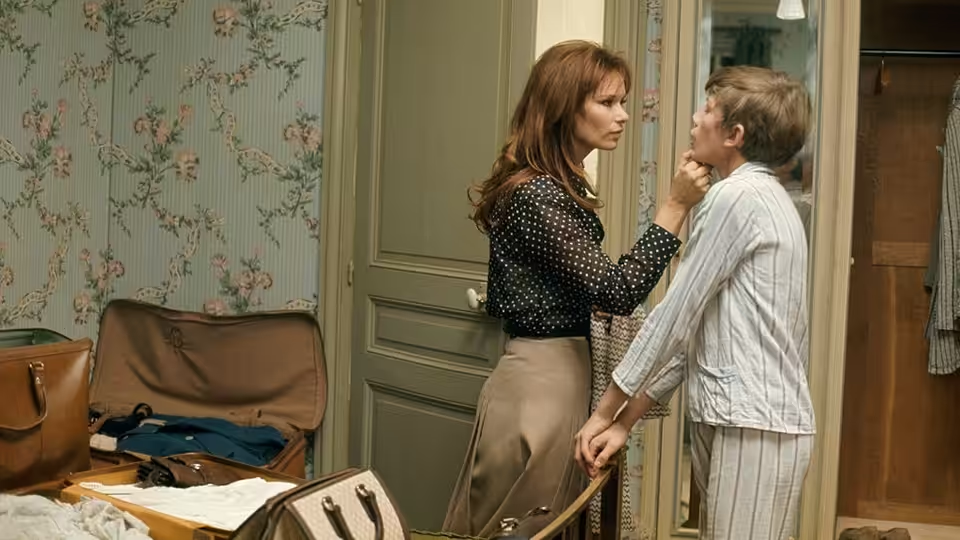
A woman touches a boy’s chin in a bedroom beside an open suitcase
Film review

Murmur of the Heart

1971 · Directed by Louis Malle · 1h 58m

In a sentenceBenoît Ferreux and Lea Massari make the awkward questions remarkably easy to put off

Louis Malle writes and directs this 1971 comedy-drama. Benoît Ferreux plays Laurent Chevalier, Lea Massari plays Clara Chevalier, and Daniel Gélin plays Charles Chevalier. Marc Winocourt and Fabien Ferreux play Marc Chevalier and Thomas Chevalier, with Michael Lonsdale as Father Henri. The other characters include Augusta (Ave Ninchi), the cook (Annie Savarin), and Freda (Gila von Weitershausen), a prostitute. Aunt Claudine (Micheline Bona), Uncle Léonce (Henri Poirier), and Fernande (Liliane Sorval) also appear among the characters in this ensemble comedy and drama.

Fi1m review

Louis Malle’s comedy-drama is warmly observed and finely acted by Benoît Ferreux and Lea Massari. Its affection for the characters becomes a serious weakness when their behaviour needs a harder look.

Murmur of the Heart is warmly performed and frustratingly unwilling to question the people it makes us like. Louis Malle, who writes and directs, is good at making his characters worth our attention before asking us to consider their behaviour. The warmth matters, and so does the sharpness of his observation. But when the film needs to examine what they have done, he becomes too willing to leave them comfortable.

Benoît Ferreux gives Laurent Chevalier enough individuality to keep him from becoming an illustration of a difficult subject. We can attend to him without feeling that every detail has been arranged to make a point. Lea Massari’s Clara Chevalier is equally persuasive, and the two performances do much of the work that the writing leaves undone. We were touched by their ease together: Ferreux and Massari make affection feel ordinary enough that it does not require a declaration.

The supporting cast includes Daniel Gélin as Charles Chevalier and Michael Lonsdale as Father Henri, but Ferreux and Massari hold our attention most firmly. Malle’s humour benefits from his interest in people beyond their immediate usefulness to the story. He allows them to be engaging without requiring them to be exemplary, and that generosity gives the comedy much of its appeal. It also makes the script’s later reluctance to scrutinise their behaviour more disappointing, because the observation elsewhere is so attentive.

Ricardo Aronovich’s cinematography and Jean-Jacques Caziot’s production design contribute to the film’s inviting manner. The visual detail is elegant without competing with the performances, and the care taken over the characters’ surroundings helps make their company pleasurable. Neither contribution feels anxious to announce itself. Yet that elegance also contributes to our reservation: the film’s pleasant appearance can make its treatment of troubling behaviour seem more satisfactory than it is.

Suzanne Baron’s editing is sympathetic to the performances, giving their warmth time to register. The continuity of tone works well for the comedy, although it becomes less helpful when the material calls for greater discomfort. At 118 minutes, the film has ample opportunity to question the impression it has created. The problem is in Malle’s writing, which relies too heavily on our affection for the characters to carry us through the difficult material.

There is a pivotal incident we will not describe. Our objection is to how little consequence the film allows it, leaving the actors to persuade us that its gentle treatment is sufficient. That is a considerable demand to make of two performances, however persuasive they are. Malle has made us interested in these people, so we want him to look harder at what their behaviour means for them; the film’s reluctance to do so feels like unfinished work.

A comedy-drama need not punish its characters, and adding a few solemn speeches would solve nothing here. Malle could, however, allow more difficulty to survive his affectionate handling of them. That reservation makes this a qualified recommendation for those interested in a film whose performances are more convincing than its treatment of its central problem. Watch it with someone prepared to disagree about what Malle lets pass.

Critical consensus AI synthesised

61
Positive
0
Mixed
4
Negative
0
The New York Times
18 October 1971 · Vincent Canby
65*

The URL identifies a New York Times review of Louis Malle’s film, but the article text is unavailable. Its verdict and specific praise or criticism cannot be verified from the page provided.

Read the full review →
RogerEbert.com
64*

The page content is inaccessible, so the critic’s verdict cannot be determined. No praise or complaint can be identified from the available text.

Read the full review →
Time Out
· TM
64*

The available description notes controversy but frames the film as concerned with more than incest. The accessible text does not reveal a specific element singled out for praise or complaint.

Read the full review →
Los Angeles Times
6 April 1989 · Sheila Benson
50*

Benson finds the film warmly observed and beautifully performed, but questions whether its pivotal moment has any real consequence. She especially praises the performances of Benoit Ferreux and Lea Massari, alongside the film’s elegant detail and sharp observation.

Read the full review →

Straight answers AI written, from our review

Is Murmur of the Heart worth watching?
Murmur of the Heart is worth considering for its performances and warmly observed comedy, though our score of 61 reflects a serious reservation. Benoît Ferreux and Lea Massari make the characters persuasive company, but we find Louis Malle too reluctant to examine their troubling behaviour; it suits viewers prepared to question the film’s gentle handling.
How long is Murmur of the Heart, and what is it rated?
Murmur of the Heart runs 1h 58m. It is a drama and comedy film.
Where can I watch Murmur of the Heart in Norway?
Murmur of the Heart is not on any streaming or rental service in Norway at the moment. It is available in 5 other countries; change your country at the top of the page to see where. Availability is checked daily.
How does Murmur of the Heart compare to The 400 Blows?
Murmur of the Heart offers a warmer account of adolescence than The 400 Blows, which we recommend more confidently for its convincing portrait of a neglected Parisian boy. Both benefit from persuasive performances, but Malle’s affection lets difficult behaviour pass too easily, while Truffaut’s film has little patience for adult authority, even if its music sometimes presses too hard for sympathy.
What should I watch after Murmur of the Heart?
After Murmur of the Heart, try The 400 Blows (1959, Fi1m 91): For another French account of adolescence, with little patience for adult authority. Then Amarcord (1973, Fi1m 82): For adolescent curiosity amid family quarrels and the absurdities of provincial life; and Fanny and Alexander (1982, Fi1m 92): For family life seen by children who notice more than adults suppose.

Cast

Awards

Academy Awards, 1973

Nominated
Best Writing, Original Screenplay

If you liked this, try…

  1. The 400 Blows (1959, Fi1m 91)For another French account of adolescence, with little patience for adult authority.

  2. Amarcord (1973, Fi1m 82)For adolescent curiosity amid family quarrels and the absurdities of provincial life.

  3. Fanny and Alexander (1982, Fi1m 92)For family life seen by children who notice more than adults suppose.

  4. The Squid and the Whale (2005, Fi1m 83)For adolescent embarrassment made worse by parents convinced of their own sophistication.

  5. Good Morning (1959) · not on Fi1m yetFor domestic comedy that takes children seriously and adult manners less so.