Nicholas Stoller’s comedy about new parents at war with the fraternity next door is loud, crude and funnier than it has any right to be, mostly because Rose Byrne refuses to play the disapproving wife. The story under the gags is thin, and the film knows it.
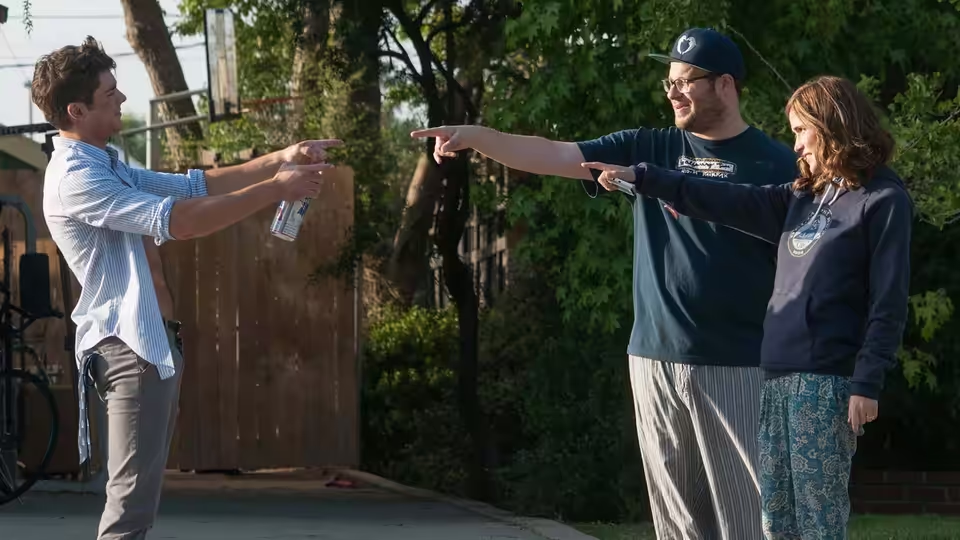
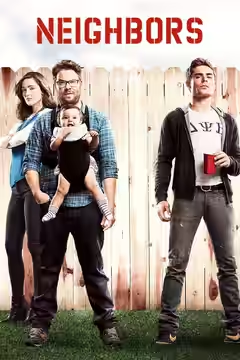
The premise of Neighbors fits on a beer mat. A couple in their thirties with a baby move next door to a fraternity, ask nicely for quiet, and are ignored; hostilities follow. Nicholas Stoller, directing a script by Andrew J. Cohen and Brendan O’Brien, has no interest in pretending this is more than it is. What he has made instead is a 97-minute escalation of pranks with a few honest observations about getting older tucked in among the jokes about male anatomy. It is uneven and it is often stupid, and we laughed a great deal more than we expected to.
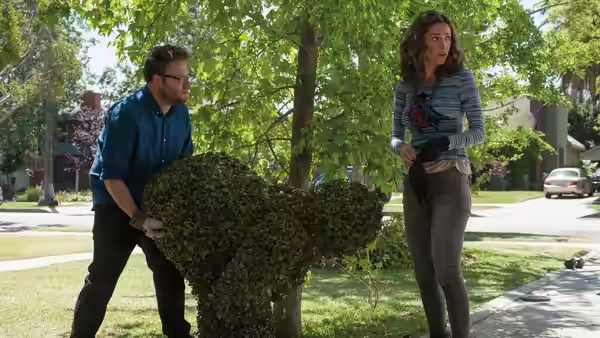
The reason is Rose Byrne. The wife in this kind of film is usually the brake, the person who says no so that the husband can say yes and the plot can happen. Byrne’s Kelly is the accelerator. She is the one who wants to go to the party, the one who proposes the nastier schemes, and the one who carries out the cruellest of them with a bright, reasonable smile while Mac stands beside her looking worried. Byrne plays every line as if it were the obvious thing to say, which is the only way this material works, and she gets the biggest laughs in the film without once raising her voice.
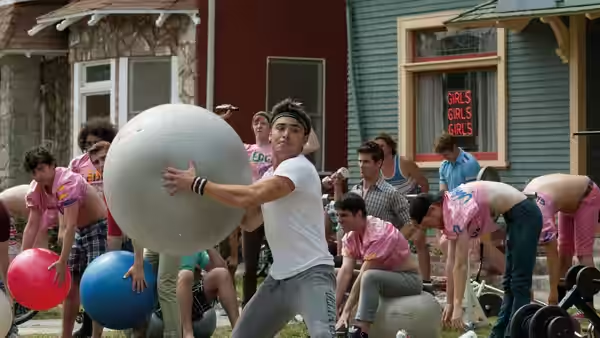
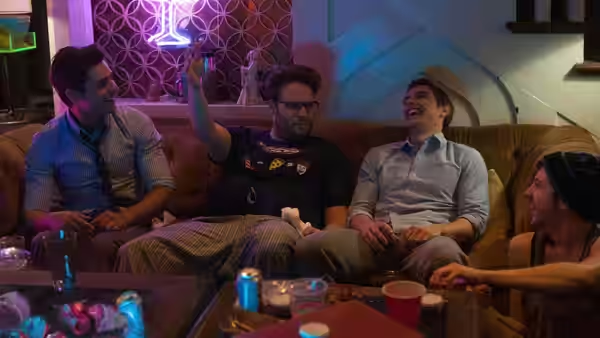
Zac Efron is the other surprise. Teddy Sanders is the fraternity’s president and its poster, and Efron plays him with a vanity so complete it becomes touching: he knows exactly how he looks, he knows it is the only thing he has, and he is starting to suspect it will not last past graduation. Dave Franco’s Pete is the clever one, the boy with the job offer, and the film is quietly sharp about what happens to a friendship when one of you has a future and the other has a house. Julie Berghoff dresses that house so that by day it is a wreck of red cups and sagging sofas and by night, under Brandon Trost’s strobes and coloured lamps, it turns into something like a nightclub, a different building entirely. The joke is that the Radners’ house, twenty feet away, is lit like a nursery.
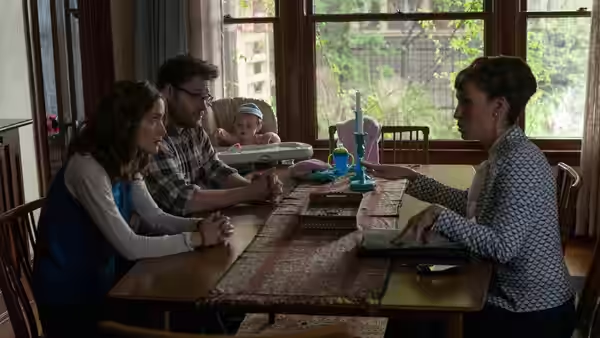
The trouble is everything between the set pieces. Stoller lets his cast riff, and Zene Baker cuts around the riffing so that scenes end where the laughs run out rather than where the scene does. Some exchanges, particularly between Rogen and Ike Barinholtz’s Jimmy, go on a full minute past the point where anyone said anything funny. Lisa Kudrow’s dean, Carol Gladstone, exists to give the war a scoreboard and does little else. Christopher Mintz-Plasse and Jerrod Carmichael are each given one joke and asked to make it last. Michael Andrews’s score is barely audible; the film is scored, in effect, by the parties, which is fair enough, but it means the quieter scenes have nothing under them.
Here is what got us. There is a running gag involving car airbags whose punchlines the trailer had already handed over, and we sat waiting for it with our arms folded, and it worked anyway, twice, loudly, in a full cinema. The timing is the whole trick: Baker holds the shot a beat longer than seems wise each time, so that the payoff arrives when we had stopped bracing for it. We also felt, somewhere in the last half hour, a small unexpected sadness for Teddy, watching Efron’s face as it dawns on him that the party is the only thing he is good at. The film does not linger on it. It goes straight back to the fireworks.
Stoller’s Forgetting Sarah Marshall (2008) had a similar looseness and a much stronger spine, a man trying to get over a woman, and every gag hung from it. Neighbors has a house and a grievance, and the grievance changes shape whenever the writers need a new prank. Against the fraternity films it is descended from, most obviously Animal House (1978), it is at least honest about the Radners: they are not the grown-ups here, they are the same people as the boys next door with worse hangovers and a baby monitor.
It is a film for a drink and for company that will not mind laughing at things nobody would admit to laughing at afterwards. It is not one for parents, or for children, or for anyone who has ever sat on a university disciplinary board. It runs 97 minutes and carries a 15, and both feel about right.