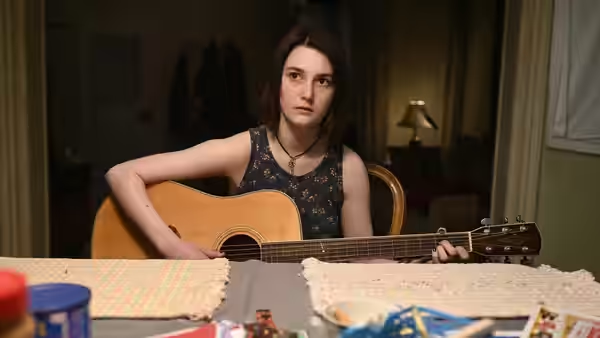
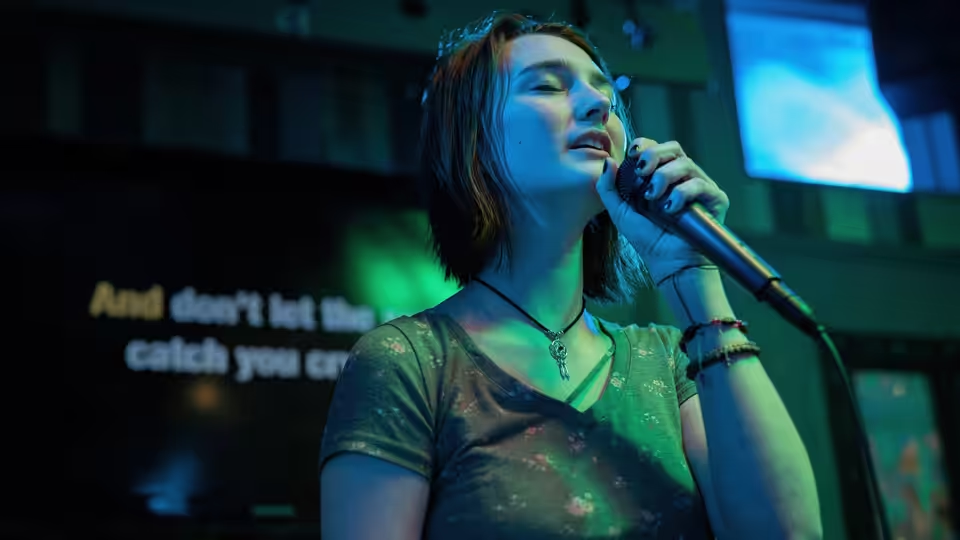
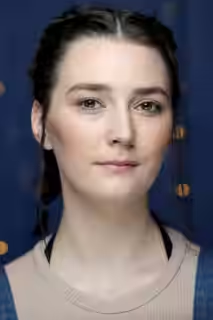
A young woman sings into a microphone on a dimly lit stage
Film review

Never Rarely Sometimes Always

2020 · Directed by Eliza Hittman · 1h 41m

In a sentenceTwo cousins, one suitcase, and a state line that turns a medical appointment into an expedition

Autumn (Sidney Flanigan), seventeen, lives in a small town in Pennsylvania, sings at the school talent show and works a supermarket checkout beside her cousin Skylar (Talia Ryder). At the local pregnancy centre she takes a test, is handed a pamphlet and told she is ten weeks pregnant. Pennsylvania will not let a girl her age end a pregnancy without a parent’s consent, and Autumn will not tell her mother (Sharon Van Etten) or her stepfather Ted (Ryan Eggold). Skylar takes cash from the till, and the two cousins board an overnight bus to New York with one suitcase and a clinic appointment that turns out to be more complicated than the leaflet promised. On the bus a talkative boy, Jasper (Théodore Pellerin), attaches himself to them.

Plays from YouTube when you press play; nothing loads from them until then.

Fi1m review

Eliza Hittman’s film about a Pennsylvania teenager travelling to New York to end a pregnancy is plain, exact and hard to shake, carried by two leads who say almost nothing. Its men are all drawn as hazards, and that is its one real flaw.

Autumn (Sidney Flanigan) is seventeen and lives in a small town in Pennsylvania. She sings at the school talent show and a boy in the audience shouts “slut” at her. She works a supermarket checkout beside her cousin Skylar (Talia Ryder), and at the end of the shift the manager takes their cash through a hatch and kisses their hands. At the local pregnancy centre a woman hands her a test and a pamphlet and tells her she is ten weeks gone. A girl her age cannot end a pregnancy in Pennsylvania without a parent’s say-so, and Autumn is not going to ask. So Skylar takes money from the till, and the two of them get on an overnight bus to New York with one suitcase between them.

Eliza Hittman wrote and directed it, and it is a plain, exact film about a hard errand. We recommend it, warmly, with one caveat we will come to. It is not an argument. Nobody makes a speech. Every obstacle Autumn meets is a form, a fee, a waiting time or a second appointment, and the film simply counts them.

Hélène Louvart shoots handheld and close, on grainy film, so that most of what we see is two faces. Pennsylvania is winter fields and strip-lit shop floors. New York is the bus station at night, yellow light on wet tiles. Meredith Lippincott’s production design does its sharpest work in the two waiting rooms: the first, back home, has cots and photographs of babies on every wall; the second has a notice about payment plans. Olga Mill keeps Autumn in the same oversized hoodie for the whole trip, because she has nothing else to change into. Julia Holter’s score is a few low synthesiser tones and it stays away for long stretches, leaving buses, escalators and Autumn’s breathing.

About halfway through, a counsellor at the clinic sits Autumn down and works through a standard form. Each question about her life at home and with men has the same four permitted answers, and they are the title of the film. Louvart holds Flanigan’s face in a single shot for the length of it, and editor Scott Cummings does not cut. We stopped breathing around the third question. Flanigan answers by answering slowly, and by not answering, and by the end we know more about the last two years of this girl’s life than any flashback could have told us. It is the best scene in the film.

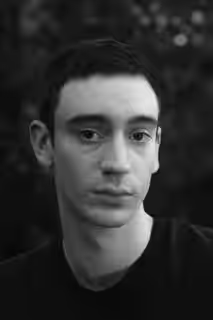
Talia Ryder’s Skylar is the other half of the picture and gets no speeches at all. She steals the money, buys the tickets, works out the subway, and when the cash runs out she keeps Jasper (Théodore Pellerin), a chatty boy from the bus, on the hook in case he turns out to be useful. The cousins hardly discuss what they are doing. There is a small gesture between them late on that we will not describe, except to say it moved us more than anything spoken in the film, and nothing is spoken during it.

The caveat is the men. The heckler; the manager; Autumn’s stepfather Ted (Ryan Eggold), who calls the family dog a slut across the dinner table; a man on the subway with his hand in his trousers; Jasper himself. Every man Autumn passes is a hazard. We take the point, but Hittman makes it six times where three would do, and the subway scene belongs to a blunter film than this one. Sharon Van Etten, as Autumn’s mother, gets a few minutes, and we wanted one more scene between them.

For a subject that is shouted about so loudly, the film is almost silent on the shouting. The word “abortion” is used as often as it would be in a clinic, which is to say plainly. It runs 101 minutes and feels longer in the way the journey is long, with a good deal of sitting on hard chairs. That is deliberate and we would not cut it. Watch it with a teenager if you have one to hand. They will find it less shocking than you do, which is worth knowing.
Critical consensus AI synthesised

85
Positive
23
Mixed
2
Negative
0

Most critics admire this film, and admire it warmly. The reviews are almost uniformly positive, with no negative notices among them. Praise clusters on Sidney Flanigan’s restrained performance as Autumn and on the near-wordless bond between her and Talia Ryder’s Skylar, which many critics treat as the film’s real subject. Hélène Louvart’s handheld cinematography is singled out repeatedly for keeping the camera close, and Eliza Hittman’s direction is credited with avoiding melodrama and moralising. Several critics name the clinic questionnaire scene, played in one unbroken take, as its centre.

The reservations are few and small, and the spread is narrow: the warmest notices call it quietly devastating, the cooler ones still call it powerful. Where critics part is on the men. IndieWire finds some early scenes of male aggression heavy-handed, and Vulture argues the film sometimes overstates the hostility around its characters, though both remain admiring overall. Nobody objects to the performances.

Evening Standard
15 May 2020 · ★★★★★ · Charlotte O'Sullivan
100

O'Sullivan calls the film gripping, funny, and emotionally affecting, with a romantic core. She especially praises Sidney Flanigan's performance as Autumn, calling it flabbergasting and worthy of an Oscar nomination.

Read the full review →
The Guardian
10 May 2020 · Mark Kermode
95*

Kermode finds the film profoundly moving, truthful and sensitively made. He especially praises the quiet, beautifully expressed bond between Autumn and Skylar.

Read the full review →
IndieWire
25 January 2020 · A- · Kate Erbland
90

Erbland calls the film Hittman’s most vivid work yet, a searing and empathetic portrait of teenage girlhood. She especially praises Sidney Flanigan and Talia Ryder’s onscreen bond, while finding some early scenes of male aggression heavy-handed.

Read the full review →
Los Angeles Times
12 March 2020 · Justin Chang
90*

Chang regards the film as a forceful, understated defense of abortion rights and Hittman’s most accomplished feature. He especially praises Sidney Flanigan’s restrained performance and the wordless bond between the two young women.

Read the full review →
Sight and Sound
10 March 2020 · Sophie Monks Kaufman
90*

The critic finds the film extraordinarily real and deeply moving, praising its sensitive portrayal of female solidarity. They single out its restrained performances and intimate camerawork for making the characters’ tenderness feel powerful.

Read the full review →
The Hollywood Reporter
24 January 2020 · festival review · David Rooney
90*

The critic finds the film bracingly honest, haunting, and moving, especially as a portrait of friendship and solidarity. He praises Sidney Flanigan and Talia Ryder’s natural performances and the tenderness of their on-screen chemistry.

Read the full review →

Straight answers AI written, from our review

Is Never Rarely Sometimes Always worth watching?
Never Rarely Sometimes Always is worth watching, and we scored it 84. Eliza Hittman's film about a Pennsylvania teenager travelling to New York to end a pregnancy is plain and exact, carried by two leads who barely speak, and one long unbroken scene at the clinic is as good as anything in it. Its one flaw is that every man in it is drawn as a hazard, and the point is made more often than it needs to be.
How long is Never Rarely Sometimes Always, and what is it rated?
Never Rarely Sometimes Always runs 1h 41m. It is a drama film.
Where can I watch Never Rarely Sometimes Always in Chile?
Never Rarely Sometimes Always is available to rent from Apple TV from CLF 2490.00. Availability is checked daily; the links above go straight to each service.
How violent or frightening is Never Rarely Sometimes Always, and is it suitable for children?
Never Rarely Sometimes Always is a UK 15 and contains no violence to speak of, but it deals directly with an unwanted pregnancy, sexual harassment and a man exposing himself on the subway, and one scene quietly implies a history of abuse. It is not frightening, and it is not for young children. We would happily watch it with a teenager, who will likely find it less shocking than an adult does.
How does Never Rarely Sometimes Always compare to 4 Months, 3 Weeks and 2 Days?
Never Rarely Sometimes Always and 4 Months, 3 Weeks and 2 Days both follow a young woman and a friend through the practical business of obtaining an abortion, but Cristian Mungiu's film, set in Bucharest in 1987, is far tenser and at times close to unbearable, while Hittman's is quieter and counts out forms, fees and waiting rooms. Mungiu's is the more gripping; Hittman's is the gentler and the easier to sit with.
What should I watch after Never Rarely Sometimes Always?
After Never Rarely Sometimes Always, try 4 Months, 3 Weeks and 2 Days (2007, Fi1m 91): Bucharest, 1987: one day, one hotel room, and a friend who does the arranging. Then Vera Drake (2004, Fi1m 84): Imelda Staunton as a 1950s London housewife who helps girls out, until the police call; and Fish Tank (2009, Fi1m 85): Andrea Arnold’s Essex teenager, filmed close and handheld, with the same refusal to explain.

Cast

Awards

Sundance Special Jury Prize Dramatic, 2020

Won
Sundance Special Jury Prize Dramatic

If you liked this, try…

  1. 4 Months, 3 Weeks and 2 Days (2007, Fi1m 91)Bucharest, 1987: one day, one hotel room, and a friend who does the arranging.

  2. Vera Drake (2004, Fi1m 84)Imelda Staunton as a 1950s London housewife who helps girls out, until the police call.

  3. Happening (2021) · not on Fi1m yetFrance, 1963: a student with weeks to act and nobody legally able to help her.

  4. Wendy and Lucy (2008) · not on Fi1m yetMichelle Williams stranded in Oregon with a dog and forty dollars; small errands, large stakes.

  5. Fish Tank (2009, Fi1m 85)Andrea Arnold’s Essex teenager, filmed close and handheld, with the same refusal to explain.

Never Rarely Sometimes Always (2020) review: quiet, exact and hard to (Chile) | Fi1m