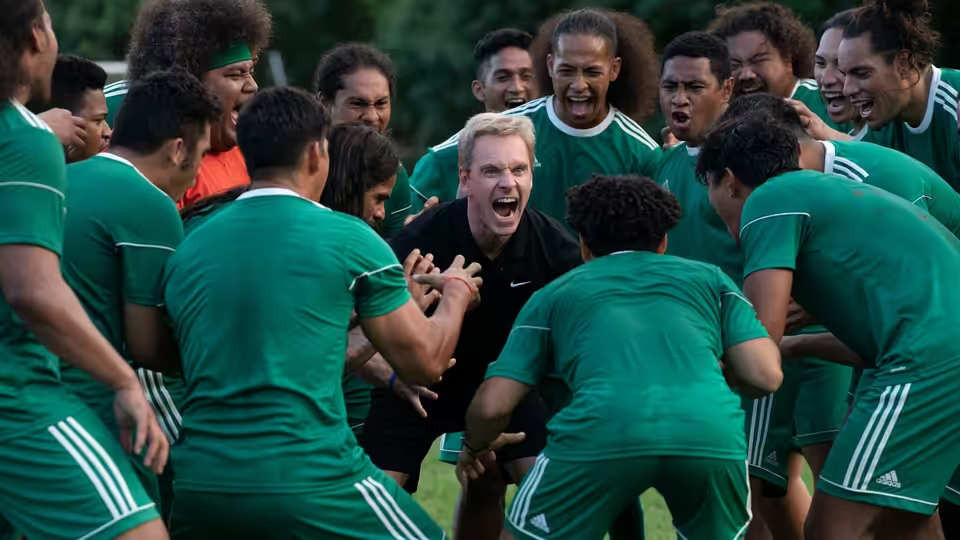
Taika Waititi has the warmest possible material, a team that lost 31–0 and kept turning up, and hands most of it to Michael Fassbender’s coach. Funny in patches, kind throughout, and about the wrong man.
The American Samoa national football team lost 31–0 to Australia in 2001, which is still the heaviest defeat in international football, and Next Goal Wins is about the man sent to stop it happening again. Thomas Rongen (Michael Fassbender) is a coach who has run out of goodwill, and Alex Magnussen (Will Arnett) and Gail (Elisabeth Moss) put him on a plane to the Pacific with instructions to get the team to score once. It is a kind film, and a lazy one, and we spent 104 minutes wishing it had been made about the other people in it.
Those other people are the best thing here. Oscar Kightley plays Tavita, who runs the football federation and, as far as we can tell, most of the island, and he does it with a straight face and perfect timing. David Fane’s Ace, the assistant coach who was there before Rongen and will be there after, gets the best line in the film and knows not to lean on it. Uli Latukefu plays Nicky Salapu, the goalkeeper who let in all thirty-one, as a man who has been carrying that number around for ten years, and the film is briefly serious when it lets him. Rachel House, as Ruth, has heard it all before and says so.
Kaimana, as Jaiyah, is the reason to see it. Jaiyah is fa’afafine, and the script by Iain Morris and Waititi handles this with more care than it handles anything else: nobody on the island thinks it needs explaining, and only Rongen makes it a problem. We were moved, properly and against our expectations, by a quiet scene between Jaiyah and Rongen in the second half, in which Kaimana refuses to be hurt on cue and the film stops making jokes for two minutes. It is the one stretch where the comedy and the true story are in the same room.
The rest of the time the film is watching Fassbender, and Fassbender is not the man for this. He plays Rongen as a shouter and a drinker who kicks water bottles and swears at teenagers, and he works hard at it, but he has no lightness, and a comedy drunk with no lightness is just a drunk. The script keeps cutting back to his marriage and his grievances as if the audience had asked, and the team disappears for stretches at a time. Waititi also gives himself a part as a priest who introduces the film and returns to narrate it, telling us things the picture could have shown. We laughed at his first appearance. By his third we had stopped.
The islanders are written as sweet, slow and endlessly forgiving, which is a pleasant way of saying most of them have been given one trait and asked to hold it for an hour and three quarters. Lachlan Milne shoots the island in bright, flat daylight and it looks like somewhere you would want to be, but the football itself is filmed close and cut fast, so we almost never see a passage of play from start to finish. Four editors are credited, Nicholas Monsour, Yana Gorskaya, Nat Sanders and Tom Eagles, and the film has the rhythm of something cut by four people who did not compare notes. Michael Giacchino’s score swells where an underdog score swells. Ra Vincent’s production design gives the federation a cramped office and a changing room with a leaking roof, and those rooms tell us more about the team than the script does.
Waititi’s Boy, from 2010, and Hunt for the Wilderpeople, from 2016, were about people on the far edge of somewhere, and they paid attention to them. This film has their warmth without their patience. Since Thor: Love and Thunder the jokes have been coming faster and landing softer, and here they land on people who deserved to be listened to.
The reviews split roughly two to one against, and we are nearer the against than the for, though not by much. It is a kind film to have on after lunch, with a good performance in the middle and a coach in the way. The 2014 documentary of the same name has the team in it for the whole ninety minutes.