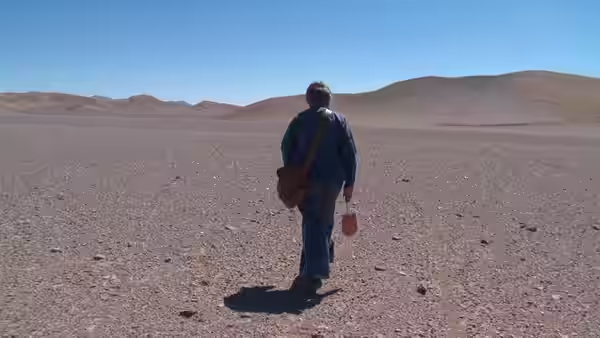
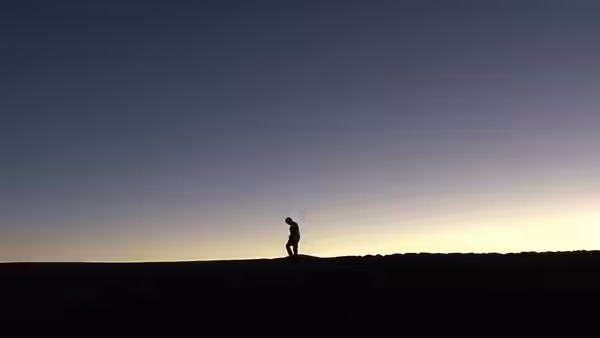
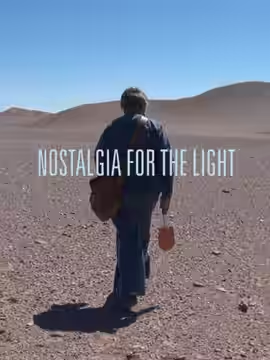
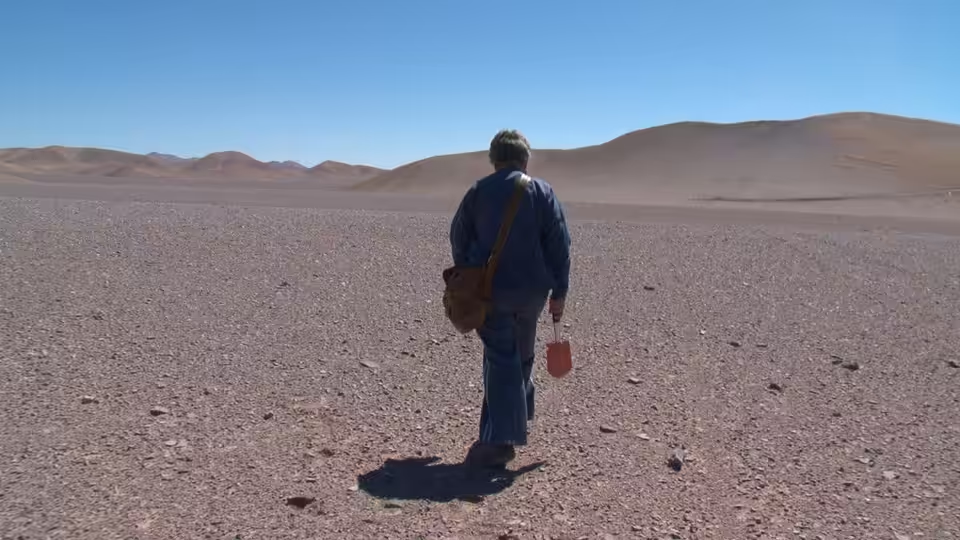
A person walks across a barren desert carrying a bag and container
Film review

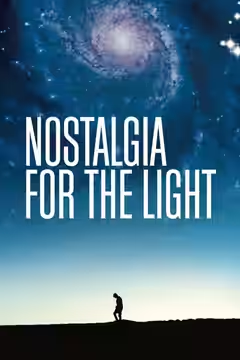
Nostalgia for the Light

2010 · Directed by Patricio Guzmán · 1h 33m

In a sentenceThe astronomers look up for the past, the women with shovels look down for it, and the desert keeps both waiting

Chile’s Atacama Desert is the driest place on earth, its sky clear enough for astronomers to build their observatories and its ground dry enough to preserve whatever is buried in it. Patricio Guzmán, narrating, brings together three kinds of people who search it. Astronomer Gaspar Galaz explains that every image a telescope collects is light from the past. Archaeologist Lautaro Núñez digs pre-Columbian remains out of the sand and walks the ruins of the nitrate mines. Luís Henríquez, held in the Chacabuco camp under Pinochet, remembers learning the constellations there, and Miguel, an architect, draws the camp from memory. On the salt flats, Violeta Berrios and Vicky Saaveda, whose relatives were disappeared by the dictatorship, sift the ground with small shovels for fragments of bone.

Plays from YouTube when you press play; nothing loads from them until then.

Fi1m review

Guzmán’s essay on Chile’s disappeared, told through the telescopes and bones of the Atacama, is a documentary that earns its big idea. The last twenty minutes press the point harder than they need to, but by then the women with shovels have done their work.

Patricio Guzmán filmed the coup of 1973 as it happened, and The Battle of Chile is still the record most people reach for. Nearly forty years on he went to the Atacama Desert with a different question. The Atacama is the driest place on earth. Its sky is so clear that astronomers from around the world have built observatories there, and its ground is so dry that nothing buried in it rots. So the astronomers gather light that left its source millions of years ago, and a few miles away women with hand shovels turn over the salt flats for the bones of relatives the Pinochet regime killed and hid. The idea could have been a conceit. Guzmán makes it hold, because of the people he found.

Katell Djian shoots it with patience. The film opens on an old telescope in Santiago, its gears turning while dust drifts through a shaft of window light, and Guzmán, narrating in his own quiet voice, remembers a childhood in a Chile that felt shut away from the rest of the world. Djian keeps coming back to that dust: motes in a sunbeam, sand blown across a plain, grain in the photograph of a galaxy. Emmanuelle Joly and Guzmán cut from a spiral nebula to a skull half out of the sand, and from the moon’s craters to the desert seen from a hill, and it takes a second each time to work out which is which. José Miguel Miranda and José Miguel Tobar score it with long held tones that fall away whenever the women speak. Nothing is rushed and nothing is loud.

The scientists are good company. Gaspar Galaz, an astronomer, explains that a telescope is a machine for looking at the past: light takes time to arrive, so what he sees has already gone. Lautaro Núñez, an archaeologist, digs pre-Columbian remains out of the same sand and points out the ruins of nitrate mines whose workers left almost no record. George Preston, another astronomer, notes that the calcium in our bones was made in stars. Luís Henríquez describes being held at Chacabuco, a mining town the regime turned into a camp, where a fellow prisoner taught the inmates the constellations until the guards stopped it. Miguel, an architect who was also imprisoned, memorised the buildings and later drew the whole camp from memory. Guzmán lays the drawings over the ruins and they match.

Then there are the women, and they are why the film is more than an intelligent essay. Violeta Berrios has been searching the desert for decades. Vicky Saaveda describes the day some of what she was looking for was found, and how little there was of it. At one point Berrios says she wishes the telescopes could look down through the earth instead of up at the sky. Until then we had been enjoying the film’s idea, admiring how neatly it had been built. When she said that, without raising her voice or looking to us for anything, the idea stopped being clever and became a grief, and it stayed that way.

It is not faultless. Guzmán’s narration has a habit of telling us what the cut has already told us: that the astronomers and the women are doing the same work, that Chile has a past it has not examined. It says this three or four times; the images had said it by the second. The last twenty minutes slow down. Valentina Rodríguez, who works among the astronomers and whose parents are among the disappeared, is asked to carry the film’s closing thoughts about how the long view of the universe helps her live, and that is a great deal to rest on one composed young woman. We believed her and still felt the film leaning on her. The archaeology is the thinnest of the strands, there so that the coin has two sides.

Guzmán has spent his career on one subject. The Battle of Chile was made in the middle of events, hand-held and out of breath. This is the same man, older, sitting still, and where the earlier film shouted this one waits. It belongs with the essay films in which a director thinks aloud over pictures, and it is more disciplined than most of them, even when the voice lingers.

It runs 93 minutes and should be watched in the dark. The night skies want the biggest screen you have, but most of the film is faces, and faces survive a sofa. Do not plan anything for the hour after.
Critical consensus AI synthesised

81
Positive
9
Mixed
2
Negative
0
Time Out
10 July 2012 · ★★★★★ · Dave Calhoun
100

The critic presents the documentary as magical and moving. The review singles out Guzmán’s exploration of Chile’s unsettled relationship with its past.

Read the full review →
The Guardian
12 July 2012 · Peter Bradshaw
95*

Bradshaw calls it a stunning, deeply intelligent film with tragic grandeur. He singles out its use of astronomy to illuminate Chile’s unresolved political trauma, alongside the moving testimony of a woman searching for the disappeared.

Read the full review →
Los Angeles Times
22 April 2011 · Kenneth Turan
92*

Turan calls the documentary a fascinating, moving art film that makes unexpected connections between different ways of exploring the past. He especially praises its ravishing imagery and the emotional force of its links between astronomers, archaeologists, and families of the disappeared.

Read the full review →
Slant Magazine
15 March 2011 · ★★★½/4 · Jesse Cataldo
88

Cataldo finds the documentary disquieting and humbling, praising how it shapes its material into a cohesive whole. He especially singles out its striking desert imagery and the human stories that give the film hope amid its grim subject matter.

Read the full review →
Empire
28 June 2012 · David Parkinson
80*

Parkinson finds the documentary insightful, easy-going and unpretentious. He particularly praises its thoughtful exploration of astronomy alongside the painful legacy of Chile’s Pinochet regime.

Read the full review →
Little White Lies
12 July 2012 · 4/4/4 · Carmen Gray
80

Gray finds the documentary poetic, moving, and strikingly original in how it connects astronomy with Chile’s dictatorship-era trauma. She singles out the testimonies of women searching for disappeared relatives as its wrenching emotional core.

Read the full review →

Straight answers AI written, from our review

Is Nostalgia for the Light worth watching?
Nostalgia for the Light is worth watching for anyone with patience for a slow, quiet documentary essay, and we scored it 83. Patricio Guzmán ties the astronomers of the Atacama to the women digging its salt flats for the bones of Pinochet's victims, and the women make the idea into grief. The narration repeats what the images have already said, and the last twenty minutes press too hard.
How long is Nostalgia for the Light, and what is it rated?
Nostalgia for the Light runs 1h 33m. It is a documentary film.
Where can I watch Nostalgia for the Light in Bulgaria?
Nostalgia for the Light is not on any streaming or rental service in Bulgaria at the moment. It is available in 14 other countries; change your country at the top of the page to see where. Availability is checked daily.
How does Nostalgia for the Light compare to Sans Soleil?
Nostalgia for the Light is the more disciplined of the two, though Sans Soleil is the model it follows: a director thinking aloud over pictures. Chris Marker wanders between Tokyo and Guinea-Bissau with curiosity and a commentary that sometimes grows tiresome; Guzmán stays in one desert with one subject and holds his idea tighter. Marker suits the restless viewer, Guzmán the one who wants to be moved.
What should I watch after Nostalgia for the Light?
After Nostalgia for the Light, try Sans Soleil (1983, Fi1m 82): Chris Marker thinking aloud over Tokyo and Guinea-Bissau; the model for this kind of film. Then The Act of Killing (2012, Fi1m 88): Indonesia’s killers restage their crimes as musicals; far louder, no less about memory.

Cast

Awards

European Film Award for Best Documentary, 2010

Won
European Film Award for Best Documentary

If you liked this, try…

  1. The Pearl Button (2015) · not on Fi1m yetGuzmán’s companion piece, water where this had sand; the same grief, the same patience.

  2. The Battle of Chile (1975) · not on Fi1m yetThe coup filmed as it happened by the same man, forty years younger and out of breath.

  3. Sans Soleil (1983, Fi1m 82)Chris Marker thinking aloud over Tokyo and Guinea-Bissau; the model for this kind of film.

  4. The Act of Killing (2012, Fi1m 88)Indonesia’s killers restage their crimes as musicals; far louder, no less about memory.

  5. The Missing Picture (2013) · not on Fi1m yetRithy Panh rebuilds Cambodia’s camps in clay figures because no footage survived.

Nostalgia for the Light (2010) review: quiet, exact and hard to shake (Bulgaria) | Fi1m