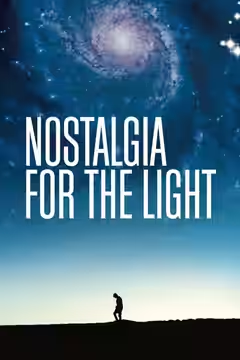
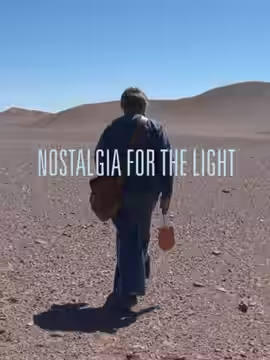
Guzmán’s essay on Chile’s disappeared, told through the telescopes and bones of the Atacama, is a documentary that earns its big idea. The last twenty minutes press the point harder than they need to, but by then the women with shovels have done their work.
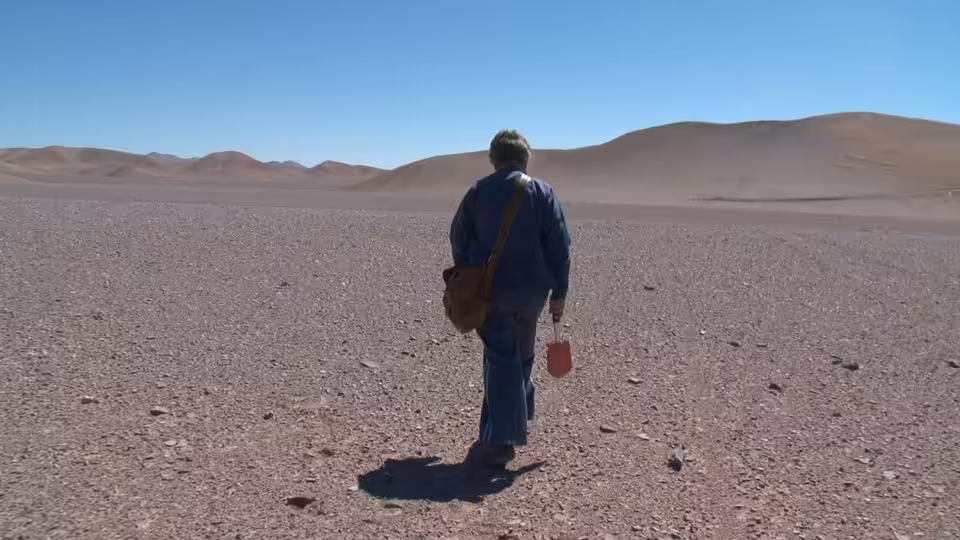
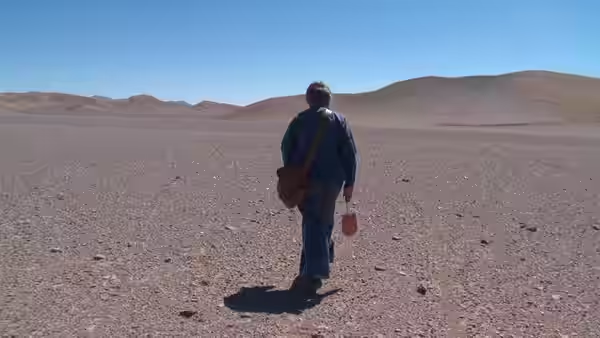
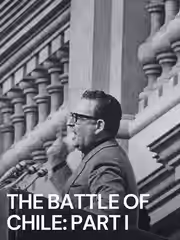
Patricio Guzmán filmed the coup of 1973 as it happened, and The Battle of Chile is still the record most people reach for. Nearly forty years on he went to the Atacama Desert with a different question. The Atacama is the driest place on earth. Its sky is so clear that astronomers from around the world have built observatories there, and its ground is so dry that nothing buried in it rots. So the astronomers gather light that left its source millions of years ago, and a few miles away women with hand shovels turn over the salt flats for the bones of relatives the Pinochet regime killed and hid. The idea could have been a conceit. Guzmán makes it hold, because of the people he found.
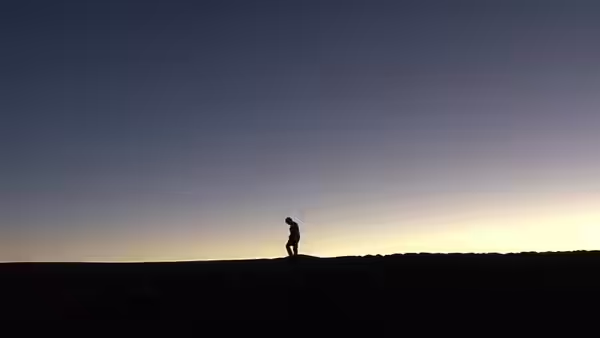
Katell Djian shoots it with patience. The film opens on an old telescope in Santiago, its gears turning while dust drifts through a shaft of window light, and Guzmán, narrating in his own quiet voice, remembers a childhood in a Chile that felt shut away from the rest of the world. Djian keeps coming back to that dust: motes in a sunbeam, sand blown across a plain, grain in the photograph of a galaxy. Emmanuelle Joly and Guzmán cut from a spiral nebula to a skull half out of the sand, and from the moon’s craters to the desert seen from a hill, and it takes a second each time to work out which is which. José Miguel Miranda and José Miguel Tobar score it with long held tones that fall away whenever the women speak. Nothing is rushed and nothing is loud.
The scientists are good company. Gaspar Galaz, an astronomer, explains that a telescope is a machine for looking at the past: light takes time to arrive, so what he sees has already gone. Lautaro Núñez, an archaeologist, digs pre-Columbian remains out of the same sand and points out the ruins of nitrate mines whose workers left almost no record. George Preston, another astronomer, notes that the calcium in our bones was made in stars. Luís Henríquez describes being held at Chacabuco, a mining town the regime turned into a camp, where a fellow prisoner taught the inmates the constellations until the guards stopped it. Miguel, an architect who was also imprisoned, memorised the buildings and later drew the whole camp from memory. Guzmán lays the drawings over the ruins and they match.
Then there are the women, and they are why the film is more than an intelligent essay. Violeta Berrios has been searching the desert for decades. Vicky Saaveda describes the day some of what she was looking for was found, and how little there was of it. At one point Berrios says she wishes the telescopes could look down through the earth instead of up at the sky. Until then we had been enjoying the film’s idea, admiring how neatly it had been built. When she said that, without raising her voice or looking to us for anything, the idea stopped being clever and became a grief, and it stayed that way.
It is not faultless. Guzmán’s narration has a habit of telling us what the cut has already told us: that the astronomers and the women are doing the same work, that Chile has a past it has not examined. It says this three or four times; the images had said it by the second. The last twenty minutes slow down. Valentina Rodríguez, who works among the astronomers and whose parents are among the disappeared, is asked to carry the film’s closing thoughts about how the long view of the universe helps her live, and that is a great deal to rest on one composed young woman. We believed her and still felt the film leaning on her. The archaeology is the thinnest of the strands, there so that the coin has two sides.
Guzmán has spent his career on one subject. The Battle of Chile was made in the middle of events, hand-held and out of breath. This is the same man, older, sitting still, and where the earlier film shouted this one waits. It belongs with the essay films in which a director thinks aloud over pictures, and it is more disciplined than most of them, even when the voice lingers.
It runs 93 minutes and should be watched in the dark. The night skies want the biggest screen you have, but most of the film is faces, and faces survive a sofa. Do not plan anything for the hour after.