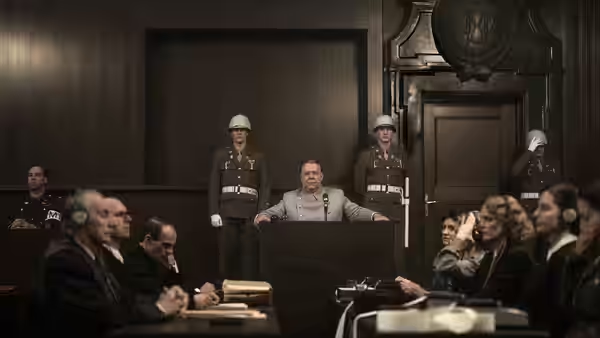
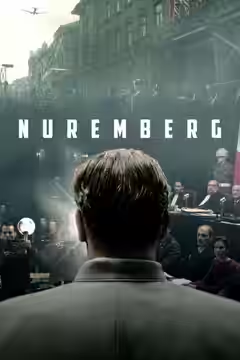
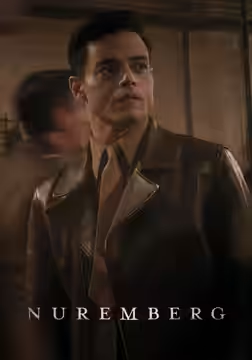
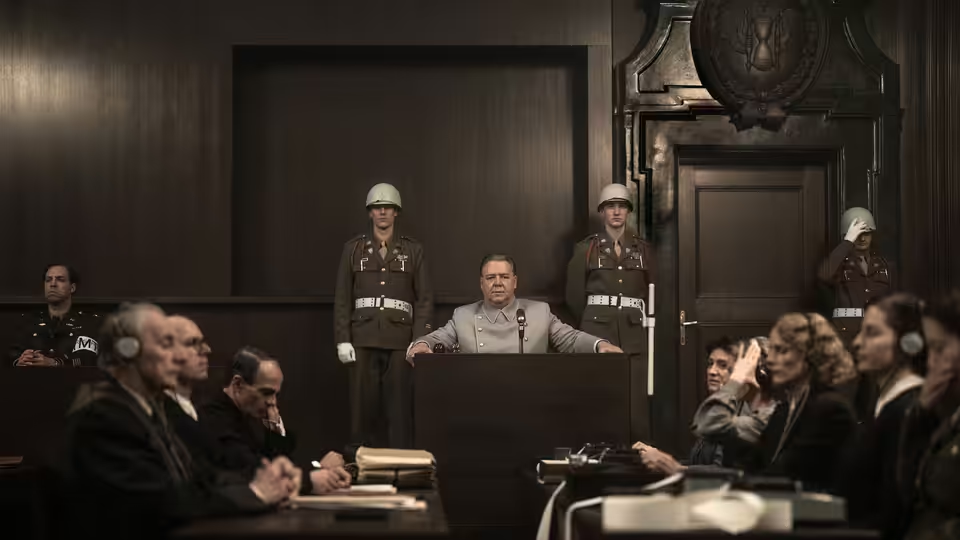
A judge presides over a courtroom as uniformed guards stand behind him
Film review

Nuremberg

2025 · Directed by James Vanderbilt · 2h 29m · Kijkwijzer 14

In a sentenceWe would happily listen to Russell Crowe for longer, provided someone turned down the music

Before the Nuremberg Trials, Douglas Kelley (Rami Malek) seeks to understand Hermann Göring (Russell Crowe) through their conversations. Göring’s charm complicates the effort to assess the man and his responsibility. Justice Robert H. Jackson (Michael Shannon) approaches the defendants with a different task, preparing to make a case against the Nazi leadership in court. Kelley wants to know how Göring thinks; Jackson needs to establish what can be proved. As preparations for the trial proceed, the film follows the private exchanges alongside the work of bringing the defendants before the court in Nuremberg.

Plays from YouTube when you press play; nothing loads from them until then.

Fi1m review

Russell Crowe makes Nuremberg worth considering, especially for those drawn to courtroom drama. James Vanderbilt handles the trial with conviction, but the central exchanges between Douglas Kelley and Hermann Göring never feel searching enough.

Nuremberg is worth considering for its actors, with a substantial reservation about what they have been given to say. James Vanderbilt approaches the trials as accessible courtroom drama, while the exchanges between Douglas Kelley and Hermann Göring promise a closer look at how such a man thinks. The film is much more assured when it gets into court. Its attempts to turn conversation into psychological discovery are watchable, but too often leave us with the obvious conclusion that a dangerous man can be personable.

Russell Crowe gives the film its strongest performance. His Hermann Göring has enough charm to hold our attention without letting us forget who is speaking, and that ordinary human appeal is disturbing. We can see why someone might keep listening to him, which gives the conversations a tension the writing does not always sustain. The script keeps returning to his charm when it needs to tell us more about how he uses it.

Rami Malek has the harder task as Douglas Kelley, because the film needs their exchanges to feel like a contest between people capable of unsettling one another. Too often, the balance favours Göring before a scene has properly begun. We can follow Kelley’s interest, but the dialogue supplies too little sense of what he discovers through it. Michael Shannon is more securely served as Justice Robert H. Jackson. In the courtroom, an argument has an immediate purpose and an opponent to answer it.

The physical production is much more convincing. Eve Stewart’s courtroom gives the proceedings a credible setting, and Dariusz Wolski photographs the drama with a polish suited to its conventional thriller ambitions. There is pleasure in that care, even when the writing is being over-explicit. Tom Eagles finds more urgency in the trial material than in the approach to it, although the film’s 149 minutes still feel longer than the story requires. Brian Tyler’s score is less helpful, pressing the seriousness of scenes that the actors have already made serious.

We were horrified by the archival footage from the liberated concentration camps. Those images show the human suffering that the conversations about responsibility can keep at a comfortable distance, and the film is right to make space for them. The difficulty comes when the familiar dramatic business resumes and seems thinner than before. The conversations that follow cannot match the force of the footage, and the writing does not become more searching to compensate.

Leo Woodall gives Sergeant Howie Triest a welcome emotional directness, though the writing leans too hard on the character to supply feeling. That is part of a wider habit of insisting on responses the material could earn for itself. A courtroom film has every reason to explain, but its explanations ought to help us understand the case. The political warnings are blunt enough to interrupt our interest in the people delivering them.

There is still a decent historical drama here for anyone drawn to trials and the people who conduct them. The supporting cast helps the formal proceedings hold our attention, despite the script’s tendency to explain too much. We would go for Russell Crowe and Michael Shannon, with expectations kept modest about the promised psychological insight. Allow for the length, and for music that rarely trusts us to recognise a serious moment.

Critical consensus AI synthesised

61
Positive
7
Mixed
10
Negative
4

The consensus on Nuremberg is mixed, though praise clusters around Russell Crowe’s portrayal of Göring. Across favourable and sceptical reviews, critics find him commanding, chilling and persuasive, with some also commending Rami Malek and the supporting cast. The courtroom scenes draw stronger responses than the build-up, while the archival concentration-camp footage is repeatedly identified as the film’s most affecting material. Admirers, including Time Out, welcome its accessible, old-fashioned courtroom-thriller approach.

The spread is wide, and the central disagreement concerns whether that conventional storytelling serves the history. Several critics find the political parallels timely; others consider them blunt or insufficiently explored. Reservations recur around uneven pacing, clumsy exposition and a central relationship that offers too little psychological insight. The archival footage also divides opinion about the surrounding drama: The Guardian argues that its force exposes the artificiality of the dramatised scenes, rather than strengthening them.

The Hollywood Reporter
8 September 2025 · festival review · Michael Rechtshaffen
80*

The critic finds the drama compelling, timely and powerfully directed. They especially praise Crowe and Malek’s performances, while also highlighting the supporting cast and the film’s consequential use of archival footage.

Read the full review →
Time Out
12 November 2025 · ★★★★ · Phil de Semlyen
80

The critic calls the film gripping and smartly executed, with a rousing old-fashioned courtroom-thriller appeal. He singles out Russell Crowe as a showstopper.

Read the full review →
Empire
14 November 2025 · Barry Levitt
78*

Levitt finds the film a powerful, well-paced addition to stories about the Nuremberg Trials, despite occasional missteps in balancing entertainment with its serious message. He especially praises the moving direction of the Holocaust-footage scene and Leo Woodall’s shattering performance.

Read the full review →
The AV Club
6 November 2025 · B · Matthew Jackson
77

The critic finds the film’s first half uneven but says it becomes compelling once the trial begins. Russell Crowe’s commanding portrayal of Göring is singled out as a particular strength.

Read the full review →
Sight and Sound
13 November 2025 · BFI
70*

The review finds the film more dramatically engaging than a prior Nuremberg miniseries and timely in its political warning, while noting some distortions of history and character. It praises Russell Crowe’s chilling portrayal of Göring and the film’s contemporary resonance.

Read the full review →
Screen Daily
9 September 2025 · Tim Grierson
65*

The headline characterizes the film as an earnest courtroom drama. The accessible text does not reveal a specific element the critic praises or faults.

Read the full review →

Straight answers AI written, from our review

Is Nuremberg worth watching?
Nuremberg is worth considering for Russell Crowe’s performance and its courtroom drama, though we score it a qualified 64 out of 100. It suits viewers interested in historical trials more than those seeking searching psychological insight: the central conversations offer too little discovery, while the 149-minute running time and insistent music test our patience.
How long is Nuremberg, and what is it rated?
Nuremberg runs 2h 29m and is rated 14 by the Kijkwijzer in Belgium. It is a history and drama film.
Where can I watch Nuremberg in Belgium?
Nuremberg is available to rent from Amazon Prime Video from €4.99. Availability is checked daily; the links above go straight to each service.
How violent or frightening is Nuremberg, and is it suitable for children?
Nuremberg has a UK 15 certificate and contains horrifying archival footage from the liberated concentration camps, making it unsuitable for children under 15. The images of human suffering warrant particular caution for sensitive older teenagers and adults; we would not mistake its emphasis on conversation and courtroom proceedings for an easy watch.
How does Nuremberg compare to Judgment at Nuremberg?
Nuremberg is the less searching drama beside Judgment at Nuremberg, which we recommend for its harder questions about responsibility, compromise and legal judgement. The longer, sterner film earns its length despite some over-explanatory speeches; Nuremberg offers a more conventional courtroom drama, with Russell Crowe compelling even when the psychological exchanges tell us too little.
What should I watch after Nuremberg?
After Nuremberg, try Judgment at Nuremberg (1961, Fi1m 82): A longer, sterner courtroom reckoning with responsibility, compromise and the limits of legal judgement. Then The Lives of Others (2006, Fi1m 84): For another study of listening, complicity and the people who serve authoritarian power.

Cast

If you liked this, try…

  1. Judgment at Nuremberg (1961, Fi1m 82)A longer, sterner courtroom reckoning with responsibility, compromise and the limits of legal judgement.

  2. The Lives of Others (2006, Fi1m 84)For another study of listening, complicity and the people who serve authoritarian power.

  3. The Ascent (1977) · not on Fi1m yetWartime interrogation tests conviction and cowardice with little room for reassuring explanations.

  4. Conspiracy (2001) · not on Fi1m yetPolite conversation becomes horrifying as officials turn mass murder into administrative business.

  5. Denial (2016) · not on Fi1m yetAnother courtroom drama concerned with how historical truth survives deliberate, organised distortion.