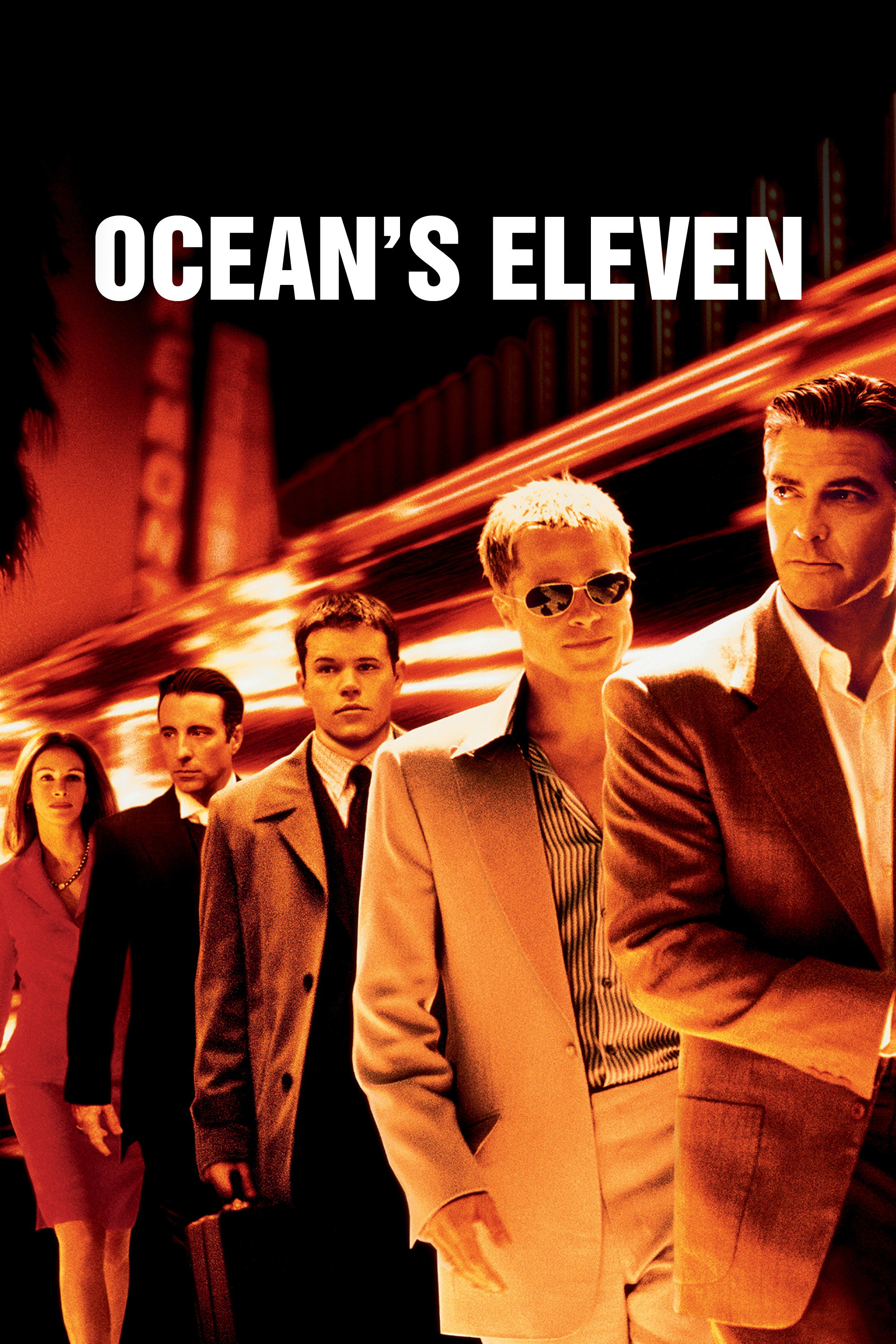
Soderbergh’s remake is the most purely pleasurable thing he has made: a robbery staged as a dance, with Clooney and Pitt leading. There is nothing underneath it and Julia Roberts is wasted. We did not mind nearly as much as we expected to.
The 1960 Ocean’s 11 was Frank Sinatra and his friends larking about in Las Vegas between shows, and nobody has ever accused it of being a good film. Steven Soderbergh’s version keeps the town, the name and the idea of a crew, and throws out everything else. Danny Ocean (George Clooney) comes out of prison with a plan to rob the vault under Terry Benedict’s three casinos on the night of a big fight, and spends the first act collecting the ten people he needs to do it. The film is 116 minutes long, moves like it is late for something, and has no interest in anything but the pleasure of watching clever people be clever. On those terms it is very good indeed.
Clooney and Brad Pitt carry the first half hour almost on their own, and they do it by not trying. Danny talks; Rusty listens, eats, and finishes the sentence. Pitt has a snack in nearly every scene he is in, and it tells you more about Rusty than a page of dialogue could: this is a man who is never worried. Clooney gives Danny the opposite quality, a stillness that is always about to become a grin. We enjoyed their recruitment tour more than we have enjoyed most whole films, because Ted Griffin’s script lets each new arrival be a small comedy of its own and then gets out.
Soderbergh shot it himself, and the camera is loose and warm, close on faces and happy to stay there. Stephen Mirrione cuts fast but never confusingly; when the plan is being explained and the film is running three or four scenes at once, you always know which one you are in. David Holmes’s score is the film’s engine, a slouching thing of organ, bass and brushed drums that makes every walk across a lobby feel like the walk before a fight. Philip Messina’s production design gives Benedict a vault that looks like a bank crossed with a cathedral, and it is a pleasure simply to look at the doors.
The ensemble earns its billing. Andy Garcia is the best idea in the film: a villain who is not stupid, not greedy and not vain, just very good at his job and very cold about it, so that every time the crew gets away with something you half expect him to have noticed. Don Cheadle’s Basher made us laugh every time he opened his mouth, and we felt slightly guilty for laughing. Elliott Gould, in silk pyjamas and enormous glasses, steals his two or three scenes as Reuben, the money. Matt Damon plays Linus as the boy who wants to be at the grown-ups’ table and Casey Affleck and Scott Caan, as the Malloy brothers, argue about everything and are never not funny.
What does not work is anything that asks us to feel. Julia Roberts is billed fifth and has perhaps ten minutes of screen time, most of it spent walking down staircases in beautiful clothes while men look at her. Tess is meant to be the reason Danny is doing this at all, and the film never makes that believable, because Clooney is plainly having far too good a time to be heartbroken. One or two critics have complained that the whole thing is fluff with no payoff, and they are not wrong about the fluff. We found we simply did not care. We sat with a grin on our face for most of two hours, felt nothing much when it ended, and were surprised how little that bothered us.
Set against Soderbergh’s own work it is a step sideways rather than forward. Out of Sight, three years earlier, was a crime picture with a real ache in it; this has traded the ache for polish. That is a fair trade for a film that knows exactly what it is, and this one does.
Watch it with company and something to drink, late enough that the lights are low, and do not ask afterwards what any of it meant. It did not mean anything. It was very well made and it was fun, and the two are rarer together than they should be.