One Fine Morning poster

One Fine Morning

2022 · Directed by Mia Hansen-Løve
1h 52mRomanceDrama15
82
Fi1m score
84
Critics · 17
Audience · not yet

Where to watch in the UK

Checked 10 September at 22:29. Prices and availability change; the service’s page is the last word.

Plays from YouTube when you press play; nothing loads from them until then.

Synopsis

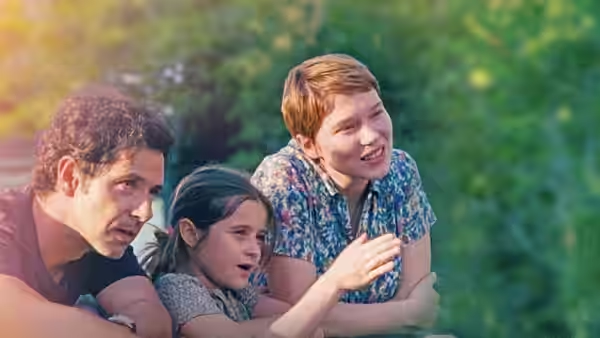
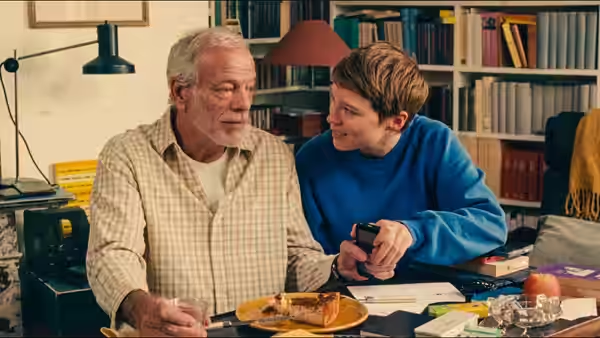
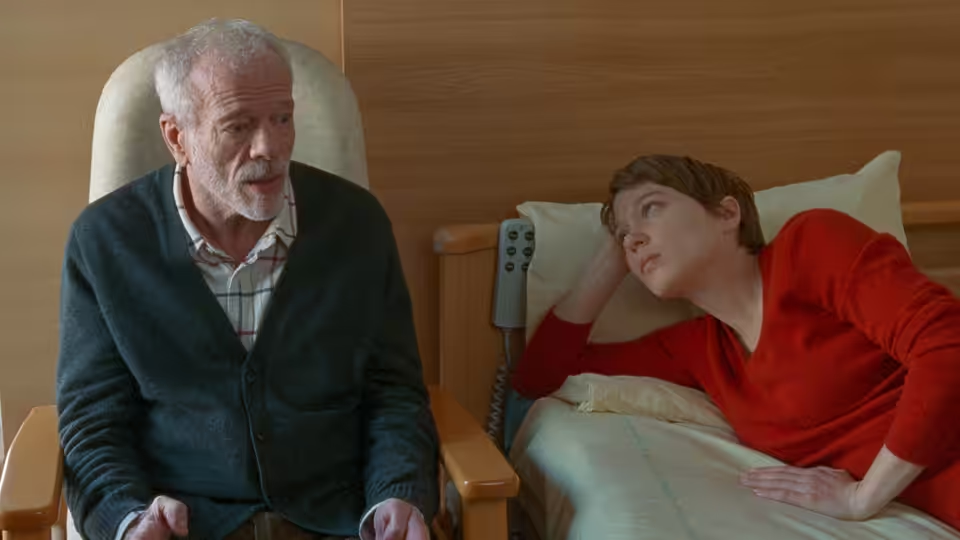
Sandra Kienzler (Léa Seydoux) is a translator in Paris, widowed, raising a young daughter, Linn (Camille Leban Martins), on her own. Her father, Georg (Pascal Greggory), is losing his mind to a neurodegenerative disease, and the family, including Françoise (Nicole Garcia) and Elodie (Sarah Le Picard), must decide where he can live and who will look after him. In the middle of the visits and the paperwork Sandra runs into Clément (Melvil Poupaud), an old friend, married, and the two begin an affair that neither of them has planned. Mia Hansen-Løve writes and directs, following Sandra between the care home, the school gate and a borrowed bed over the course of a year.

Fi1m review

In a sentenceHer father is fading, her lover keeps forgetting he is married, and she carries the shopping for both

Mia Hansen-Løve puts a woman between a father who is leaving her slowly and a lover who cannot decide to stay, and watches without fuss. Seydoux is quietly superb, Greggory better still; the affair is the weaker half, but see it.

Mia Hansen-Løve makes films about people getting on with things, and One Fine Morning is the plainest of them. Sandra (Léa Seydoux) is a translator in Paris, widowed, with a young daughter and a father, Georg (Pascal Greggory), whose mind is being taken from him by a neurodegenerative disease. She visits him, argues with the family about where he should live, and somewhere in all this runs into Clément (Melvil Poupaud), an old friend with a wife, and goes to bed with him. That is the whole film. It is quiet and it is honest, and it is one of the best things Hansen-Løve has made.

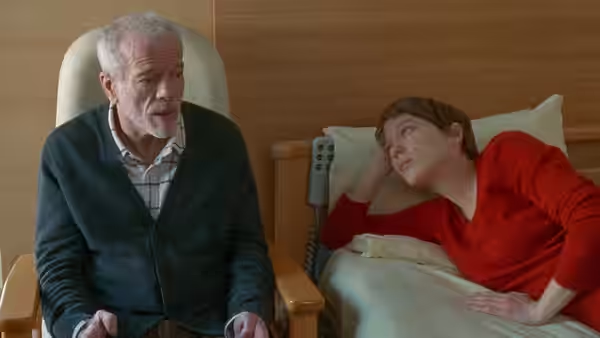
Greggory is the reason it works. He plays Georg as a courteous man who knows something is wrong and has decided to be polite about it. There is a moment, early on, when he loses the thread of a sentence and, rather than panic, waits for it to come back. It did not come back. We had braced ourselves for the illness and not for the good manners, and it was the manners that got at us. Nicole Garcia and Sarah Le Picard, as Françoise and Elodie, share the visits and the arguments about care homes, and none of the three is allowed a speech.

Seydoux has the harder job, because Sandra is mostly holding herself together, and holding together is not much to act. She does it with the body rather than the face. She cries in the street, briefly, and then goes to collect her daughter. She sits in a booth turning other people’s words into French while her own life goes unspoken. When the affair starts she is startled by her own appetite, and Seydoux lets that show as something close to embarrassment. It is a performance of small adjustments, and we did not catch her making one of them.

Denis Lenoir shoots Paris in daylight, on pavements and in stairwells and small kitchens, with no interest in making it pretty. The light is the light there happened to be. Mila Preli’s production design gives Sandra a flat that is cramped and lived in, and gives the institutions Georg passes through corridors that all look the same, which is rather the point. Judith de Luze keeps Sandra in the same coat for most of the film; she has other things to think about than clothes, and we believe it. Marion Monnier cuts the way Hansen-Løve’s films are always cut, ending a scene the moment it has said what it needs to and starting the next one already underway, and there is hardly any music to tell us how to feel.

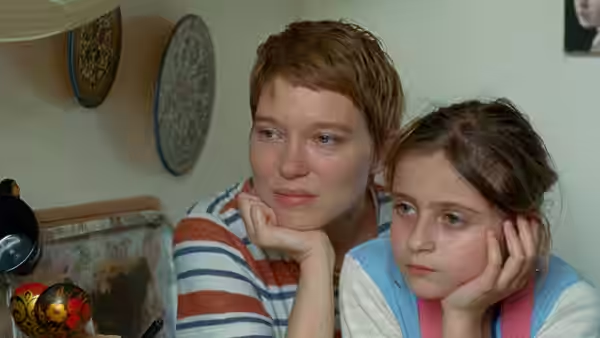
The affair is where the film is thinner. Poupaud is good, warm and a little cowardly, and the scenes in bed are frank without being showy; the 15 certificate is earned there and nowhere else. But Clément leaves, comes back, leaves again, and by the third time we had started to count. The scenes between them are the same scene, several times, and Hansen-Løve seems to know this and to have decided that is how affairs are. She is right, but it does not make the middle hour any tighter. Sandra’s daughter Linn (Camille Leban Martins) is drawn more lightly than she might have been, and mostly stands in for what Sandra has to get home to.

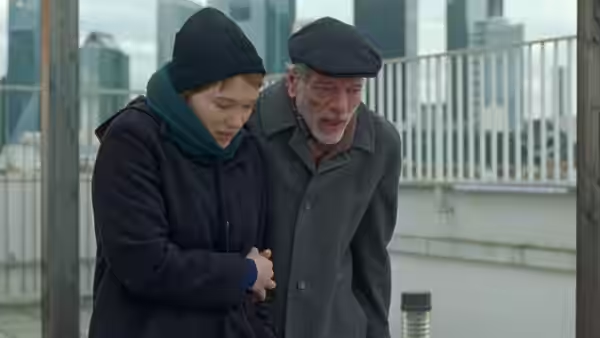
Set against the director’s own work, this sits closer to Father of My Children and Things to Come than to Bergman Island: no artists talking about art, just a family dealing with a hospital. The story is drawn from her own life, and it shows in the details that nobody would invent, the forms, the waiting, the way grief has to fit around a school timetable. Most critics have been warm, and one or two have found it bleak. We did not. Sandra goes to the cinema, kisses someone she should not, and takes her father for a walk, and the film treats all three as reasons to keep going.

Watch it at home, on an evening when you are not expecting to be cheered up, and you may find you have been. At 112 minutes it is exactly as long as its year needs to be, and it does not end where you expect it to.

Critical consensus AI synthesised

84
Positive
16
Mixed
1
Negative
0

The reviews for One Fine Morning are warm and closely bunched, with the great majority positive and only one mixed. The praise lands first on Léa Seydoux, whom nearly every critic singles out for a performance built on restraint, several calling it the strongest work of her career. Behind her, most critics credit Mia Hansen-Løve for handling a father’s decline and a married lover’s arrival with a light touch and no sentimentality, letting feeling rise out of ordinary routines rather than plotted turns. Sight and Sound is unusual in placing Pascal Greggory’s father, rather than Seydoux, at the film’s centre. The reservations are small and scattered: Paste finds the melancholy pervasive and the drama low-key, Deadline thinks the story slight if warm, and The Skinny notes a meandering plot that Seydoux has to hold together. Nobody argues that the film is anything other than accomplished; the disagreement is only over how much it adds up to.

Time Out
21 May 2022 · ★★★★★ · Anna Bogutskaya
100

The intimate drama explores romantic and familial love through a single mother's experiences with her father's decline and a new affair, avoiding sentimentality. Seydoux delivers a magnetic performance highlighting subtle emotional shifts.

Read the full review →
Empire
14 April 2023 · Ian Freer
90*

Hansen-Løve confirms her status as a filmmaker who finds magic in everyday life, family, and relationships. The film features a career-best performance from Seydoux and feels authentic and human.

Read the full review →
The AV Club
24 January 2023 · A- · Timothy Cogshell
90

The critic finds the film consistent with Hansen-Løve's canon—quiet, languidly paced, and beautifully composed—about family, friends, lovers, disappointments, and passions. It is bittersweet but mostly bitter, and lovely in its intimate, authentic portrayal of everyday circumstances.

Read the full review →
Evening Standard
14 April 2023 · Charlotte O'Sullivan
85*

Seydoux delivers an intoxicating performance as a woman balancing parental care and a passionate affair. The director excels at capturing hard-to-articulate emotions in a quiet, authentic portrait of family and personal life.

Read the full review →
Film Comment
· Clinton Krute
85*

The critic praises the film's radiant yet clear-eyed portrayal of grief and new love through an autofictional lens. Hansen-Løve's direction is singled out for its precise capture of everyday rhythms and avoidance of sentimentality.

Read the full review →
Los Angeles Times
9 December 2022 · Justin Chang
85*

The lucid, affecting film follows a widow through routines of caregiving and tentative romance, emphasizing incremental real-life drama over conventional arcs. Seydoux delivers one of the year's best performances through emotional reserve and naturalistic grace.

Read the full review →

Cast

Stills

Awards

European Film Award for Best Actress, 2022

Nominated
European Film Award for Best Actress

If you liked this, try…

Things to Come poster

Things to Come

2016 · Hansen-Løve and Huppert, a marriage ends, and nobody raises their voice once

Amour poster

Amour

2012 · The harder, colder version of the same illness, in one Paris flat

35 Shots of Rum poster

35 Shots of Rum

2008 · Claire Denis on a father and daughter who love each other and must part

The Father poster

The Father

2020 · Dementia from the inside, with Hopkins and a flat that keeps changing shape

Tokyo Story poster

Tokyo Story

1953 · Ozu’s parents visit their grown children; the quietest heartbreak in cinema