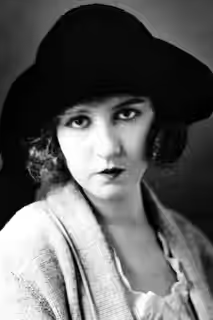
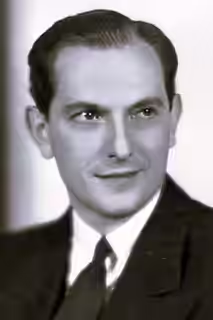
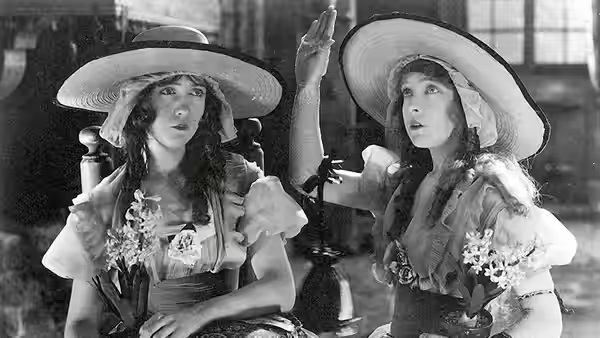
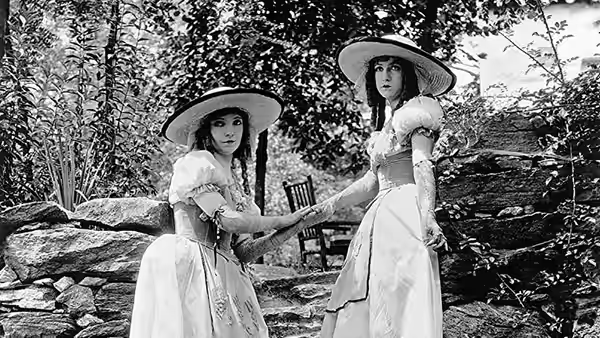
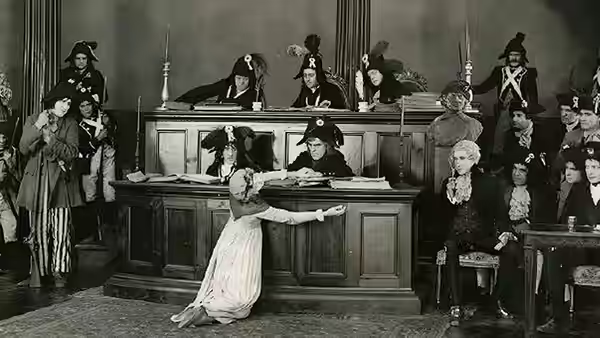
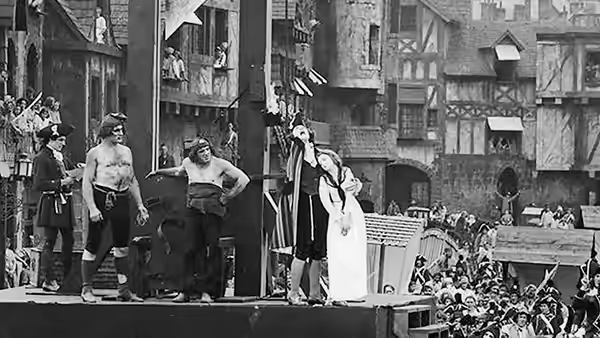
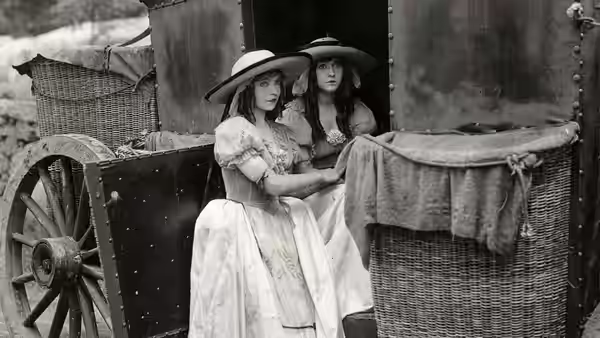
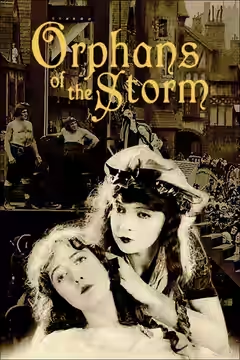
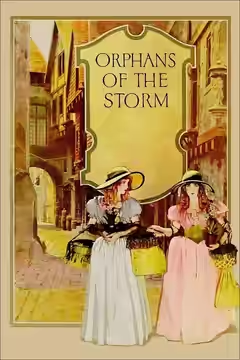
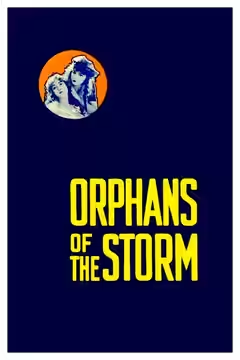
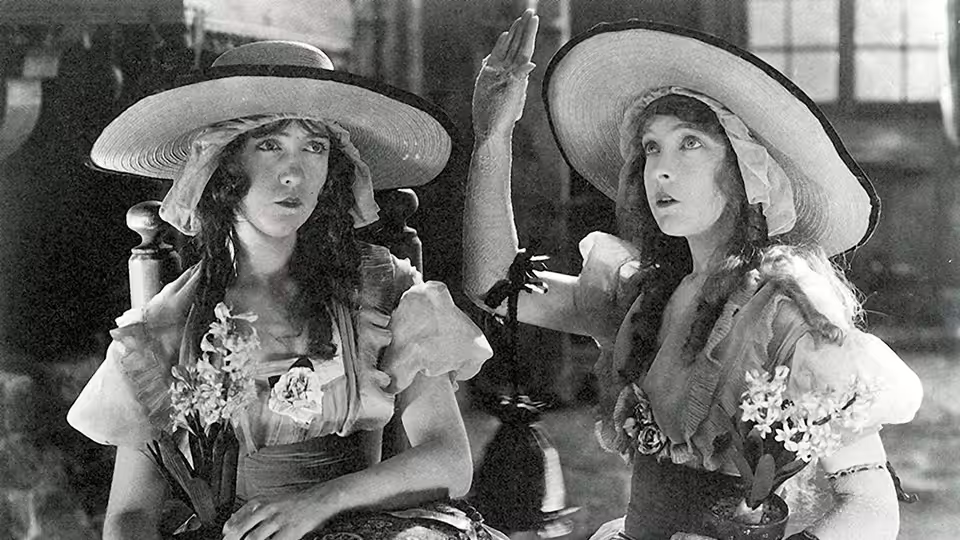
Henriette (Lillian Gish) and Louise (Dorothy Gish) sit together indoors beneath broad hats, holding flowers
Film review

Orphans of the Storm

1921 · Directed by D.W. Griffith · 2h 30m

In a sentenceWe would believe Lillian Gish long before we believed this version of history

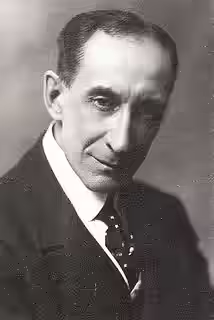
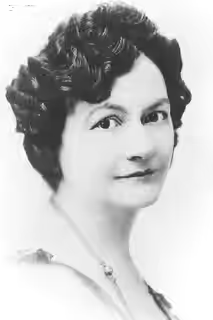
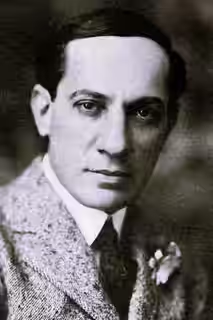
Orphans of the Storm centres on Henriette Girard (Lillian Gish) and Louise Girard (Dorothy Gish), with Joseph Schildkraut as Chevalier de Vaudrey. Their story combines romance and historical drama, and its characters include Danton (Monte Blue) and Robespierre (Sidney Herbert). Mother Frochard (Lucille La Verne), Jacques Frochard (Sheldon Lewis) and Pierre (Frank Puglia) also feature, alongside Picard (Creighton Hale) and Marquis de Praille (Morgan Wallace). D.W. Griffith writes and directs the 150-minute film, bringing these characters together in a melodrama concerned with personal feeling and historical events.

Fi1m review

D.W. Griffith’s historical melodrama earns its length chiefly through Lillian Gish and its capacity for suspense. The emphatic storytelling can tire us, and the history needs scepticism, but the feeling repays the patience.

D.W. Griffith’s Orphans of the Storm is good historical melodrama, provided the melodrama matters more to us than the history. Its incidents are extravagant, its emotional demands insistent, and Lillian Gish makes enough of them count to justify the attention. At 150 minutes, it does require patience. We recommend it to anyone comfortable with a film that would rather risk being excessive than let an emotion pass quietly.

We were moved by Lillian Gish as Henriette Girard. Her emotional directness makes the extravagant plotting easier to accept, because we remain concerned with the person at its centre. That is harder than it sounds in material which keeps increasing the dramatic pressure. A performance this emphatic could become exhausting, but she makes the feeling seem necessary, even when we have reservations about the incident provoking it.

Dorothy Gish plays Louise Girard, with Joseph Schildkraut as Chevalier de Vaudrey, though our attention repeatedly returns to Lillian Gish. The acting asks us to accept a degree of emotional openness that can take some adjustment. We find that directness mostly welcome, and the film’s age is neither an excuse for it nor an obstacle to enjoying it. There are nevertheless passages when the insistence becomes tiring: we have understood the feeling and would welcome a little less persuasion.

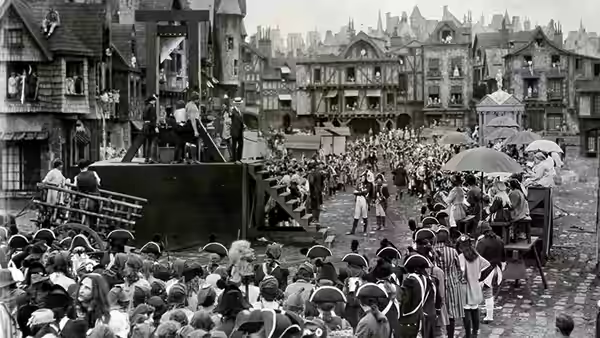
The cinematography is credited to Hendrik Sartov, Billy Bitzer and Paul H. Allen. The pictures are most persuasive when they give us time to attend to a performance; the broader effects cannot hold our interest as reliably. Rose Smith and James Smith’s editing provides much of the excitement, making dramatic urgency out of developments that invite objections when considered calmly. We were gripped despite those objections, because the cutting keeps our concern ahead of our doubts.

The screenplay, also by D.W. Griffith, is less convincing when approached as history. Danton (Monte Blue) and Robespierre (Sidney Herbert) appear among its characters, but their presence should not encourage anyone to treat the film as a reliable guide to events. The questionable fidelity matters because the storytelling is so forceful about securing our agreement. We can enjoy the dramatic complications without accepting the account of history that accompanies them.

William Frederick Peters is credited with the music, though the performances and editing already give us firm instructions about how to feel. The greater reservation is the length, which makes the repeated emotional emphasis more noticeable. There are stretches when the drama would benefit from moving on sooner, rather than asking for another measure of sympathy. That weakness does not cancel the excitement, but it makes the film easier to recommend to an admirer of historical romance than to someone merely curious about it.

Judged as melodrama, its strengths are substantial: a central performance worth watching closely and suspense that survives our doubts about the plotting. The extravagance is part of the pleasure, until the repetition begins to blunt it. A more restrained film might lose something valuable, but a tighter one would not necessarily do so. Allow an evening for Lillian Gish, and keep some scepticism for the history.

Critical consensus AI synthesised

3 of 6
Positive
2
Mixed
1
Negative
0
Radio Times
★★★★ · Robyn Karney
80

The four-star rating indicates a positive verdict. The review praises the film’s colourful, melodramatic incidents and Lillian Gish’s performance.

Read the full review →
Variety
31 December 1920 · Variety Staff
70*

The review is positive, finding the film’s dramatic finale consistently thrilling despite its questionable historical fidelity. It singles out the tense guillotine rescue sequence for praise.

Read the full review →
Time Out
· DT
65*

The available page metadata does not reveal the critic’s verdict. It describes the film as a neglected epic and notes its use of real champagne, but the article text is unavailable.

Read the full review →

Straight answers AI written, from our review

Is Orphans of the Storm worth watching?
Orphans of the Storm is worth watching for admirers of historical melodrama, and we score it 73 for Lillian Gish’s moving performance and the editing’s sustained suspense. Its 150 minutes can feel overextended, especially when the emotional emphasis becomes repetitive, and we recommend enjoying the romance without trusting the history.
How long is Orphans of the Storm, and what is it rated?
Orphans of the Storm runs 2h 30m. It is a drama and history film.
Where can I watch Orphans of the Storm in Thailand?
Orphans of the Storm is not on any streaming or rental service in Thailand at the moment. It is available in 2 other countries; change your country at the top of the page to see where. Availability is checked daily.
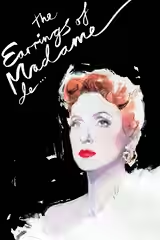
How does Orphans of the Storm compare to The Earrings of Madame de...?
Orphans of the Storm offers more emphatic melodrama than The Earrings of Madame de..., which handles romance and social rank with greater restraint and equal feeling. We favour the latter for its less insistent approach, despite some convenient plotting; Griffith’s film suits those happy to give Lillian Gish and the suspense time to justify its length.

Cast

If you liked this, try…

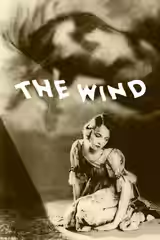
  1. The Wind (1928) · not on Fi1m yetLillian Gish gives another reason to take unrestrained screen emotion seriously.

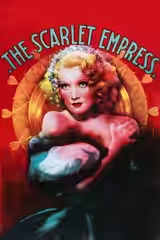
  2. The Scarlet Empress (1934) · not on Fi1m yetHistorical drama with imperial excess and little interest in behaving respectably.

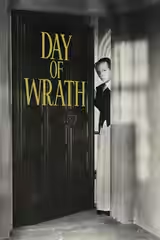
  3. Day of Wrath (1943) · not on Fi1m yetPrivate feeling meets public cruelty in a far sterner historical drama.

  4. The Earrings of Madame de… (1953, Fi1m 87)Romance and social rank handled with more restraint and equal feeling.

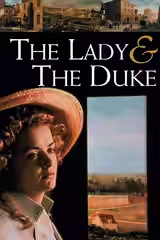
  5. The Lady and the Duke (2001) · not on Fi1m yetRevolutionary politics become personal, with more room for awkward loyalties.