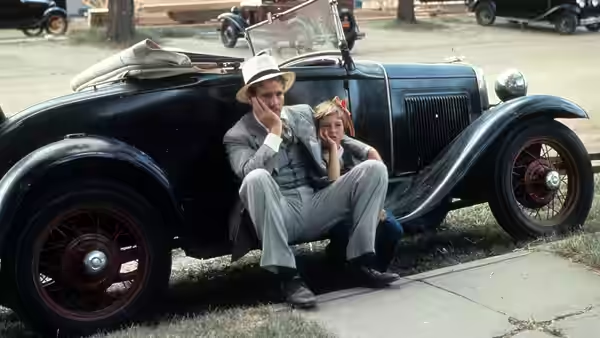
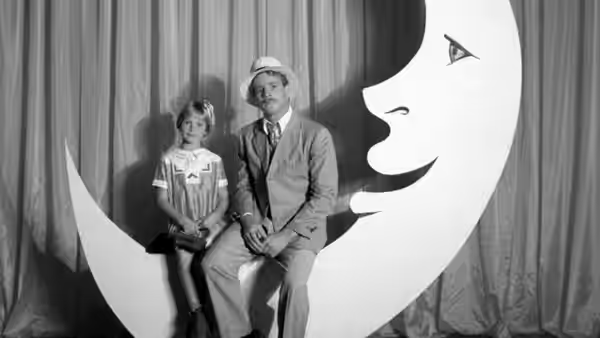
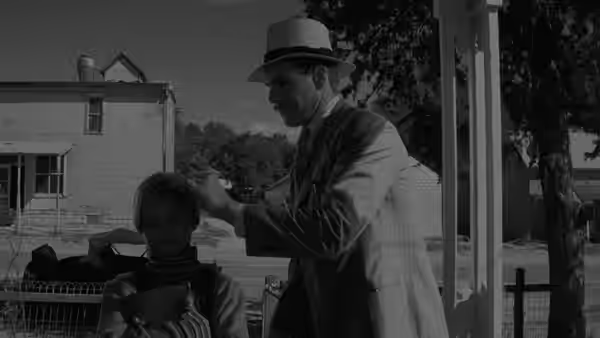
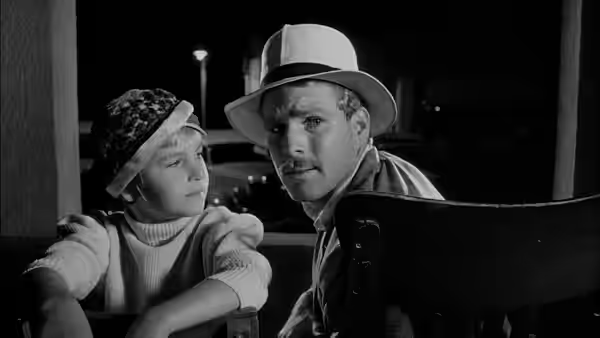
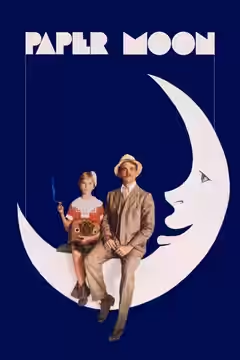
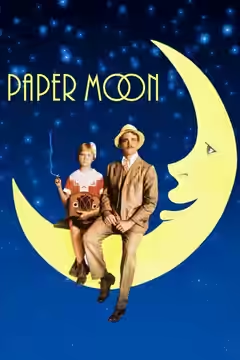
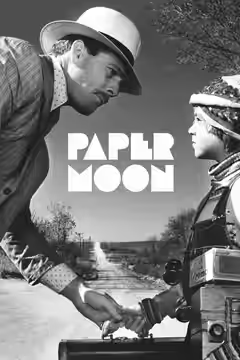
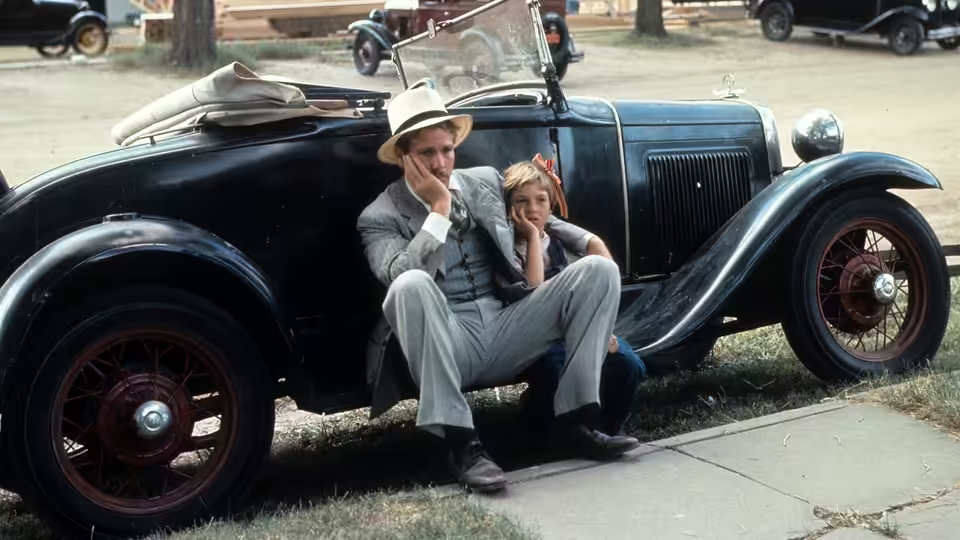
Moses Pray (Ryan O'Neal) and Addie Loggins (Tatum O'Neal) sit beside their car on a roadside curb
Film review

Paper Moon

1973 · Directed by Peter Bogdanovich · 1h 42m

In a sentenceA Bible salesman meets the one customer in Kansas he cannot talk round, and she comes up to his elbow

Kansas, in the Depression. Addie Loggins (Tatum O’Neal) has just buried her mother, and the only mourner who is not a neighbour is Moses Pray (Ryan O’Neal), a travelling Bible salesman who may or may not be her father. The women at the graveside press him to deliver the girl to her aunt in Missouri, and he agrees once he spots a way to squeeze two hundred dollars out of the family of the man responsible for the accident. He spends the money. Addie finds out, and will not let it go. So the two of them drive across the plains in his Ford, selling embossed Bibles to recent widows, arguing over the radio, and picking up a carnival dancer called Trixie Delight (Madeline Kahn) along the way.

Plays from YouTube when you press play; nothing loads from them until then.

Fi1m review

Bogdanovich’s Depression road comedy puts a con man and a small girl in a car and lets Tatum O’Neal win every scene. It is dry, handsome and funny; only a slack stretch in the middle keeps us from handing it to strangers.

Peter Bogdanovich made this straight after The Last Picture Show and What’s Up, Doc?, and it borrows from both: the black-and-white Depression of the first, the speed of the second. Alvin Sargent’s script, from Joe David Brown’s novel, is simple. A woman has died in Kansas. A man in a good hat, Moses Pray (Ryan O’Neal), arrives at the graveside late and is asked to take her daughter, Addie Loggins (Tatum O’Neal), to an aunt in Missouri. He agrees because he has seen a way to make two hundred dollars out of it. Addie, who is small and silent and misses nothing, works out what he has done within a day. We think it is the best film Bogdanovich made, and we recommend it warmly, with one soft stretch to report.

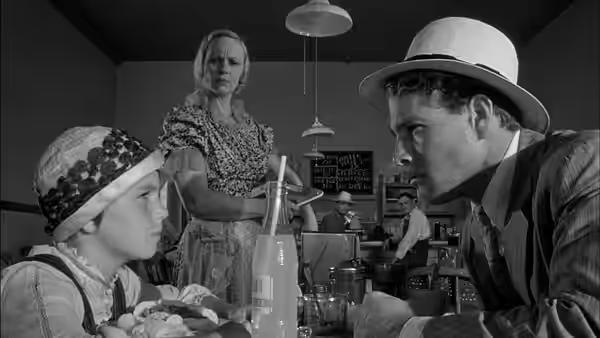
The trade Moses is in is selling Bibles. He reads the obituaries, has the widow’s name embossed in gold on the cover, knocks on the door and tells her that her late husband ordered it. It is a cruel scam and the film does not pretend otherwise; it also lets you watch Addie get better at it than he is. She knows which widow is poor and which has money, and she adjusts the price. The scene in a diner where she tells him, over and over, that she wants her two hundred dollars is where the film declares what it is: a comedy about two people who each think they are the senior partner.

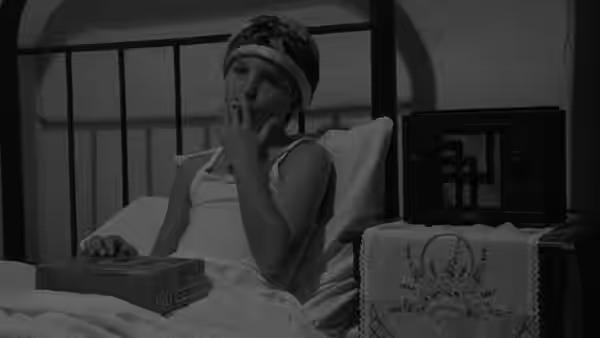
László Kovács shoots it in black and white with the camera kept low and everything in focus, so that the Kansas horizon sits flat across the frame and the sky takes up most of the picture. Scenes are played in long takes, with both O’Neals in the shot and no cutting to tell you who won. Verna Fields mostly leaves the takes alone, and the film is quicker for it. Polly Platt did both the production design and the costumes: the dust on the Ford, the hotel rooms with iron bedsteads, Addie’s overalls, and the cloche hat and cigarette she adopts because her mother had them. There is no composed score; the music comes out of car radios and parlour sets, and it stops when someone switches it off.

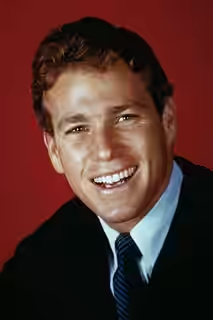
Tatum O’Neal is the reason people still talk about the film, and they are right. She does not ask to be liked, she does none of the things a child actor is usually asked to do, and she can hold a close-up while thinking. Ryan O’Neal is better than he is usually given credit for: he plays Moses as a man slightly less clever than his suit, who is being out-negotiated by a child and knows it. There is a scene in a hotel room where Addie sits at a dressing table with a photograph of her mother, trying on lipstick, the radio playing, and nobody says anything. It moved us more than we were ready for. It is the stillness that does it, and the fact that the camera does not cut away to Moses to tell us how to feel.

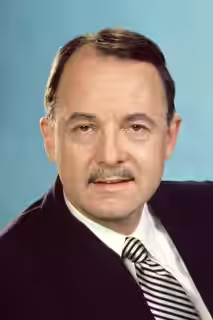
Madeline Kahn arrives at a carnival as Trixie Delight, a dancer with a maid, Imogene (P.J. Johnson), and a plan for Moses. Kahn is funny in the way she is always funny, all breath and bosom and pretended refinement, and she gets one speech, on a hillside, that is sad without the film pointing at it. But her stretch is where the picture slackens. The cons stop, the car stops, and for a quarter of an hour the film waits in a hotel for the two women to settle who owns the man. John Hillerman’s Deputy Hardin brings a proper crime plot into the last third, and that works better, though the mechanics are the least interesting part of the film. At 102 minutes it is not long, and the slack is noticeable only because the rest is so taut.

Set against the director’s own work, it is warmer than The Last Picture Show and better built than What’s Up, Doc?, and it has aged less than either. The ending reaches for a feeling it has already earned, which is a small vanity and not a fault.

Watch it with a child who thinks she is cleverer than you. She will side with Addie, and so, by the end, will you.

Critical consensus AI synthesised

78
Positive
5
Mixed
2
Negative
0

Most critics warm to Paper Moon, and the praise clusters in the same places. Several call it a cynical charmer, a Depression-era comedy whose affection for its two leads stops the bleaker material from taking over. Tatum O’Neal’s debut draws the strongest notices, described as sensational and mesmerising, and Madeline Kahn is singled out alongside her. Laszlo Kovacs’s black-and-white photography is credited with giving the road journey its affectionate sheen, and more than one review notes the blend of Hawksian comedy and Fordian lyricism.

The reservations are faint. Time Out finds it charming and not too sentimental, which is approval with the brakes on. The spread runs from a four-star notice to full marks from The Skinny, which calls the film perfect and sweet. Two of the seven reviews, from The New York Times and RogerEbert.com, cannot be read in full, so their verdicts are unconfirmed and the consensus really rests on five voices.

Slant Magazine
26 November 2024 · ★★★★½ · Jake Cole
90

The review praises the film as a cynical yet charming comedy whose affection for its leads keeps its bleak social commentary from overwhelming it. It particularly singles out Tatum O’Neal’s mesmerizing performance and the way the camera conveys Addie’s perspective.

Read the full review →
Variety
31 December 1972 · Variety Staff
85*

The review is strongly positive, praising the film’s performances. It singles out Tatum O’Neal’s screen debut as sensational and Madeline Kahn as excellent.

Read the full review →
Radio Times
★★★★ · Tom Hutchinson
80

Hutchinson calls the film a cynical charmer, illuminated by Bogdanovich’s directorial talent. He especially praises Laszlo Kovacs’s monochromatic photography for giving the journey an affectionate sheen.

Read the full review →
Time Out
· GA
70*

The available description presents the film as charming and not too sentimental. It singles out the blend of Hawksian comedy and Fordian lyricism for praise.

Read the full review →
RogerEbert.com
65*

The critic's verdict cannot be verified from the blocked page. No praise or complaint can be reliably extracted.

Read the full review →
The New York Times
17 May 1973 · Vincent Canby
65*

The page identifies a New York Times article about Paper Moon, but its review text is inaccessible. I cannot determine the critic’s verdict or what the review singles out for praise or complaint.

Read the full review →

Straight answers AI written, from our review

Is Paper Moon worth watching?
Paper Moon is worth watching for almost anyone, and we scored it 86. It is a dry, handsome Depression comedy about a Bible-selling con man and the small girl who out-negotiates him, with Tatum O'Neal winning every scene. Only a slack quarter of an hour in the middle, when the car stops and the cons stop, keeps it from the top shelf.
How long is Paper Moon, and what is it rated?
Paper Moon runs 1h 42m. It is a comedy and crime film.
Where can I watch Paper Moon in Ukraine?
Paper Moon is not on any streaming or rental service in Ukraine at the moment. It is available in 26 other countries; change your country at the top of the page to see where. Availability is checked daily.
How violent or frightening is Paper Moon, and is it suitable for children?
Paper Moon is a PG film with no violence to speak of and nothing we would call frightening. Its heroes are swindlers who cheat recent widows, there is a crime plot in the last third, and a child takes up smoking and lipstick, so it suits older children who can enjoy watching a girl be cleverer than the adults. The squeamish have nothing to fear.
How does Paper Moon compare to The Sting?
Paper Moon is the smaller, drier and better film of the two, and The Sting is the bigger, glossier and more pleased with itself. Both are Depression con comedies from the same year, but Bogdanovich plays his in long black-and-white takes with a child at the centre, while Hill builds an elaborate plot around Newman and Redford. Choose The Sting for star company and twists; choose Paper Moon for wit and feeling.
Is Paper Moon based on a true story or a book?
Paper Moon is based on a novel by Joe David Brown, adapted by Alvin Sargent, and not on a true story. Sargent keeps the story simple: a con man, a small girl who may be his daughter, and a drive across Kansas selling Bibles to widows. You do not need to have read the book, and we would not say it adds anything.
What should I watch after Paper Moon?
After Paper Moon, try The Sting (1973, Fi1m 85): The same year’s other Depression con film, bigger, glossier and much more pleased with itself. Then Central Station (1998, Fi1m 85): A hard Brazilian letter-writer and an orphaned boy travel inland; nobody softens before they should; and The Last Picture Show (1971, Fi1m 89): Bogdanovich’s earlier black-and-white small-town film, colder than this one and just as well shot.

Cast

Awards

Academy Awards, 1974

Nominated
Best Sound
Nominated
Best Writing, Adapted Screenplay
Won
Best Supporting Actress

Silver nugget for the best foreign film, 1974

Won
Silver nugget for the best foreign film

If you liked this, try…

  1. Alice in the Cities (1974) · not reviewed yetWenders puts a drifting man and a small girl on the road, in black and white, a year later.

  2. The Sting (1973, Fi1m 85)The same year’s other Depression con film, bigger, glossier and much more pleased with itself.

  3. Kikujiro (1999) · not reviewed yetKitano’s grumpy gangster escorts a boy across Japan; the child wins most of the arguments.

  4. Central Station (1998, Fi1m 85)A hard Brazilian letter-writer and an orphaned boy travel inland; nobody softens before they should.

  5. The Last Picture Show (1971, Fi1m 89)Bogdanovich’s earlier black-and-white small-town film, colder than this one and just as well shot.