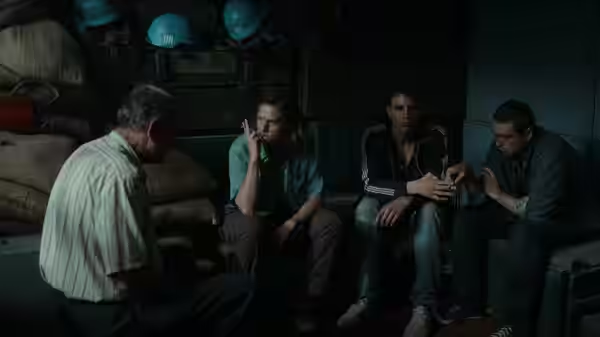
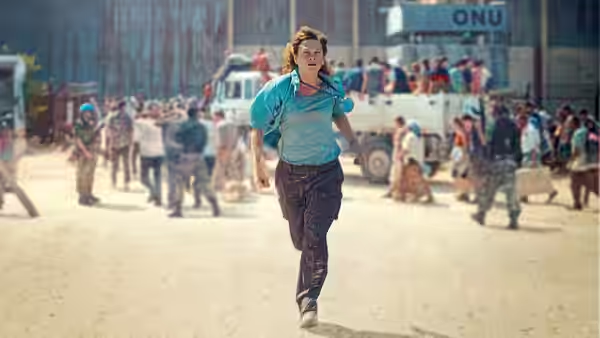
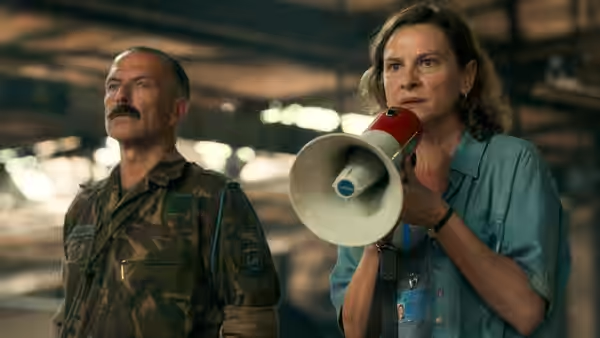
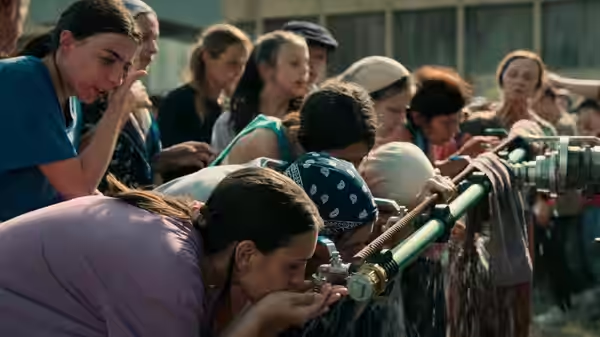
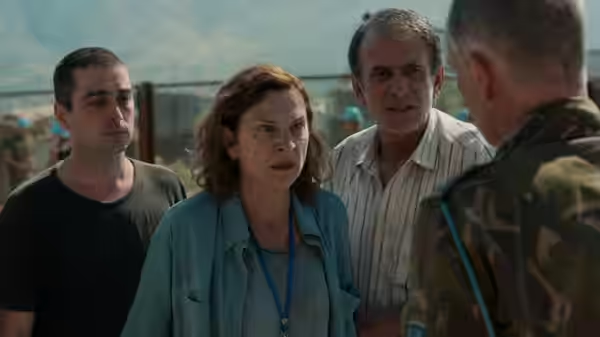
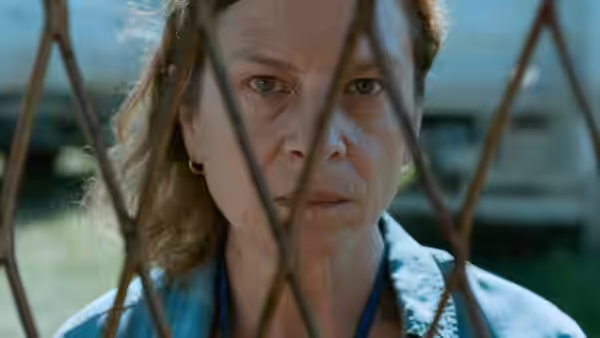
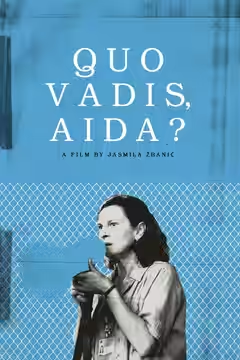
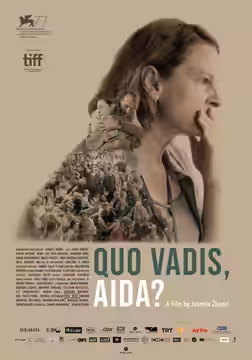
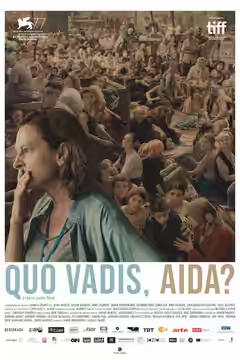
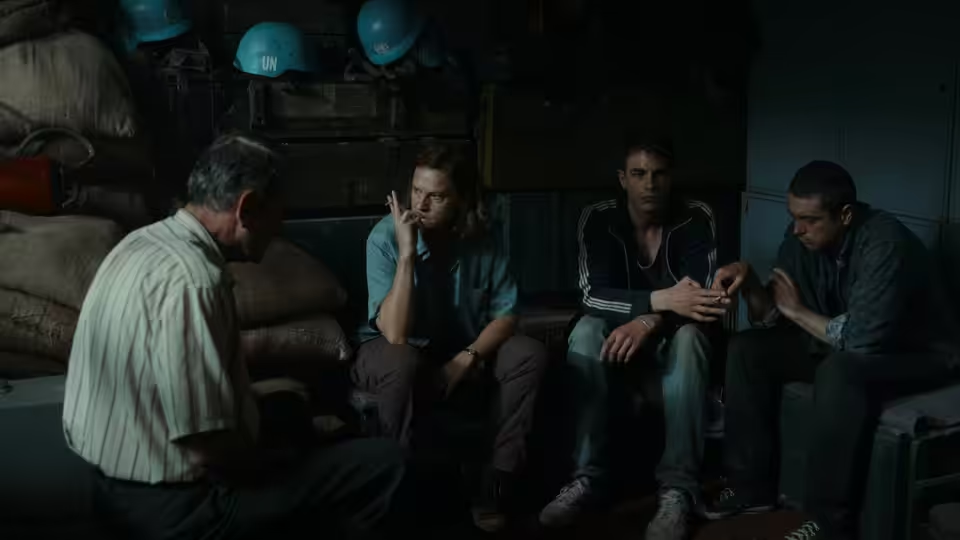
Aïda (Jasna Đuričić) talks with three men seated among sandbags and helmets
Film review

Quo Vadis, Aida?

2021 · Directed by Jasmila Žbanić · 1h 44m · OFNAA IIB

In a sentenceWe sat still for 104 minutes and felt we ought to be doing something

In Srebrenica, Aïda Selmanagić (Jasna Đuričić) tries to protect her family as a military crisis threatens civilian lives. Nihad (Izudin Bajrović), Hamdija (Boris Ler) and Sejo (Dino Bajrović) are among the people around her. Colonel Karremans (Johan Heldenbergh) and General Ratko Mladić (Boris Isaković) hold military authority over events that civilians cannot control. Aïda needs safety for the people closest to her, but her choices depend on decisions taken by others. Her efforts bring her up against the failures of institutions on which her family’s survival depends.

Plays from YouTube when you press play; nothing loads from them until then.

Fi1m review

Jasmila Žbanić’s Srebrenica drama is harrowing and worth the distress. Jasna Đuričić gives a mother’s efforts to save her family an urgency that the controlled filmmaking never exploits for easy excitement.

Quo Vadis, Aida? is a war drama we would urge people to see, despite the distress it causes. Jasmila Žbanić keeps the Srebrenica massacre close to one woman, Aïda Selmanagić (Jasna Đuričić), and her efforts to save her family. That choice gives the film a clear purpose: we are asked to follow what she tries to do, and to understand why she keeps trying. It is a demanding 104 minutes, made bearable by the care taken with the people whose lives are threatened.

Đuričić gives Aïda a physical urgency that makes even the prospect of waiting feel intolerable. Her performance has the strain of someone who must keep thinking while frightened, with other people’s lives depending on her ability to do so. We were frightened for her, because the effort she puts into protecting her family is so visible and offers so little reassurance. Žbanić allows that effort to remain uncomfortable; there is no invitation to applaud Aïda for being a resourceful heroine and settle back into our seats.

Christine A. Maier’s cinematography stays restless, but the film remains easy to follow. That clarity matters, because the drama depends on understanding how much control Aïda has over what happens to her family. Jarosław Kamiński’s editing changes pace without letting the danger seem to have passed. The gentler passages have enough time for affection to be felt, so that danger never becomes the only thing we know about these people, or the only reason to care about them.

Hannes Salat’s production design and Antoni Łazarkiewicz’s music are harder to separate from the film’s effect. Neither feels like something offered for admiration on its own, which helps keep our attention on the people. Žbanić is particularly careful about how much excitement she permits the material to generate. The tension can be nearly unbearable, but there is little of the pleasure a thriller usually offers when it puts a capable person in danger and lets us anticipate an escape.

Our reservation is that such close attention to Aïda leaves some of the people around her less fully felt. Johan Heldenbergh’s Colonel Karremans and Boris Isaković’s General Ratko Mladić matter chiefly for the authority they exercise, and neither holds our attention in quite the same way. Žbanić makes the institutional failure clear, sometimes clearer than the individuals involved. This is a small limitation, but it means the film’s human detail is concentrated heavily in Đuričić’s performance, with less to discover elsewhere.

Against the conventions of the war film, Žbanić resists making courage reassuring. Aïda’s determination does not turn the wider catastrophe into a test of whether one person is brave or clever enough. The institutional failures matter precisely because individual effort cannot compensate for them. Affection for a family is allowed to be ordinary, while the demands being made on that family are appalling; Đuričić makes that fear recognisable without making it comfortable to watch. See it when you can give it your full attention, rather than squeeze it between other things.

Critical consensus AI synthesised

86
Positive
11
Mixed
1
Negative
0

Most critics find Quo Vadis, Aida? a harrowing, humane account of the Srebrenica massacre, with praise centred on Jasna Đuričić’s performance. The reviews repeatedly single out her portrayal of Aida for making the personal consequences of institutional failure painfully clear. Jasmila Žbanić’s direction draws similarly strong approval: critics praise the sustained tension, clear handling of unfolding chaos and restraint around violence. Several stress that the focus on Aida preserves tenderness and individual humanity amid the historical horror.

There is little documented disagreement over the film’s central strengths, and eleven of the twelve reviews are positive. Differences lie chiefly in emphasis, from the camerawork’s restless immediacy to the exposure of international apathy. Time Out supplies the lone mixed entry, but its accessible text gives no specific grounds for reservations. The available reviews therefore establish a broad favourable consensus without revealing a clear recurring criticism.

Evening Standard
20 January 2021 · ★★★★★ · Charlotte O'Sullivan
100

O’Sullivan calls the film a strong Oscar contender and an intensely upsetting drama. She praises its shifts in pace and its ability to make moments of tenderness and impending violence feel equally vivid.

Read the full review →
IndieWire
15 September 2020 · A- · Jude Dry
90

Dry calls the film a gripping, tragic, and humane account of genocide. She praises Žbanić’s slow-building tension and Aida-centered perspective for preserving the characters’ humanity while deepening the tragedy.

Read the full review →
Los Angeles Times
9 March 2021 · Justin Chang
90*

Chang praises the film as a taut, shattering account of the Srebrenica massacre that maintains urgency without sensationalizing the violence. He singles out Jasna Đuričić’s physically and emotionally demanding performance and the filmmaking’s restrained immediacy.

Read the full review →
The Guardian
24 January 2021 · Mark Kermode
90*

Kermode finds the film profoundly moving, engaging viewers while confronting them with the horror of the massacre. He especially praises Jasna Đuričić’s portrayal of Aida and the film’s human heart amid historical atrocity.

Read the full review →
Variety
5 September 2020 · festival review · Jessica Kiang
90*

Kiang finds the film harrowing, compelling, and morally clear in its account of the Srebrenica massacre. She especially praises Jasna Đuričić’s portrayal of Aida, whose position brings the personal and institutional failures into sharp focus.

Read the full review →
Empire
22 January 2021 · David Parkinson
85*

Parkinson finds the film harrowingly compelling and an unflinching exposure of international apathy. He especially praises its humanising focus on Aida and the restless immediacy of the camerawork.

Read the full review →

Straight answers AI written, from our review

Is Quo Vadis, Aida? worth watching?
Quo Vadis, Aida? is worth watching for its harrowing account of a mother trying to protect her family during the Srebrenica massacre, and we score it 92. Jasna Đuričić’s performance makes the fear painfully recognisable, though some supporting figures receive less attention. We recommend it for an evening when you can give a demanding war drama your full attention.
How long is Quo Vadis, Aida?, and what is it rated?
Quo Vadis, Aida? runs 1h 44m and is rated IIB by the OFNAA in Hong Kong. It is a war and drama film.
Where can I watch Quo Vadis, Aida? in Hong Kong?
Quo Vadis, Aida? is not on any streaming or rental service in Hong Kong at the moment. It is available in 24 other countries; change your country at the top of the page to see where. Availability is checked daily.
How violent or frightening is Quo Vadis, Aida?, and is it suitable for children?
Quo Vadis, Aida? has a UK 15 certificate and is not suitable for children under 15; its sustained fear for civilian lives also makes it demanding viewing for older teenagers and adults. We find the tension nearly unbearable because a mother’s efforts to protect her family offer so little reassurance. The distress warrants caution even without a detailed account of onscreen violence.
How does Quo Vadis, Aida? compare to The Ascent?
Quo Vadis, Aida? and The Ascent are gruelling war dramas that keep moral choices close to frightened, fallible people. We recommend Quo Vadis, Aida? for the immediate urgency of a mother trying to save her family; The Ascent, following two partisans into a collaborator’s interrogation room, is the stronger fit for an interest in conscience under pressure. Neither suits a tired evening.
What should I watch after Quo Vadis, Aida??
After Quo Vadis, Aida?, try The Ascent (1977, Fi1m 88): Another war drama that keeps moral choices close to frightened, fallible people. Then The Official Story (1985, Fi1m 81): A family story that makes political violence impossible to keep outside; and The Lives of Others (2006, Fi1m 84): For another tense account of institutions deciding how much a life matters.

Cast

Awards

Gaudí Award for Best European Film, 2022

Nominated
Gaudí Award for Best European Film

LUX European Audience Film Award, 2022

Won
LUX European Audience Film Award

Academy Awards, 2021

Nominated
Best International Feature Film

BAFTA Film Awards, 2021

Nominated
Best Direction
Nominated
Best Film Not in the English Language

European Film Award for Best Actress, 2021

Won
European Film Award for Best Actress

European Film Award for Best Director, 2021

Won
European Film Award for Best Director

European Film Award for Best Film, 2021

Won
European Film Award for Best Film

European Film Award for Best Screenwriter, 2021

Nominated
European Film Award for Best Screenwriter

European University Film Award, 2021

Nominated
European University Film Award

IFFR audience award, 2021

Won
IFFR audience award

Independent Spirit Awards, 2021

Nominated
Best Foreign Film

International Submission to the Academy Awards, 2021

Nominated
International Submission to the Academy Awards

Golden Orange Award for Best Film in International Competition, 2020

Won
Golden Orange Award for Best Film in International Competition

Venice Film Festival, 2020

Nominated
Golden Lion

If you liked this, try…

  1. The Ascent (1977, Fi1m 88)Another war drama that keeps moral choices close to frightened, fallible people.

  2. The Official Story (1985, Fi1m 81)A family story that makes political violence impossible to keep outside.

  3. The Lives of Others (2006, Fi1m 84)For another tense account of institutions deciding how much a life matters.

  4. The Missing Picture (2013) · not reviewed yetA different, formally inventive way to confront atrocity without turning it into spectacle.

  5. The Battle of Algiers (1966, Fi1m 93)For political filmmaking that makes collective danger immediate without simplifying its causes.