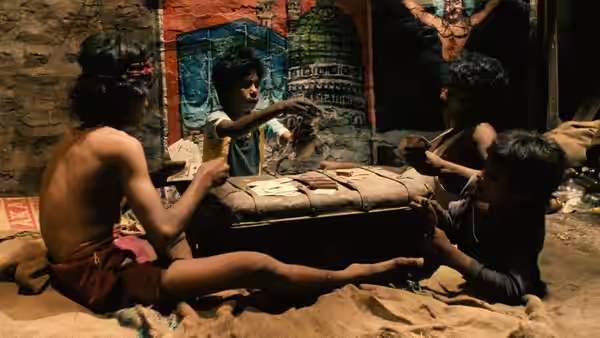
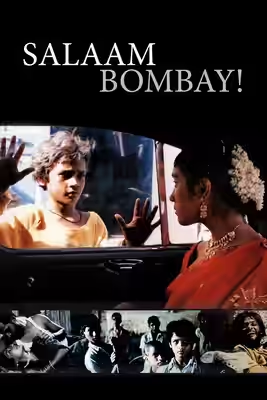
Three boys sit together on a nighttime street, one wearing a helmet
Film review

Salaam Bombay!

1988 · Directed by Mira Nair · 1h 53m

In a sentenceA city full of grown-ups, and the children still have to look after themselves

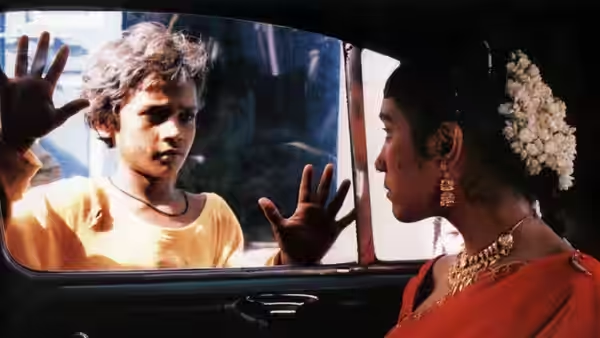
On Bombay’s streets, Krishna / Chaipau (Shafiq Syed) is one of the children trying to survive amid poverty. His world includes Manju Golub (Hansa Vithal), Rekha Golub (Anita Kanwar), Baba Golub (Nana Patekar) and Chillum (Raghubir Yadav). Their lives cross as the children negotiate a city that offers little protection. Krishna / Chaipau needs to get through the day, with hardship always close at hand. The story follows him within a wider community of children and adults, whose separate difficulties become part of his daily life.

Fi1m review

Mira Nair’s street drama is moving without making poverty look noble. Shafiq Syed gives it a persuasive centre, and the crowded life around him holds our attention, even when the storytelling slows more than it should.

Mira Nair’s film is moving, humane and sometimes slower than it needs to be. Its attention to children surviving on Bombay’s streets gives it a force that does not depend on making every scene more distressing than the last. There is life here beyond the hardship, and Nair allows us to take an interest in it. We recommend the film for that breadth of attention, with a reservation about the stretches where its storytelling loses pace.

Shafiq Syed, playing Krishna / Chaipau, gives it a convincing centre. His performance feels unforced, with none of the practised pleading that can make a screen child seem to have an adult hovering just out of sight. We were moved by him, because he makes the daily business of surviving feel ordinary, and that ordinariness is painful to watch. Nair trusts the young performers enough to let their presence carry scenes without making each one an occasion for pity.

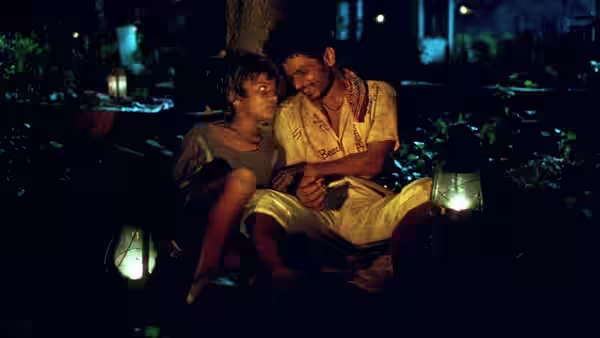
Sandi Sissel’s cinematography gives Bombay’s streets a busy, inhabited quality. The naturalism is persuasive because the city feels capable of continuing beyond the particular life being followed. Mitch Epstein’s production design contributes to that impression, without making the surroundings feel arranged simply to demonstrate deprivation. There is pleasure in the film’s liveliness, and it matters that the children inhabit somewhere we can believe continues beyond the edges of the frame.

Sooni Taraporevala’s screenplay draws several lives into the children’s story, a choice that gives the film company as well as complication. We need that sense of other people nearby, each with concerns that do not begin and end with Krishna / Chaipau. The film’s compassion comes from the time it spends attending to them. Occasionally that generosity spreads the attention too thinly, and the narrative has to work to recover its earlier urgency.

Barry Alexander Brown’s editing is more effective at sustaining the street scenes’ energy than at keeping the slower sections alive. When the pace slackens, the account of hardship starts to feel more deliberately presented, and we become conscious of how long we have been watching. L. Subramaniam’s music supports the emotion, though the young performers need little help making it felt. At 113 minutes, the film could afford to be tighter without becoming less attentive.

Hansa Vithal, as Manju Golub, also benefits from the film’s interest in children as individuals. In a drama about poverty, there is always a risk that everyone becomes either deserving or cruel, leaving the audience little to do except approve of its own sympathies. Nair’s young cast makes that response inadequate. We want to keep watching these particular people, even when the narrative is giving us less reason to press on.

The slower passages remain a real reservation, especially for anyone expecting a briskly plotted crime story. But Syed and the other young performers are worth the patience the film occasionally requires. See it when there is time to watch properly; the children deserve more than half our attention.

Critical consensus AI synthesised

77
Positive
5
Mixed
1
Negative
0
Los Angeles Times
19 October 1988 · Sheila Benson
85*

Benson praises the film as an assured, compassionate portrait that finds understanding without softening the harshness of street life. She especially singles out Nair’s cinematic eye and the young performers’ convincing work.

Read the full review →
Radio Times
★★★★ · David Parkinson
80

Parkinson calls the film an arresting, empathetic and uncompromising study of street life. He especially praises the naturalistic performance of Shafiq Syed, a homeless child cast after workshops brought the young performers together.

Read the full review →
Slant Magazine
12 December 2025 · ★★★★ · Derek Smith
80

Smith finds the film authentically alive, tender, and intimate despite a narrative that loses momentum in juvenile detention. He praises its vivid, naturalistic portrayal of slum life without cheap sentimentality or easy resolutions.

Read the full review →
The Guardian
17 June 2021 · Peter Bradshaw
80*

Bradshaw finds that the film remains powerful and fiercely unsentimental. He singles out its throbbing energy and its refusal to offer an easy resolution.

Read the full review →
Time Out
· RS
70*

The available description suggests an admiring verdict on Nair’s film. It singles out her Dickens-like ability to draw together the lives of children surviving on Bombay’s streets.

Read the full review →
The New York Times
7 October 1988 · festival review
65*

The page content is inaccessible, so the critic’s verdict and specific praise or complaint cannot be verified. The available page does not provide enough text to summarize the review.

Read the full review →

Straight answers AI written, from our review

How long is Salaam Bombay!, and what is it rated?
Salaam Bombay! runs 1h 53m. It is a crime and drama film.
Where can I watch Salaam Bombay! in Czechia?
Salaam Bombay! is not on any streaming or rental service in Czechia at the moment. It is available in 2 other countries; change your country at the top of the page to see where. Availability is checked daily.
What should I watch after Salaam Bombay!?
After Salaam Bombay!, try Pixote (1980, Fi1m 88): Another unsparing account of children surviving where adults offer little protection. Then The 400 Blows (1959, Fi1m 91): A child’s stubbornness and vulnerability receive the same careful, unsentimental attention; and Wadjda (2012, Fi1m 80): For a child’s resourcefulness given room to be funny as well as defiant.

Cast

Awards

Academy Awards, 1989

Nominated
Best International Feature Film

International Submission to the Academy Awards, 1989

Nominated
International Submission to the Academy Awards

If you liked this, try…

  1. Pixote (1980, Fi1m 88)Another unsparing account of children surviving where adults offer little protection.

  2. The 400 Blows (1959, Fi1m 91)A child’s stubbornness and vulnerability receive the same careful, unsentimental attention.

  3. Streetwise (1984) · not reviewed yetA documentary that lets street children speak without making their lives reassuring.

  4. Wadjda (2012, Fi1m 80)For a child’s resourcefulness given room to be funny as well as defiant.

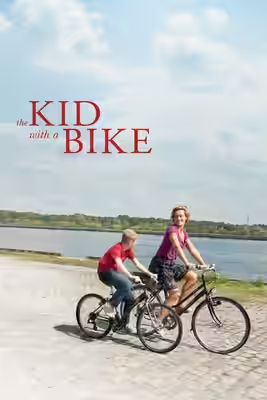
  5. The Kid with a Bike (2011) · not reviewed yetA smaller, tightly focused story of childhood need and imperfect adult care.

Free account

Know what to watch tonight

Two lists that know where things are streaming, collections you can share, your own score beside ours, and Discover that remembers what you have seen.

  • Want to see, sorted by what is streaming now
  • Seen, with your score out of ten
  • No adverts, ever