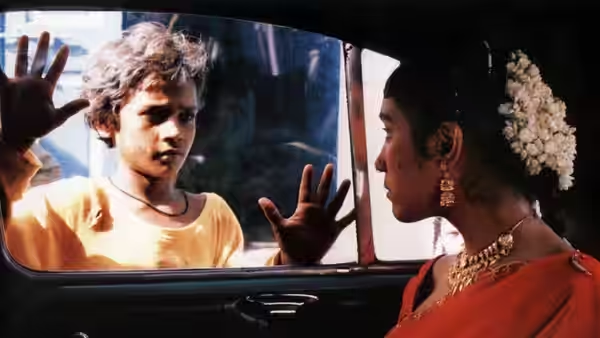
Mira Nair’s street drama is moving without making poverty look noble. Shafiq Syed gives it a persuasive centre, and the crowded life around him holds our attention, even when the storytelling slows more than it should.
Mira Nair’s film is moving, humane and sometimes slower than it needs to be. Its attention to children surviving on Bombay’s streets gives it a force that does not depend on making every scene more distressing than the last. There is life here beyond the hardship, and Nair allows us to take an interest in it. We recommend the film for that breadth of attention, with a reservation about the stretches where its storytelling loses pace.
Shafiq Syed, playing Krishna / Chaipau, gives it a convincing centre. His performance feels unforced, with none of the practised pleading that can make a screen child seem to have an adult hovering just out of sight. We were moved by him, because he makes the daily business of surviving feel ordinary, and that ordinariness is painful to watch. Nair trusts the young performers enough to let their presence carry scenes without making each one an occasion for pity.
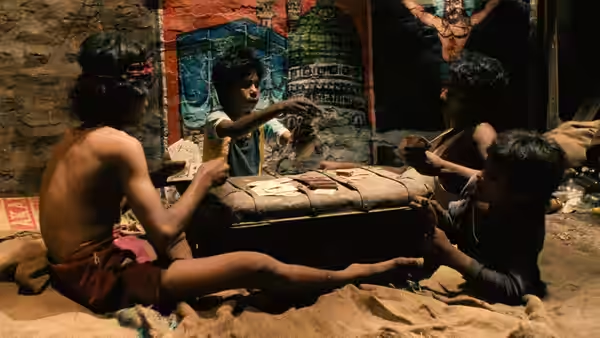
Sandi Sissel’s cinematography gives Bombay’s streets a busy, inhabited quality. The naturalism is persuasive because the city feels capable of continuing beyond the particular life being followed. Mitch Epstein’s production design contributes to that impression, without making the surroundings feel arranged simply to demonstrate deprivation. There is pleasure in the film’s liveliness, and it matters that the children inhabit somewhere we can believe continues beyond the edges of the frame.
Sooni Taraporevala’s screenplay draws several lives into the children’s story, a choice that gives the film company as well as complication. We need that sense of other people nearby, each with concerns that do not begin and end with Krishna / Chaipau. The film’s compassion comes from the time it spends attending to them. Occasionally that generosity spreads the attention too thinly, and the narrative has to work to recover its earlier urgency.
Barry Alexander Brown’s editing is more effective at sustaining the street scenes’ energy than at keeping the slower sections alive. When the pace slackens, the account of hardship starts to feel more deliberately presented, and we become conscious of how long we have been watching. L. Subramaniam’s music supports the emotion, though the young performers need little help making it felt. At 113 minutes, the film could afford to be tighter without becoming less attentive.
Hansa Vithal, as Manju Golub, also benefits from the film’s interest in children as individuals. In a drama about poverty, there is always a risk that everyone becomes either deserving or cruel, leaving the audience little to do except approve of its own sympathies. Nair’s young cast makes that response inadequate. We want to keep watching these particular people, even when the narrative is giving us less reason to press on.
The slower passages remain a real reservation, especially for anyone expecting a briskly plotted crime story. But Syed and the other young performers are worth the patience the film occasionally requires. See it when there is time to watch properly; the children deserve more than half our attention.