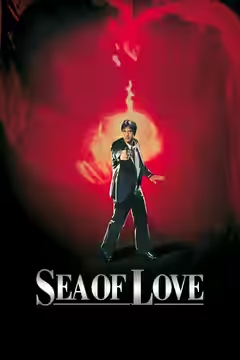
Frank Keller (Al Pacino) kisses Helen Cruger (Ellen Barkin) against a doorway
Film review

Sea of Love

1989 · Directed by Harold Becker · 1h 53m

In a sentenceAl Pacino and Ellen Barkin make neglecting police work look almost sensible

Frank Keller (Al Pacino) is a burned-out policeman caught between a criminal investigation and his attraction to Helen Cruger (Ellen Barkin). He wants a relationship, but police work leaves little room for easy trust. Sherman (John Goodman) is among the people around Frank as the case competes with his growing interest in Helen. Frank and Helen’s attraction brings the possibility of companionship into a life already occupied by suspicion, while the investigation makes it difficult to keep professional caution separate from his private feelings.

Plays from YouTube when you press play; nothing loads from them until then.

Fi1m review

Al Pacino and Ellen Barkin make the attraction convincing enough to carry a familiar thriller. The mystery strains credibility, but the performances give Sea of Love warmth, tension and a reason to care.

Harold Becker’s Sea of Love is a good thriller whenever it lets its actors complicate matters. It attempts something worth doing: making a police investigation and an adult romance interesting at the same time, without setting the relationship aside whenever there is police work to do. Richard Price’s screenplay gives the characters enough wit and discomfort to hold our attention. The plotting needs rather more indulgence, particularly as the film approaches its resolution.

Al Pacino plays Frank Keller with a vulnerability that makes the prospect of romance matter. The burned-out policeman is familiar territory, and the performance could have stopped at exhaustion and professional competence. Instead, he lets us feel how much this man might want company and how poorly equipped he is to accept it. There is pleasure in watching an actor take a stock character seriously enough to find someone worth caring about inside it.

Ellen Barkin, as Helen Cruger, gives him someone sufficiently compelling to make that effort worthwhile. Their attraction feels plausible, which is more useful here than simply making either of them look desirable. We wanted this relationship to work, because their chemistry makes Frank’s weariness seem less permanent. The romance holds our attention even when the investigation is giving us reasons to question the screenplay, and neither performance needs us to mistake these people for innocents.

John Goodman, playing Sherman, contributes to the film’s welcome sense that other people exist beyond the central couple. His presence helps the humour sit comfortably alongside the tension rather than feeling like an apology for it. Richard Price’s sharp writing is important here: the film remains entertaining when nobody is supplying another reason to be suspicious. We would gladly spend longer with these performers, which is a useful quality in a mystery that cannot always withstand close examination.

Cinematographer Ronnie Taylor and production designer John Jay Moore support the director’s relatively unshowy approach. Their work keeps the surroundings from competing with the actors, though it leaves us with fewer memorable images than memorable performances. That seems a reasonable choice for material so dependent on attraction and uncertainty. The reservation is that Harold Becker sometimes controls the tension too carefully, making danger feel manageable when a little more disorder would help.

David Bretherton’s editing keeps the thriller moving without making the relationship feel like an interruption. Trevor Jones’s music provides useful unease, although the actors are already doing much of that work themselves. The larger difficulty is the familiar machinery of the mystery, which becomes implausible when it ought to settle our doubts. We will leave the particulars alone. The problem is not that a thriller requires some generosity, but that this one eventually asks for more than its otherwise credible performances prepare us to give.

Within the crime-romance genre, the film earns its place through the attention paid to adult loneliness and desire. It is entertaining, sometimes funny, and sufficiently interested in its characters to survive a shaky explanation. Anyone chiefly concerned with a watertight investigation should lower their expectations. Choose it for the couple, and allow the detectives a little latitude.


Critical consensus AI synthesised

72
Positive
5
Mixed
3
Negative
0

Most critics find Sea of Love an entertaining, suspenseful thriller, with the strongest agreement centring on Al Pacino’s performance and his chemistry with Ellen Barkin. The praise goes beyond star presence: reviews pick out the vulnerability and weariness Pacino brings to the detective, and the believable sexual tension that gives the romance weight. Richard Price’s screenplay and Harold Becker’s handling of the mystery also receive credit for keeping familiar material involving.

The reservations concern plausibility, depth and how well the film holds together, with responses ranging from enthusiastic to qualified rather than hostile. Empire finds the ending unconvincing and unsatisfying, while Eye for Film welcomes the unpredictability of a late turn. The Los Angeles Times enjoys the performances but finds the entertainment superficial and formulaic. The New Yorker likewise finds plenty to enjoy, yet argues that Becker’s direction flattens material that could have been more daring.

Variety
31 December 1988 · Variety Staff
85*

The review finds the film a suspenseful noir, elevated by Pacino’s performance. It especially praises the depth he brings to the burned-out cop and calls his romance believable.

Read the full review →
Radio Times
★★★★ · Tom Hutchinson
80

Hutchinson praises the film as a tough, suspenseful mystery thriller with strong sexual tension. He singles out the plausible erotic chemistry between Al Pacino and Ellen Barkin, alongside Richard Price’s sharp screenplay and Harold Becker’s realistic direction.

Read the full review →
Empire
1 January 2009 · Ian Nathan
75*

Nathan finds the thriller gripping overall, despite an implausible and unsatisfying ending. He praises Pacino and Barkin’s sizzling chemistry and the intrigue Becker sustains along the way.

Read the full review →
Time Out
· BC
75*

The review finds the thriller efficient but says Pacino’s return makes it essential viewing. It especially praises several scenes as among the best of his work.

Read the full review →
Los Angeles Times
15 September 1989 · KEVIN THOMAS
65*

Thomas calls it a slick, amusing diversion that works as superficial entertainment but offers little depth. He praises the chemistry and performances of Pacino, Barkin and Goodman, while noting implausibilities and a familiar thriller formula.

Read the full review →
The New York Times
15 September 1989 · Janet Maslin
64*

The page content is inaccessible, so the critic’s verdict cannot be established. No specific praise or complaint is available from the provided page text.

Read the full review →

Straight answers AI written, from our review

Is Sea of Love worth watching?
Sea of Love is worth watching for its convincing adult romance and strong performances, and we score it 75 out of 100. Al Pacino and Ellen Barkin give the familiar thriller warmth and tension, though we recommend it more for their chemistry than for an investigation that withstands close scrutiny.
How long is Sea of Love, and what is it rated?
Sea of Love runs 1h 53m. It is a crime and drama film.
Where can I watch Sea of Love in Chile?
Sea of Love is available to rent from Amazon Prime Video and Apple TV from CLF 2.99. Availability is checked daily; the links above go straight to each service.
How violent or frightening is Sea of Love, and is it suitable for children?
Sea of Love carries a UK 18 certificate and is not suitable for children. We find its tension controlled rather than overwhelming, but that is not a measure of its violence or adult content. The certificate is the clearest guide here: treat it as adult viewing, not a thriller for younger teenagers.
How does Sea of Love compare to Klute?
Sea of Love is the warmer, funnier choice beside Klute, while Klute is stronger at sustaining unease. We recommend the former for Pacino and Barkin’s convincing attraction, and the latter for Jane Fonda’s controlled, moving performance and its patient treatment of fear and vulnerability. Neither is chiefly worth choosing for the detective story: one strains credibility, the other is too transparent.
What should I watch after Sea of Love?
After Sea of Love, try Klute (1971, Fi1m 82): A patient thriller that gives attraction, fear and vulnerability room to develop. Then The Secret in Their Eyes (2009, Fi1m 78): For a crime story whose strongest feelings outlast the immediate police work; and Decision to Leave (2022, Fi1m 82): Another investigation becomes complicated when the detective allows himself to become emotionally involved.

Cast

If you liked this, try…

  1. Klute (1971, Fi1m 82)A patient thriller that gives attraction, fear and vulnerability room to develop.

  2. The Big Easy (1986) · not reviewed yetFor more sexual confidence, compromised police work and leads who enjoy each other.

  3. In the Cut (2003) · not reviewed yetA harsher encounter between sexual curiosity and the fear of a stranger.

  4. The Secret in Their Eyes (2009, Fi1m 78)For a crime story whose strongest feelings outlast the immediate police work.

  5. Decision to Leave (2022, Fi1m 82)Another investigation becomes complicated when the detective allows himself to become emotionally involved.

Free account

Know what to watch tonight

Two lists that know where things are streaming, collections you can share, your own score beside ours, and Discover that remembers what you have seen.

  • Want to see, sorted by what is streaming now
  • Seen, with your score out of ten
  • No adverts, ever