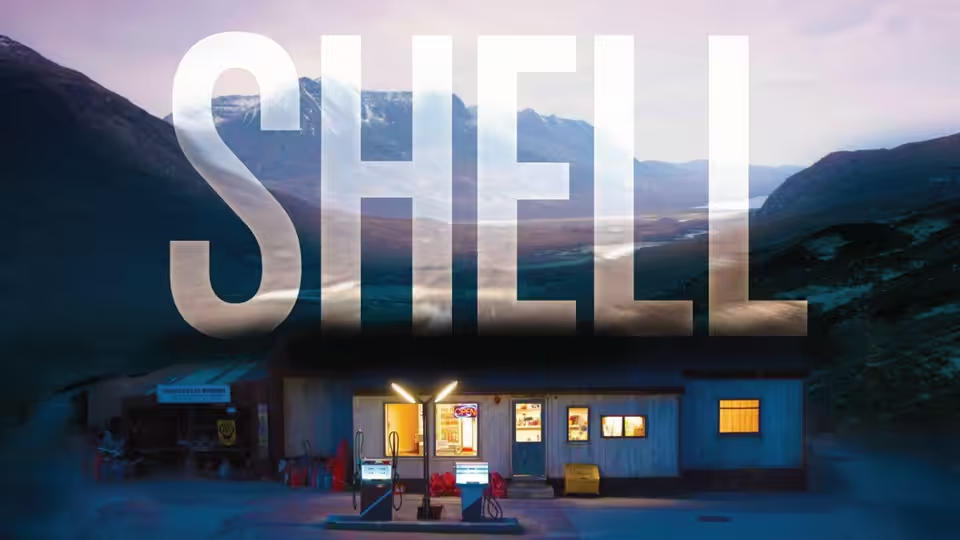
A small roadside petrol station glows beneath mountains at dusk
Film review

Shell

2013 · Directed by Scott Graham · 1h 31m

In a sentenceAll that space in the Highlands, and still nobody has enough room

In the remote Scottish Highlands, Shell (Chloe Pirrie) is at the centre of a story about cramped lives and difficult desires. Around her are Pete (Joseph Mawle), Hugh (Michael Smiley) and Adam (Iain De Caestecker), with Claire (Kate Dickie) also among the characters. The drama stays close to Shell and the people around her, against a landscape that stretches far beyond their immediate surroundings. Its concerns are intimate: loneliness, the need for contact, and the difficulty of understanding what another person wants.

Fi1m review

Scott Graham’s Shell is a sensitive, unsettling drama held together by Chloe Pirrie. Its patience sometimes becomes inertia, and the melodrama is less persuasive than the quiet observation, but we recommend it for the performance.

Shell is worth seeing for Chloe Pirrie, whose performance gives this sparse drama the human interest it needs. Scott Graham, directing his own screenplay, takes loneliness seriously without making every moment an invitation to pity. The difficulty is that he sometimes waits longer than the material warrants. We recommend it, with a warning that its deliberate pace is occasionally more deliberate than rewarding.

Graham sets cramped lives against the remote Scottish Highlands, and the contrast works without much explanation. Space does not make these people free, or help them understand their desires. The film belongs to the quieter end of British drama, where a setting and a performance must do work that dialogue might otherwise handle. At its strongest, it trusts us to notice discomfort without having someone announce it. That trust makes the more emphatic passages harder to accept.

Pirrie gives Shell enough presence to keep that approach alive. We were moved by her performance, particularly by the way she makes the character’s loneliness matter without requiring the film to become more talkative. A sparse screenplay can leave an actor looking stranded; here, the attention keeps returning to Shell because Pirrie rewards it. Graham is fortunate to have a lead who can sustain interest when the storytelling slows. She makes the patience feel worthwhile more often than the script does.

Yoliswa von Dallwitz’s cinematography is the other strong reason to stay. The Highland scenery has an unfamiliar, sometimes forbidding beauty, and the compositions make the surroundings part of our understanding of the characters. We can admire the view while remaining conscious of how confined their lives feel. Jamie Lapsley’s production design contributes to that sense of confinement without competing with the landscape for attention. The setting remains persuasive even when the drama begins to strain.

Rachel Tunnard’s editing gives the performances space, which is sensible until the pauses begin to feel interchangeable. We found our attention slipping during the slower stretches because the film does not always give us something new to notice. Restraint needs variation as much as a busier style does. Graham’s screenplay can seem reluctant to advance, leaving the actors and images to sustain passages that would benefit from being shorter. At 91 minutes, this is hardly an overlong film, but it can feel like one.

The greater problem is the move towards melodrama, which sits awkwardly with the earlier reserve. We will leave the events undescribed; the objection is to the change in emphasis, not to the film allowing strong feelings. Graham has already shown that quiet observation can make those feelings legible. When he presses harder, the effect becomes less convincing, and the weakness is particularly noticeable beside Pirrie’s performance.

There is enough sensitivity here to distinguish Shell from dramas that treat unhappiness as proof of seriousness. Its occasional humour helps, and its visual care serves people rather than merely decorating their distress. For an evening when a quiet, demanding character study appeals, Pirrie is a good reason to give it the time.

Critical consensus AI synthesised

68
Positive
3
Mixed
4
Negative
0

The reviews lean towards qualified approval of Shell, with praise clustering around its remote Highland setting and the close connection between landscape and character. Critics repeatedly admire the visual composition and the way the scenery sharpens the portrait of cramped lives and frustrated desire. Chloe Pirrie’s performance draws particular praise, while several reviews find sensitivity, intelligence and promise in the film’s sparse approach and willingness to take risks.

Reservations centre on pace and the final act. Several critics find the move towards melodrama abrupt or at odds with the patient storytelling that precedes it. The Evening Standard is more troubled by the slowness, suggesting that the drama sometimes all but stops. Enthusiasm varies considerably, though none of the seven assessments is negative: HeyUGuys offers the strongest endorsement, praising Pirrie and the bold storytelling while still finding the conclusion weakened by its abruptness.

Empire
8 March 2013 · Guy Lodge
80*

Lodge finds the film a moving character study that avoids familiar British miserabilism with sly humour and visual poetry. He especially praises the startling cinematography, which reveals an alien beauty in the remote Highlands.

Read the full review →
The Guardian
14 March 2013 · Xan Brooks
75*

Brooks finds the film haunting and spellbinding, though it slips into melodrama at the end. He praises its sharp portrait of cramped lives and desire in the Scottish Highlands.

Read the full review →
Screen Daily
26 September 2012 · festival review · Fionnuala Halligan
64*

The accessible page does not reveal Halligan’s verdict. It also hides any specific praise or complaint from the review.

Read the full review →
Time Out
12 March 2013 · ★★★ · Cath Clarke
60

The review presents Scott Graham’s debut as promising. It singles out its dark-hearted, risk-taking qualities, likening them to Andrea Arnold’s films.

Read the full review →
Total Film
1 March 2013 · ★★★ · Tom Dawson
60

Dawson finds the film brooding and artfully composed, but says its melodramatic resolution jars with its patient, sparse approach. He praises how closely the British film entwines place and character.

Read the full review →
Evening Standard
15 March 2013 · The Standard
55*

The critic finds the film sensitive and intelligent, but so slow-burning that it sometimes seems to stop. They praise Chloe Pirrie’s performance and the beautiful scenery.

Read the full review →

Straight answers AI written, from our review

Is Shell worth watching?
Shell is worth watching for Chloe Pirrie’s sensitive performance, and we score it 72 out of 100. We recommend it for an evening when a quiet, demanding character study appeals: the Highland setting deepens its sense of loneliness, though the pauses sometimes drag and the more forceful melodrama is less convincing.
How long is Shell, and what is it rated?
Shell runs 1h 31m. It is a drama film.
Where can I watch Shell in Austria?
Shell is not on any streaming or rental service in Austria at the moment. It is available in 2 other countries; change your country at the top of the page to see where. Availability is checked daily.
How violent or frightening is Shell, and is it suitable for children?
Shell has a UK 15 certificate, so it is not suitable for children under 15. We find it emotionally unsettling in its treatment of loneliness and difficult desires, but cannot offer a specific warning about violence or frightening scenes from the information available. Older teenagers drawn to restrained, adult drama are its more natural audience.
How does Shell compare to Fish Tank?
Shell is the quieter choice beside Fish Tank, with both films closely observing a young woman’s restricted life. We favour Fish Tank for a tense, compassionate drama with fraught encounters and expressive dance scenes; Shell suits a more contemplative evening, sustained by Chloe Pirrie and the Highland setting, though its patience sometimes becomes inertia.
What should I watch after Shell?
After Shell, try Fish Tank (2009, Fi1m 85): Another young woman’s restricted life, observed with fierce attention and little reassurance. Then Morvern Callar (2002, Fi1m 82): A Scottish character study that lets behaviour carry what dialogue leaves unsaid; and Leave No Trace (2018, Fi1m 88): Isolation and family attachment, handled with patience that keeps earning its place.

Cast

If you liked this, try…

  1. Fish Tank (2009, Fi1m 85)Another young woman’s restricted life, observed with fierce attention and little reassurance.

  2. Morvern Callar (2002, Fi1m 82)A Scottish character study that lets behaviour carry what dialogue leaves unsaid.

  3. Leave No Trace (2018, Fi1m 88)Isolation and family attachment, handled with patience that keeps earning its place.

  4. The Quiet Girl (2022, Fi1m 84)Sparse speech and careful observation make a child’s need for affection painfully clear.

  5. Vagabond (1985, Fi1m 90)A harsher account of solitude, refusing easy explanations for its young woman.