Jeff Fowler’s third Sonic film is louder and a little better than the two before it, chiefly because Jim Carrey plays both Robotniks and is allowed to run. Around him is a fast, competent family film that tries for grief and settles for volume.
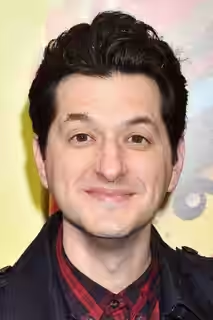
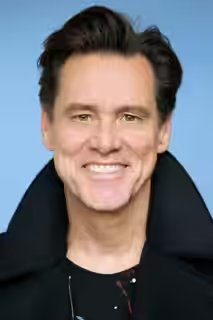
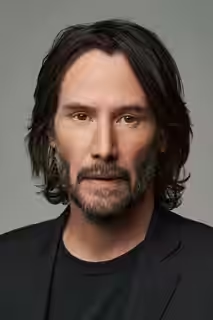
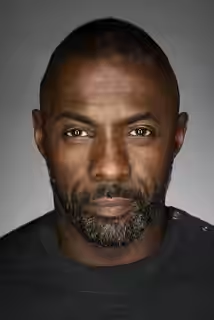
Jeff Fowler’s third Sonic film arrives with a plan, and the plan is more. More hedgehogs, more Robotniks, more cities to run through, more score. Sonic (Ben Schwartz), Knuckles (Idris Elba) and Tails (Colleen O’Shaughnessey) are a team now, or have been told they are. Shadow (Keanu Reeves) is let out of a government facility and proves faster and angrier than any of them. Ivo Robotnik (Jim Carrey) comes back from hiding, and so does a second Robotnik, Gerald, also Carrey. The result is a loud, quick, mostly likeable family film that is better than its predecessors, and not by much.
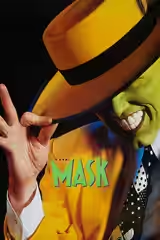
Carrey is the reason to go. As Ivo he is unshaven, sulking and out of practice, a villain who has stopped bothering. As Gerald he is stooped, white-haired and delighted with himself, and the two of them bicker like a couple who have shared a house too long. We laughed out loud, more than once, and every time it was Carrey: two versions of one man interrupting each other, finishing each other’s insults, and at one point performing a dance routine that has no business in the plot and is the best thing in the film. The script by Pat Casey, Josh Miller and John Whittington seems to know this, because whenever the hedgehogs stall it cuts back to the Robotniks.
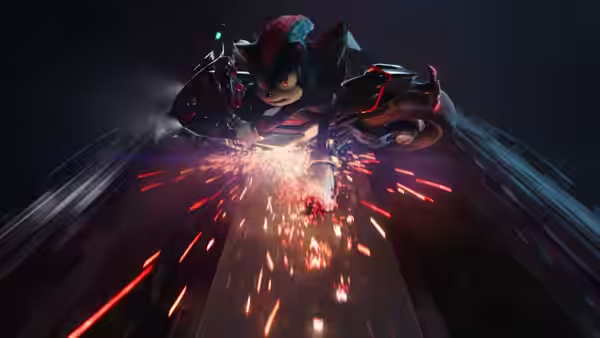
Reeves plays Shadow low and slow, as though reading something at a funeral, and it works better than it should. The character has a loss behind him, which the film shows early and returns to often, and Reeves gives the lines a weight the animation cannot always carry; the face is a hedgehog’s face and there are limits. Still, it moved us a little, a film about a blue cartoon asking a child to think about losing someone, and we had not expected that. Then the drums came back.
The drums are Tom Holkenborg’s, and there are a great many of them. His score is a pulse, a bass hit and more pulse, mixed high, so that the bigger the set piece, the less of it we could hear. Brandon Trost shoots the human scenes flat and bright and the action in blue-and-orange night, and Al LeVine cuts the fights so fast that twice we lost the thread entirely and knew who was winning only because the music told us. Luke Freeborn’s Robotnik lairs are the one design pleasure, red and chrome and rounded like something laid rather than built. Eleanor Baker keeps Ivo in black, with a moustache that appears to have its own lighting.
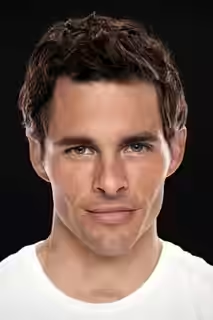
The humans are stranded. James Marsden and Tika Sumpter, as Tom and Maddie, are on hand to be supportive and to be carried about at speed, and they each get one scene of feeling before going back to holding coats. Lee Majdoub’s Agent Stone, devoted to Robotnik past all reason, has more to do this time and is quietly funny doing it. Krysten Ritter’s Director Rockwell exists to say that the hedgehogs are dangerous and to be wrong about it.
The second half tries for something bigger and sadder, and we will not describe it. What we can say is that a film which has spent an hour on two Robotniks squabbling asks, in its final stretch, to be taken seriously about grief and revenge, and the join shows. The children in our screening did not appear to mind. We minded a little, because the quieter story Reeves was telling with his voice was more interesting than the one the effects were telling with explosions, and the effects won.
Against the first two films this is an improvement: more plot, less padding, a villain with a reason. Against the family films it would like to sit beside, it is still a machine for putting bright things on a screen quickly. It runs 110 minutes and carries a PG. Take the children, sit near the back, and if the score becomes too much, Carrey will be along shortly.