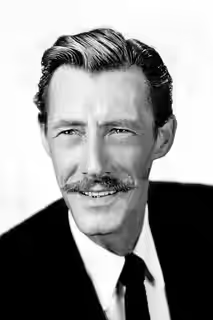
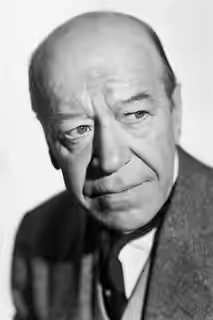
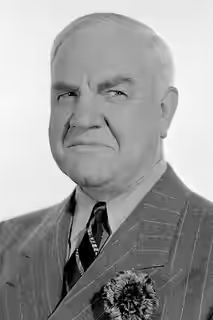
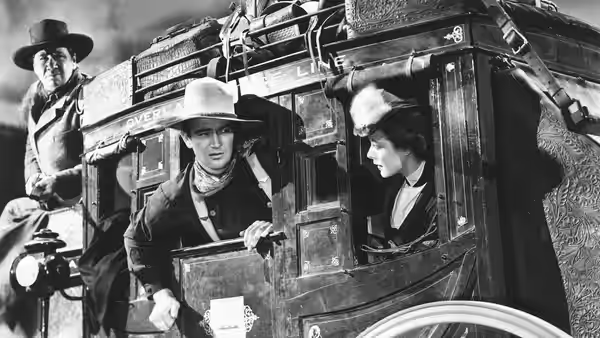
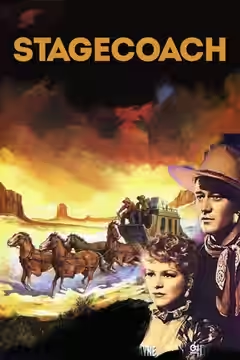
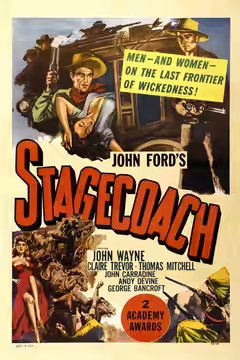
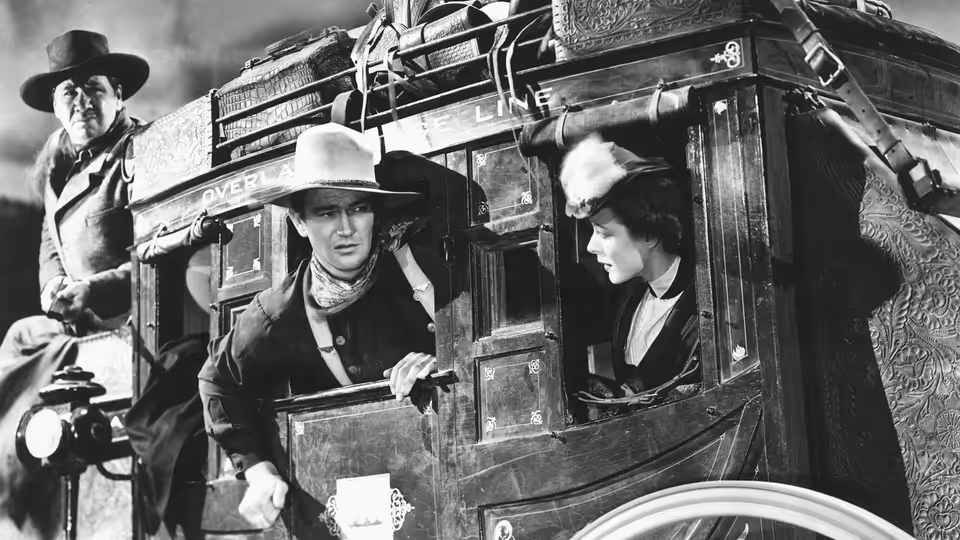
Cowboy leans from stagecoach window beside woman passenger in hat
Film review

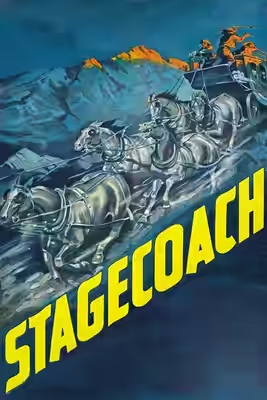
Stagecoach

1939 · Directed by John Ford · 1h 36m

In a sentenceA crowded coach, dangerous country and passengers who still find time to disapprove of one another

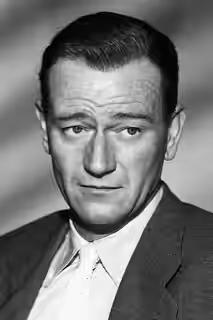
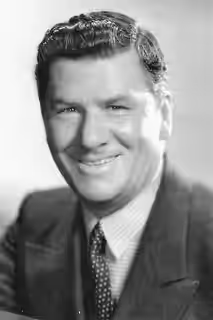
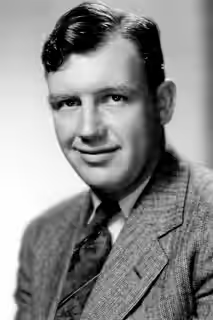
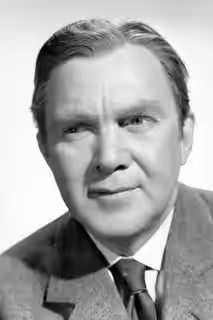
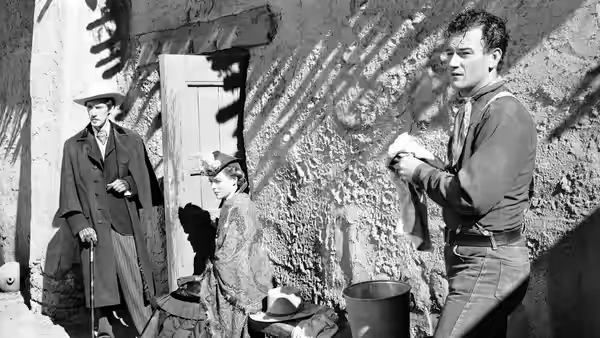
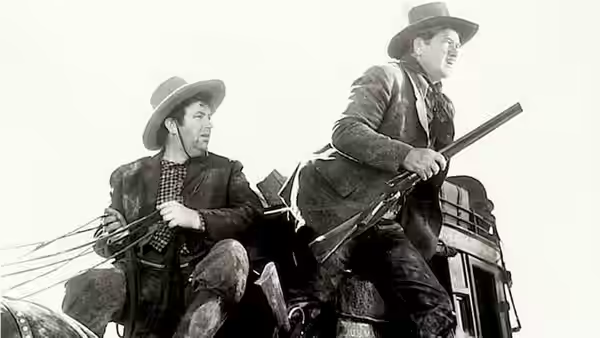
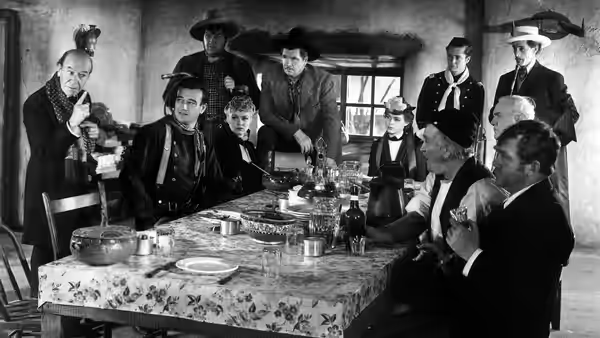
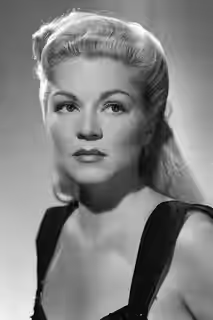
A stagecoach crosses the Old West under threat of Apache attack. Dallas (Claire Trevor), The Ringo Kid (John Wayne) and Doc Josiah Boone (Thomas Mitchell) become part of the travelling company, alongside Lucy Mallory (Louise Platt) and Hatfield (John Carradine). Marshal Curly Wilcox (George Bancroft) and Buck (Andy Devine) also make the journey. The immediate task is to get the passengers safely through dangerous country. Inside the coach, differences of status and temperament complicate the journey, forcing people who have little in common into close company.

Fi1m review

John Ford’s Western gives its passengers the attention that makes the action matter. It is a gripping ensemble adventure, with a serious caveat about its treatment of the Apache.

John Ford’s Stagecoach is a fine Western, brisk, involving and more interested in its passengers than its simple journey requires. It understands the pleasure of putting incompatible people in close quarters and making them stay there. Dudley Nichols gives the ensemble enough competing claims on our attention that waiting for action never feels like waiting for the film to begin. Across 96 minutes, the coach has to carry a considerable amount of human disagreement. The journey gives those disagreements time to develop.

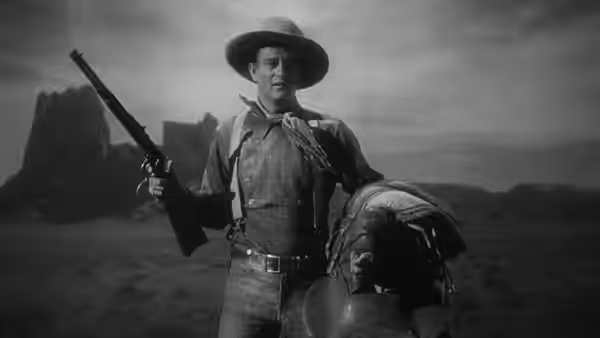
Claire Trevor, as Dallas, makes us care about what happens between the dangers. She gives the character enough feeling to hold our attention without needing the whole film arranged around her. John Wayne plays The Ringo Kid with a directness that suits the pace, and his ease makes the performance feel unforced. Their appeal is important to the film’s generosity: we are interested in spending time with these people well before the journey has tested them.

Thomas Mitchell’s Doc Josiah Boone and Andy Devine’s Buck give the journey much of its comic energy. Some of the comic business goes on after we have got the joke. George Bancroft, as Marshal Curly Wilcox, provides a useful steadiness beside them. Dudley Nichols’s script occasionally makes it too easy to decide which travellers deserve our trust. The cast keeps us interested after the writing has settled the matter.

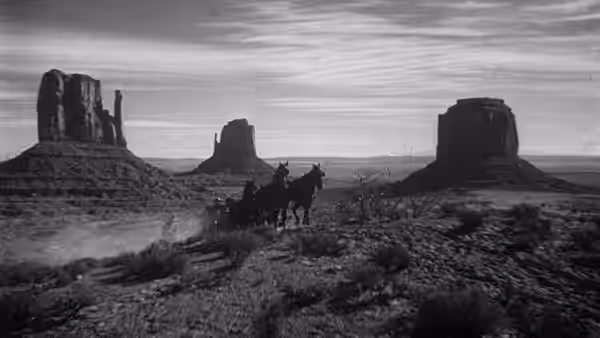
Bert Glennon’s cinematography gives the country around the coach a scale that makes the journey feel exposed. We have time to register the size of the landscape and the vulnerability of the people crossing it. Walter Plunkett’s costume design helps keep the crowded company distinct, although the acting does most of the work of establishing their differences. The open country makes a useful contrast with the coach, where differences of manner and status are difficult to avoid.

Otho Lovering, Dorothy Spencer and Walter Reynolds edit the action with a welcome respect for where everyone is. We were gripped because we could follow the coach through the danger, with none of the uncertainty about space that so often passes for excitement. That clarity also lets us keep thinking about the passengers while the action is under way. Gerard Carbonara’s music is less subtle: its encouragement sometimes adds emphasis that the action does not need.

The serious reservation is the Apache threat. John Ford gives the travellers the benefit of individual attention, then asks us to accept the people threatening them chiefly as a source of danger. We can admire the suspense without pretending that this is a small matter, particularly in a film so alert to unfair judgements elsewhere. The warmth within the coach makes the lack of comparable curiosity outside it more conspicuous.

For an ensemble adventure, this is still a persuasive way to proceed: establish the company, then make us worry about it. The film’s reputation as a model for later stories of people thrown together is easy to understand. Its economy is especially welcome; John Ford does not need a long running time to make a crowded cast memorable. See it for the passengers, even if Westerns are not usually your choice.
Critical consensus AI synthesised

85
Positive
10
Mixed
0
Negative
0

The reviews are uniformly positive, with praise clustering around John Ford’s direction, the sharply drawn passengers and action that remains clear while sustaining suspense. Most critics regard Stagecoach as a foundational western, but their enthusiasm extends beyond its influence: they find the storytelling vigorous, the landscape photography expressive and the ensemble worth caring about. Several also see its confined travelling group as a model for later ensemble adventures and disaster films.

The spread runs from warm approval to stronger enthusiasm, rather than revealing a split over particular faults. The supplied reviews offer few explicit reservations. The New Yorker focuses on Depression-era conflicts, law and abuses of authority, while the Los Angeles Times stresses the ensemble performances and the film’s importance within Ford’s work. Both are less emphatic in their assessments than most of the other reviews, without disputing the strengths praised elsewhere.

Empire
1 January 2000 · Simon Braund
90*

The critic hails Ford's transformation of a simple plot into a masterpiece of characterization, visual poetry, and action, particularly praising the groundbreaking stunts and Yakima Canutt's fall under the horses.

Read the full review →
RogerEbert.com
1 August 2011 · Roger Ebert
90*

Ebert praises the film as a landmark that renewed the careers of John Ford and John Wayne, establishing them as a legendary partnership and influencing countless later ensemble-driven stories. He singles out the elegant pacing, rich characterizations of the stagecoach passengers, and the thrilling yet clear action sequences for particular praise.

Read the full review →
Slant Magazine
25 May 2010 · Fernando F. Croce
90*

The critic celebrates Stagecoach as an enduring foundational western that captures Ford's vision of the Old West through its populist camaraderie, visual grandeur, and blend of folklore, allegory, and redemption. He singles out the film's vitality and humanism, noting how it feels both classical and startlingly modern despite decades of influence on the genre.

Read the full review →
The Guardian
9 July 2006
90*

The critic calls Stagecoach a landmark in cinematic history that made Monument Valley famous and launched John Wayne as a major star. They praise its superb suspenseful storytelling, fully fleshed-out characters and indelible sequences like the Indian pursuit and final shoot-out.

Read the full review →
The New York Times
3 March 1939 · Frank S. Nugent
90*

The critic hails John Ford's direction for sweeping aside talkie artifice to create a grand, camera-driven motion picture that is a genuine rib-thumper and beautiful to behold. He singles out the director's handling of the ensemble cast and the overall vigorous storytelling for praise.

Read the full review →
Time Out
18 January 2012 · NF
90*

The critic praises Ford's film as the first modern Western whose influence is impossible to overstate. It established the Monument Valley landscape, Wayne's long partnership with Ford, and much of the mythology explored in the director's later Westerns.

Read the full review →

Straight answers AI written, from our review

Is Stagecoach worth watching?
Stagecoach is worth watching for anyone who enjoys an ensemble adventure, and we scored it 84. John Ford's Western is more interested in its quarrelling passengers than its journey requires, which is why the action matters when it comes. The serious caveat is its treatment of the Apache, who exist chiefly as a threat.
How long is Stagecoach, and what is it rated?
Stagecoach runs 1h 36m. It is a western film.
Where can I watch Stagecoach in Thailand?
Stagecoach is not on any streaming or rental service in Thailand at the moment. It is available in 15 other countries; change your country at the top of the page to see where. Availability is checked daily.
How does Stagecoach compare to The Lady Vanishes?
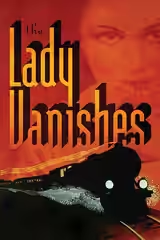
Stagecoach and The Lady Vanishes both put irritable travellers in close quarters and let the friction feed the suspense. Ford's Western is the more generous with its cast and the clearer in its action, while Hitchcock's railway mystery is funnier and more tense, though its plotting becomes fussy. Choose Stagecoach for the people, The Lady Vanishes for the puzzle.
What should I watch after Stagecoach?
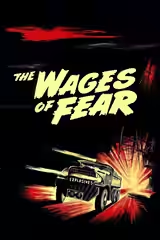
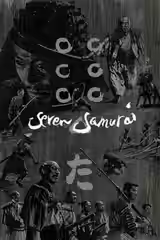
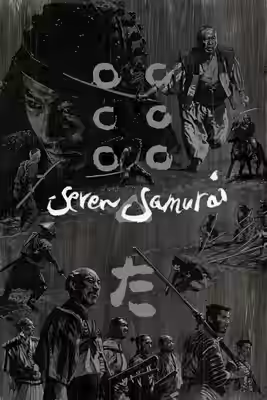
After Stagecoach, try The Lady Vanishes (1938, Fi1m 88): Another crowded journey where social irritation becomes part of the suspense. Then The Wages of Fear (1953, Fi1m 90): A dangerous road journey that makes every stretch of ground matter; and Seven Samurai (1954, Fi1m 95): Patient character work makes the clearly staged action count for more.

Cast

Awards

Academy Awards, 1940

Nominated
Best Cinematography, Black-and-White
Nominated
Best Director
Nominated
Best Film Editing
Nominated
Best Picture
Nominated
Best Production Design
Won
Best Score, Adaptation or Treatment
Won
Best Supporting Actor

If you liked this, try…

  1. The Lady Vanishes (1938, Fi1m 88)Another crowded journey where social irritation becomes part of the suspense.

  2. The Wages of Fear (1953, Fi1m 90)A dangerous road journey that makes every stretch of ground matter.

  3. Seven Samurai (1954, Fi1m 95)Patient character work makes the clearly staged action count for more.

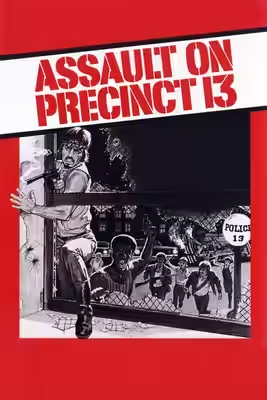
  4. Assault on Precinct 13 (1976) · not reviewed yetStrangers under siege discover practical reasons to set their differences aside.

  5. Meek's Cutoff (2010, Fi1m 82)A Western journey that questions whose knowledge the travellers choose to trust.

Free account

Know what to watch tonight

Two lists that know where things are streaming, collections you can share, your own score beside ours, and Discover that remembers what you have seen.

  • Want to see, sorted by what is streaming now
  • Seen, with your score out of ten
  • No adverts, ever