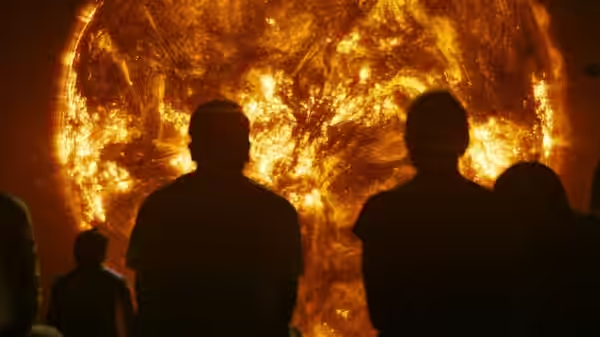
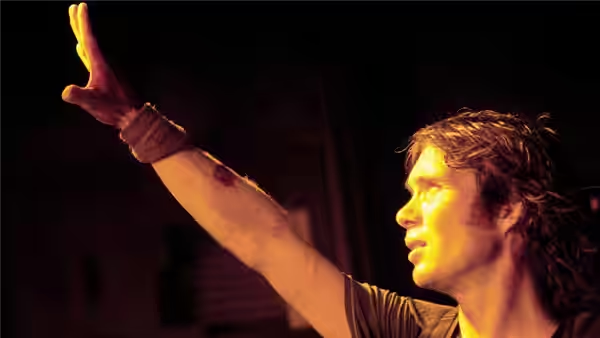
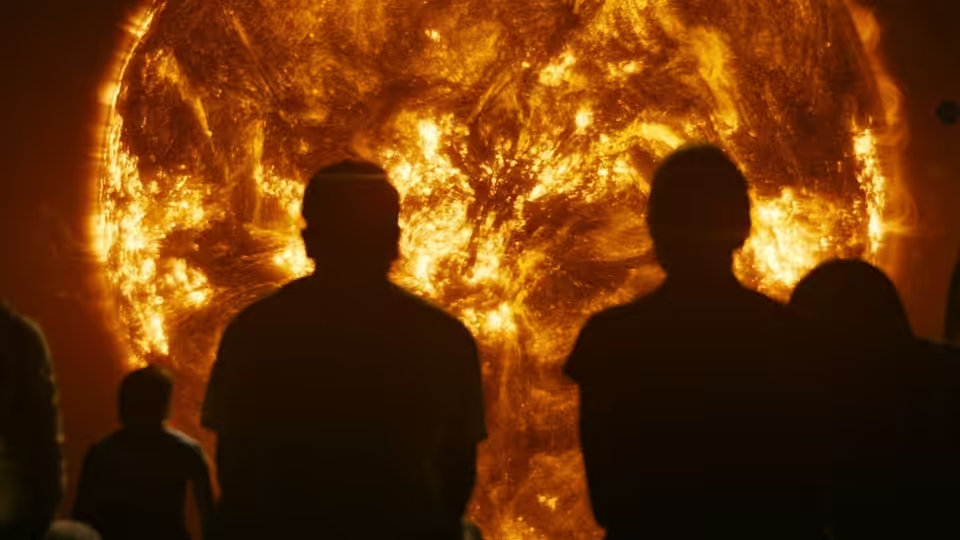
Silhouetted figures watching the sun's fiery surface
Film review

Sunshine

2007 · Directed by Danny Boyle · 1h 48m

In a sentenceA crew sets out to rescue the sun and keeps staring at it, which is fair; so did we

The sun is dying, and a crew travels into space on a mission to reignite it. Among them are Capa (Cillian Murphy), Cassie (Rose Byrne), Mace (Chris Evans), Corazon (Michelle Yeoh), Searle (Cliff Curtis) and Kaneda (Hiroyuki Sanada). Their task is to save humanity, but approaching the star means bringing themselves closer to the danger it poses. The crew must balance their own survival against the purpose of the voyage, while the sun itself becomes an object of fascination as well as fear.

Fi1m review

Danny Boyle and Alex Garland send a crew to relight the sun, and the first two acts are patient, frightening, beautifully built science fiction. The third loses its way, but the journey is worth taking.

Danny Boyle and Alex Garland send a crew into space to reignite a dying sun. Garland does not dress it up. Sunshine is good for its first two acts, before a turn we will not describe makes it a different and lesser film. The journey is still worth the evening.

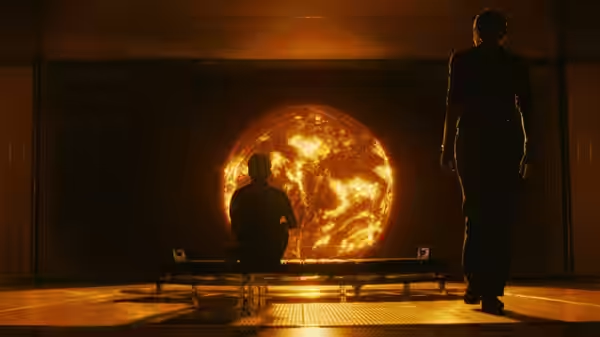
Alwin H. Küchler makes the sun dominate the images, so the crew’s fascination with it becomes easy to understand. We were frightened by how strongly they were drawn to it. There is something unsettling about watching people approach a star when the pictures make its destructive power feel so immediate. Boyle lets us spend enough time looking to share their curiosity, even as the mission grows more alarming.

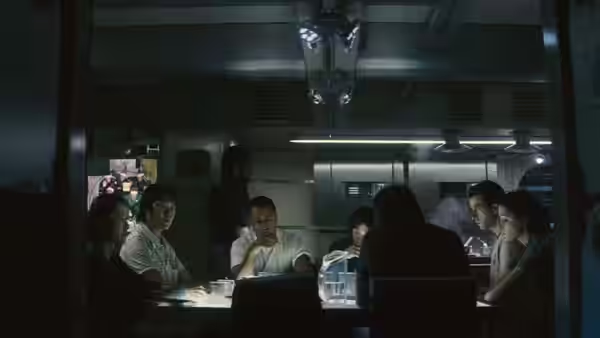
Mark Tildesley’s ship is the other thing to look at. Its practical appearance helps us accept a mission that sounds implausible when written down. Even at this scale, the ship seems like somewhere people have to work. That matters: the danger becomes easier to take seriously if the crew look as though they belong in their surroundings.

Chris Gill cuts the early stretches with real patience. He gives the danger time to register before asking us to fear the next thing, and the pace allows the crew’s decisions to carry some weight. John Murphy’s score sustains that tension and keeps the fate of people beyond the spacecraft in mind. It gives the mission an emotional force that Garland’s dialogue does not always manage.

Garland writes the crew as jobs rather than people, and for the most part that is the right call. Cillian Murphy is watchful and slightly absent as Capa. Chris Evans, as Mace, is short-tempered and practical, and the film is better for his impatience. Rose Byrne plays Cassie as the crew’s conscience with few lines. Still, the thin characterisation makes it harder to stay involved when the film begins to lose its way.

Then the turn. Boyle’s control becomes less secure, and there are passages when the action is hard to follow. The picture that had been so patient starts to hurry. The questions it had raised about what a person owes to strangers are set down in favour of more conventional thrills.

Boyle and Garland made a more convincing transition from quiet to violence in 28 Days Later. Here the change seems to belong to another script. For much of its running time Sunshine sits comfortably with the thoughtful space films of the 1970s that it plainly admires. The later reliance on familiar thriller devices feels unnecessary.

It runs 108 minutes and carries a 15. Watch it on the largest screen you have, with the lights off. The sunlight needs the black around it.

Critical consensus AI synthesised

63
Positive
9
Mixed
2
Negative
3

Most critics like Sunshine, though few love it without qualification. Nine of the fourteen reviews are positive, and the praise clusters around the look of the thing: the ship, the effects, and the way the sun itself becomes a presence the crew cannot stop staring at. Danny Boyle is credited with sustaining real tension, and several reviews place the film alongside the thoughtful science fiction of the 1970s rather than the usual space adventure. Time Out singles out the sound design and score.

The reservations are almost unanimous about where they fall: the final act. Review after review describes a film that holds together for two-thirds of its length and then turns into a horror-film chase that undercuts what came before. The spread is wide, from warm to hostile. Variety and Slant go furthest, the latter finding a philosophical blank behind the spectacle, while The Hollywood Reporter stands nearly alone in praising the whole without complaint.

The Hollywood Reporter
3 April 2007
90*

The critic calls it an extraordinary film operating on visceral, psychological, and spiritual levels during a space voyage with mankind's fate at stake. It praises the gritty realism, fidelity to probable science, adventure, heroics, and old-fashioned thrills while distinguishing it from typical sci-fi epics.

Read the full review →
Empire
23 July 2007 · Olly Richards
80*

The critic finds it a knuckle-gnawingly tense, glorious action thriller that marks another genre nailed by Danny Boyle, with near-faultless visual gloss and shimmery sophistication. They single out the breathtaking production values and Boyle's mastery of white-knuckle cinema for praise, while noting a fumbled, nonsensical finale.

Read the full review →
The Guardian
6 April 2007 · Peter Bradshaw
80*

The critic praises the film's stunning visuals and compelling central idea of a mission to reignite the dying sun, placing it in the tradition of thoughtful 1970s science fiction. He notes some reservations about the final act not fully emerging from the established characters but ultimately calls it a thrilling and sensual spectacle.

Read the full review →
Screen Daily
4 April 2007
70*

The critic praises Danny Boyle's sci-fi thriller for its eye-popping visuals, eco-conscious screenplay, and striking performances, noting its ambitious tone akin to 2001 rather than conventional genre fare.

Read the full review →
The New York Times
20 July 2007 · Critic’s Pick · Manohla Dargis
70*

The critic praises Boyle's visually arresting and tingly science-fiction thriller about a mission to save the dying sun, noting its debt to classics like 2001 while highlighting the director's skill at delivering chills and tension.

Read the full review →
Time Out
3 April 2007 · Ben Walters
70*

While noting thin characterisation and derivative elements, the critic highlights the film's impressive sound design, score, and the captivating, perilous relationship between the crew and the sun, with striking visuals.

Read the full review →

Straight answers AI written, from our review

Is Sunshine worth watching?
Sunshine is worth watching for science-fiction viewers who enjoy patient tension and convincing spacecraft, and we score it 74 out of 100. We recommend it for its frightening approach to the sun and carefully built first two acts, with a substantial caveat: the final stretch trades thoughtful questions for less convincing thriller devices.
How long is Sunshine, and what is it rated?
Sunshine runs 1h 48m. It is a science fiction and thriller film.
Where can I watch Sunshine in Colombia?
Sunshine is streaming on Disney+ in Colombia. Availability is checked daily; the links above go straight to each service.
How violent or frightening is Sunshine, and is it suitable for children?
Sunshine carries a UK 15 certificate and is not suitable for children under 15; its sustained tension also makes it a cautious choice for easily frightened older teenagers. We find the crew’s fascination with the sun unsettling because its destructive power feels so immediate, and the later action becomes harder to follow.
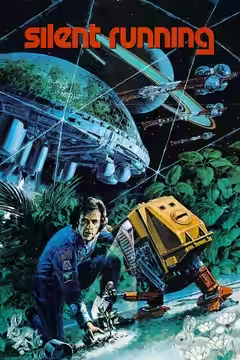
How does Sunshine compare to Silent Running?
Sunshine offers a larger, more threatening space mission than the small ecological fable of Silent Running, and we recommend both with reservations. We find Sunshine persuasive as patient science fiction before its thriller turn weakens it; Silent Running offers a more intimate focus and likeable drones, though its shrill speeches and songs are drawbacks.

Cast

If you liked this, try…

Sunshine (2007) review: two fine acts and a third that panics (Colombia) | Fi1m