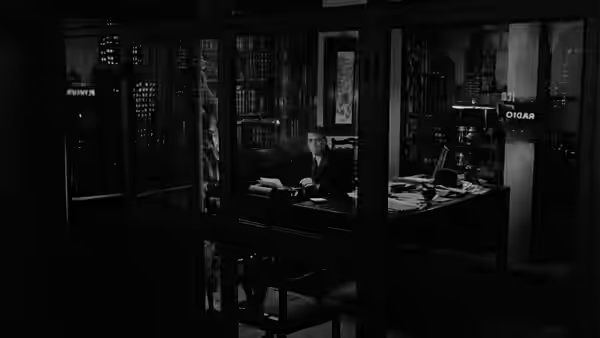
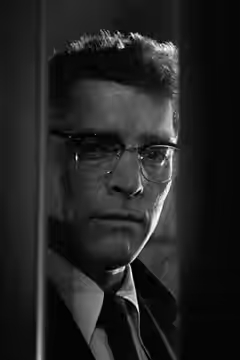
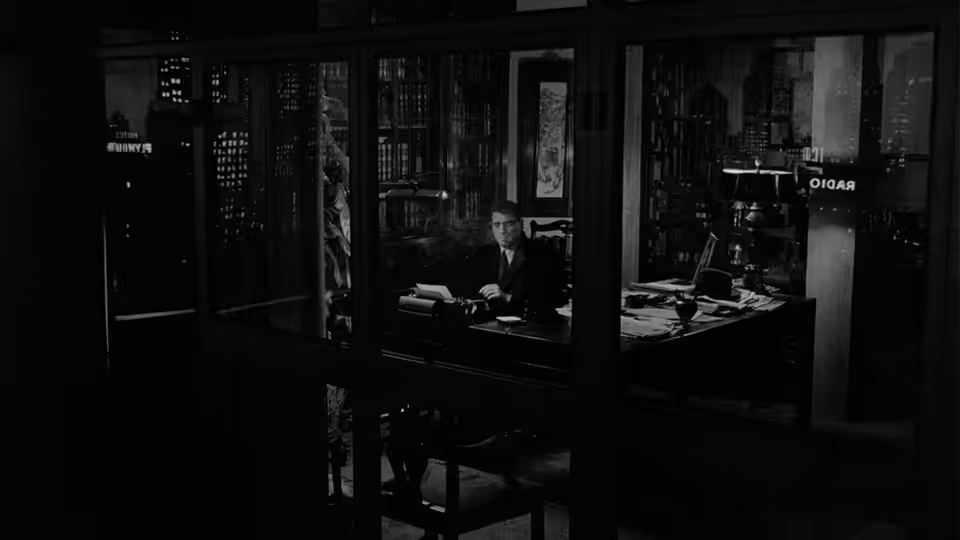
A man sits at a desk in an office, seen through glass partitions
Film review

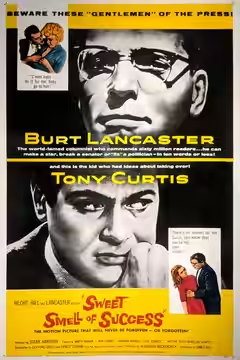
Sweet Smell of Success

1957 · Directed by Alexander Mackendrick · 1h 37m

In a sentenceBurt Lancaster makes dinner with a senator look like something that requires legal advice

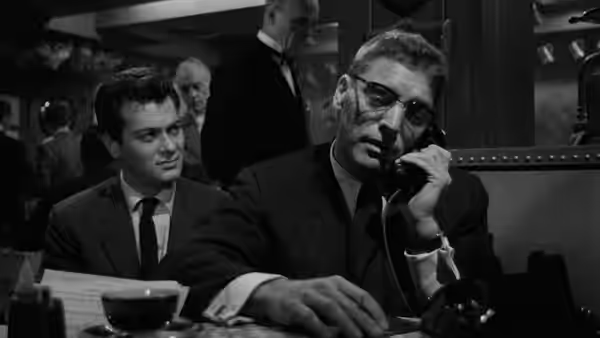
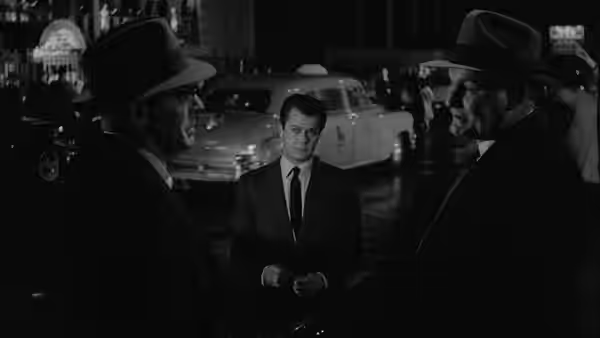
New York after dark brings Sidney Falco (Tony Curtis) into the company of columnist J.J. Hunsecker (Burt Lancaster). At a dinner with a senator, J.J.’s influence is on display; in his dealings with Sidney, he has a proposition to make. There is also a private matter: his sister, Susan Hunsecker (Susan Harrison), is secretly involved with Steve Dallas (Martin Milner). J.J.’s devotion to Susan sits alongside his appetite for power. The film follows these connections through the city’s nightlife, with public influence and private relationships becoming difficult to keep apart.

Plays from YouTube when you press play; nothing loads from them until then.

Fi1m review

Alexander Mackendrick’s press drama is vicious, funny and superbly acted. Burt Lancaster and Tony Curtis make every conversation worth watching, though the young lovers receive less of the writers’ attention.

Sweet Smell of Success is a hard, funny drama about men who make other people wait for permission to matter. We recommend it, with a reservation about how little freedom it gives the people caught between its two leads. Alexander Mackendrick makes conversation feel dangerous without asking anyone to raise a fist. The men can do enough damage while remaining perfectly polite. Much of the tension comes from waiting to hear how an apparently civil remark will be received.

Burt Lancaster plays J.J. Hunsecker as someone who expects the conversation to arrange itself around him. His restraint is the frightening part: he does not need to advertise the threat in every sentence. We laughed at the dinner with the senator, then felt ashamed of how much we enjoyed the intimidation. The pauses let us anticipate the next humiliation. Sitting at that table looks like a dangerous professional obligation.

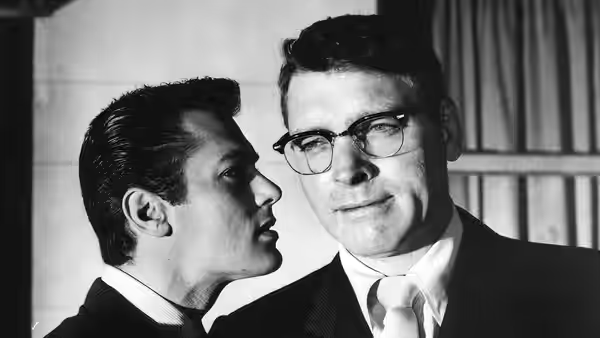
Tony Curtis gives Sidney Falco a more restless sort of calculation. His eagerness makes every exchange feel provisional, as though the next remark might improve his standing or destroy it. He allows the wish to impress to become ugly without making the man incomprehensible. We can see why somebody would keep trying with J.J., even when the sensible response would be to leave. A small change of tone is enough to make us reconsider how much freedom Sidney has to say no.

The screenplay by Ernest Lehman and Clifford Odets gives them plenty to work with. Its insults are carefully made, and occasionally we become more aware of that workmanship than of the person speaking. That is a small cost, but it keeps some exchanges from feeling spontaneous. More often, the verbal display is exactly right for men who are always performing for one another. Alan Crosland, Jr. edits with an ear for the pause after a remark, allowing the listener’s discomfort to register before the talk resumes.

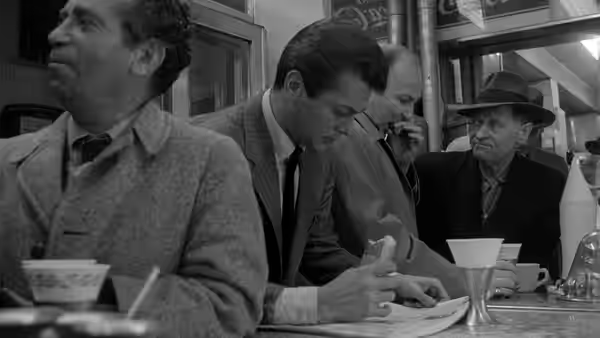
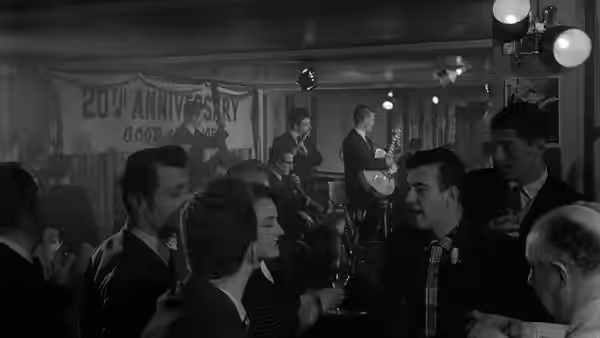
James Wong Howe’s black-and-white photography gives the New York night weight and detail. We can believe that these men would want to spend their lives in this city, which matters when so much of their company is unpleasant. At the dinner with the senator, the civilised setting makes the cruelty harder to dismiss as somebody else’s problem. Elmer Bernstein’s jazz score supplies a nervous energy that suits all this manoeuvring. It keeps the film from becoming ponderous about how badly everyone behaves.

The reservation concerns Susan Hunsecker and Steve Dallas, played by Susan Harrison and Martin Milner. Their secret romance offers some relief from the calculating talk elsewhere, but the couple get less interesting writing. The contrast makes sense: plain speech is welcome among people who turn every sentence into a contest. Still, we wanted them to be more than comparatively decent company. The film’s concentration on its bullies leaves the younger characters with too little space to surprise us.

As a drama about the press, it is narrow and pitiless, with little interest in anyone doing an honest day’s work. That narrowness largely suits its purpose: staying close to these men lets us watch the excuses form as they speak. Over 97 minutes, the concentration rarely slackens. See it for the two lead performances and the pleasure of dialogue spoken by people who know precisely where it will hurt.
Critical consensus AI synthesised

73
Positive
5
Mixed
4
Negative
1

The reviews lean favourable, with praise clustering around the sharp dialogue, Lancaster and Curtis’s performances, and the evocation of New York after dark. Admirers find the film’s account of media power both thrilling and sharply observed, with the acting giving its vicious exchanges conviction. James Wong Howe’s black-and-white photography draws particular attention, while the jazz score also earns praise for its contribution to the nocturnal atmosphere.

The spread is wide, though the available reservations are less numerous than the scores alone suggest: three entries lack enough review text to establish a specific position. Variety finds the drama compelling but questions the clarity of the columnist’s devotion to his sister. The New York Times supplies the strongest dissent, objecting to the cynical, sordid outlook and the portrayal of power and ambition as relentlessly corrupting. The central divide concerns the darkness that admirers find bracing and the dissenting review finds objectionable.

Empire
1 January 2015 · Colin Kennedy
95*

Kennedy regards the film as a cast-iron classic and one of Hollywood’s darkest works. He singles out its sharp dialogue, standout performances, and richly detailed photography and jazz score.

Read the full review →
The AV Club
23 February 2011 · A · Noel Murray
95

Murray praises the film as an unusually thrilling, sharply observed portrait of media power. He singles out Lancaster and Curtis’s performances, along with the biting dialogue and James Wong Howe’s vivid city photography.

Read the full review →
The Guardian
16 September 2001 · Philip French
95*

French considers the film a masterpiece and an example of intelligent Hollywood cinema at its best. He particularly praises the crackling dialogue, alongside the performances and the film’s vivid vision of New York nightlife.

Read the full review →
Slant Magazine
23 February 2011 · ★★★★½ · Glenn Heath Jr.
90

The critic calls the film a virtuosic, intoxicating portrait of American power lust and praises Criterion’s essential Blu-ray release. He singles out James Wong Howe’s textured black-and-white cinematography and the transfer’s detail.

Read the full review →
Evening Standard
10 April 2012
75*

The critic regards it as a bracing, still-great drama, though it was too dark for its time. He especially praises Lancaster and Curtis’s risky, vicious performances and the film’s nocturnal photography.

Read the full review →
Time Out
· CA
65*

The page is identified as a review, but the critic’s verdict is not visible. The available description notes Mackendrick’s association with British humour, but reveals no specific praise or complaint.

Read the full review →

Straight answers AI written, from our review

Is Sweet Smell of Success worth watching?
Sweet Smell of Success is well worth watching for its viciously funny dialogue and Burt Lancaster and Tony Curtis’s performances; we score it 88 out of 100. We recommend it particularly for those who enjoy dramas where polite conversation can be threatening, with the reservation that the young lovers receive less interesting writing than the men controlling their lives.
How long is Sweet Smell of Success, and what is it rated?
Sweet Smell of Success runs 1h 37m. It is a drama film.
Where can I watch Sweet Smell of Success in Slovakia?
Sweet Smell of Success is not on any streaming or rental service in Slovakia at the moment. It is available in 45 other countries; change your country at the top of the page to see where. Availability is checked daily.
How does Sweet Smell of Success compare to Ace in the Hole?
Sweet Smell of Success favours intimate intimidation, while Ace in the Hole follows a reporter making another man’s suffering serve his career. We favour Sweet Smell of Success for the exchanges between its two leads; Ace in the Hole suits an appetite for a more openly furious press drama, though its script sometimes makes greed explain too much.
Is Sweet Smell of Success based on a true story or a book?
Sweet Smell of Success is adapted from a novel by Ernest Lehman, who also writes the screenplay with Clifford Odets. We recommend approaching it without prior reading: the performances make the struggle for influence clear, and the pleasure lies in hearing how carefully these men choose their words to hurt or impress.
What should I watch after Sweet Smell of Success?
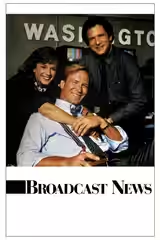
After Sweet Smell of Success, try Ace in the Hole (1951, Fi1m 87): Another press drama where ambition makes somebody else’s suffering seem useful. Then Broadcast News (1987, Fi1m 84): A warmer examination of media ambition, with room for professional skill and conscience.

Cast

If you liked this, try…

  1. Ace in the Hole (1951, Fi1m 87)Another press drama where ambition makes somebody else’s suffering seem useful.

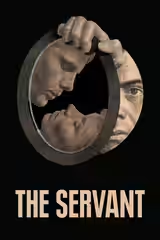
  2. The Servant (1963) · not on Fi1m yetFor another poisonous relationship sustained by watchfulness, dependency and carefully delivered humiliations.

  3. The Bad Sleep Well (1960) · not on Fi1m yetCorporate respectability conceals vicious conduct, with patience that makes the cruelty worse.

  4. The Lost Honour of Katharina Blum (1975) · not on Fi1m yetFor a harsher look at what newspapers can do to private lives.

  5. Broadcast News (1987, Fi1m 84)A warmer examination of media ambition, with room for professional skill and conscience.