Irvine Welsh adapts three of his own stories and Paul McGuigan films them with real energy, but only the first, with Maurice Roëves as a drinking God, earns its cruelty. The other two mistake unpleasantness for honesty.
Irvine Welsh adapts three of his own short stories, Paul McGuigan directs them, and the result is 107 minutes of Edinburgh at its least welcoming. The first story is good, and funny in a way that made us feel slightly grubby. The second is bleak and the third is one idea played well past the point where it stopped working. One out of three is roughly what we think of the film, and we suspect it is roughly what the film thinks of its characters.
The Granton Star Cause opens the picture and is the reason to watch it. Boab (Stephen McCole) is dropped by his football team, thrown out by his parents, left by his girlfriend Evelyn (Jenny McCrindle) and sacked, all on the same day, and then he goes to the pub and finds God (Maurice Roëves) already there. Roëves plays Him as a heavy drinker with a grievance, a man who has watched Boab waste every chance he was given and has decided to say so. Welsh writes the speech as pub talk rather than scripture and Roëves delivers it without once raising his voice. What God does next we will not describe, except to say that McGuigan and his editor Andrew Hulme cut it at the speed of a joke, and we laughed, and then noticed we were laughing at a man losing everything he had.
A Soft Touch is harder to sit through and means to be. Johnny (Kevin McKidd) marries Catriona (Michelle Gomez), who is pregnant and not interested in him, and then Larry (Gary McCormack) moves in upstairs and begins taking whatever he wants. McKidd is the best thing in the film, a decent man who registers each humiliation a beat late and never fights back. Alasdair Walker shoots the stairwells and the flat in grey daylight that makes everything look damp. The trouble is the tone. We felt for Johnny from the first scene, and by the end we felt the film did not, that it was watching him the way Larry does, for sport, and we were angry about that. The closing shot is stark and well judged. It is also the only moment in half an hour where anyone behind the camera seems to care what happens to him.
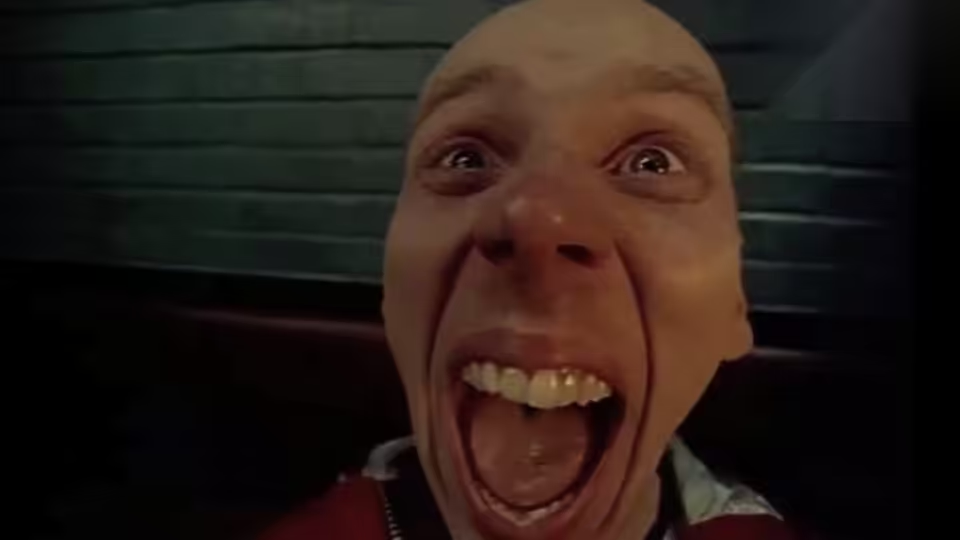
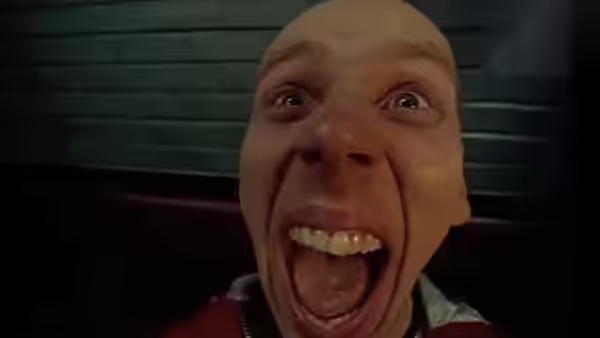
The title story is the one the trailer sells and the one with the most going on. Coco Bryce (Ewen Bremner) is a drinker and a fighter with a girlfriend, Kirsty (Arlene Cockburn), and no plans. During a storm he takes acid, lightning strikes, and he wakes up somewhere he should not be; the same night Jenny (Jemma Redgrave) and Rory (Martin Clunes), a middle-class couple across the city, are having their first child. The premise is a good one and Bremner commits to it entirely, mouth open, limbs going in four directions. For ten minutes it is funny. Then it is the same scene again. Mike Gunn and Richard Bridgland give the couple a pale, tidy flat that looks like a show home next to Coco’s scheme, and Pam Tait and Lynn Aitken dress Redgrave and Clunes in the sort of knitwear that tells you everything about them before they speak. Dan Mudford’s music pushes the segment towards farce and the writing does not quite get there with it.
Welsh’s own Trainspotting, filmed by Danny Boyle in 1996 with Bremner and McKidd in the cast, is the comparison the film cannot avoid, and McGuigan does not try to. The difference is not energy, which this has, but attention. Boyle’s film liked its people even while it watched them ruin themselves. This one lines them up and knocks them down, and after the first story, where God does the knocking with some wit, it starts to feel like the point. Three stories also means three endings, and Hulme cannot do much about the fact that the film stops twice before it finishes.
Most critics have been harder on it than we are, and we understand why; the middle story alone would sink a film half this length. What keeps it up is Roëves in the pub and McKidd on the stairs, two performances that would be worth watching in anything. See it for the first story if Welsh is yours, and know that the 18 certificate is doing real work. If the second story makes you want to stop, we would not argue.