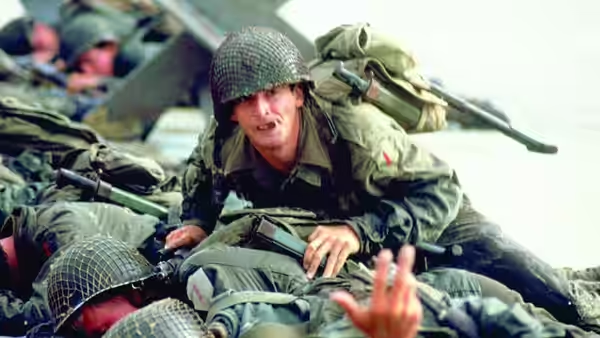
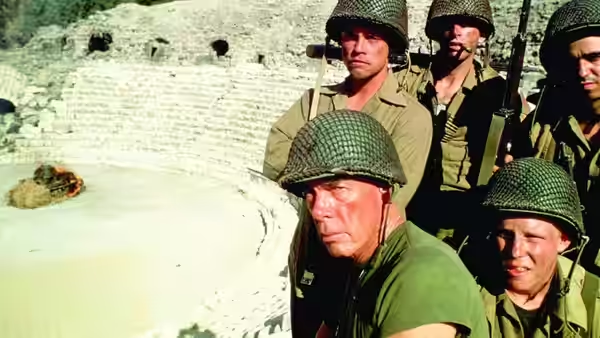
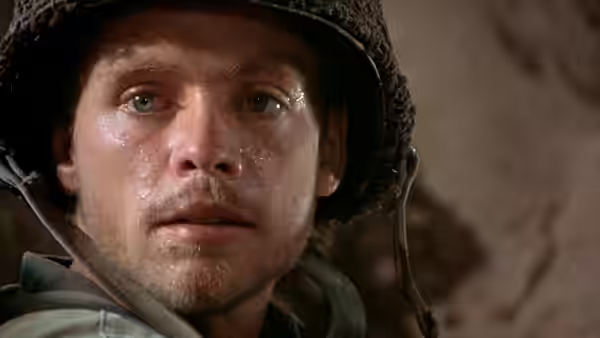
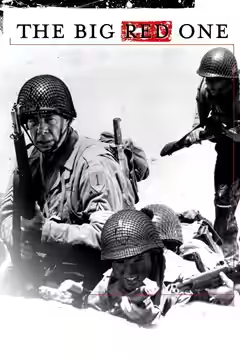
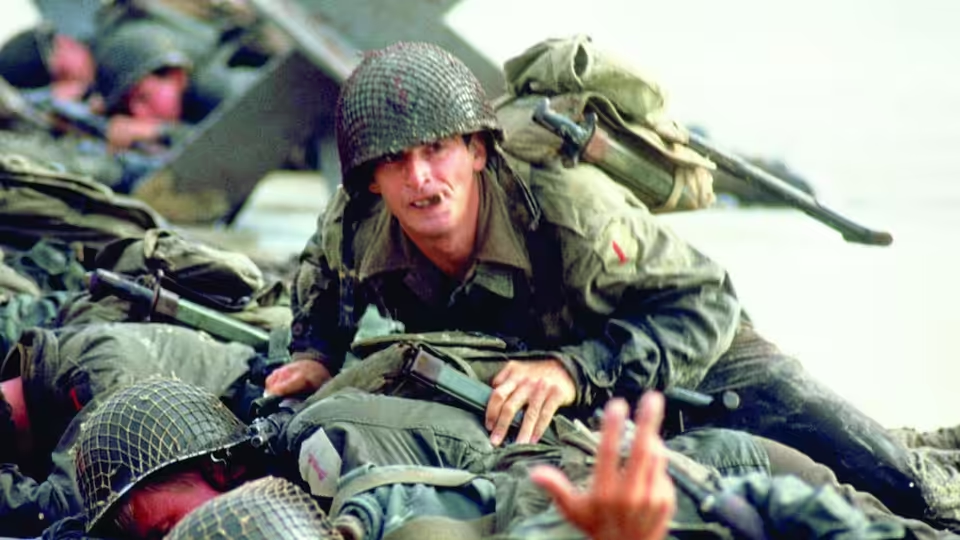
Griff (Mark Hamill) crawls over fallen soldiers with a rifle slung across his back
Film review

The Big Red One

1980 · Directed by Samuel Fuller · 1h 53m

In a sentenceFive men walk from North Africa to the end of the war and refuse to learn the new boys’ names

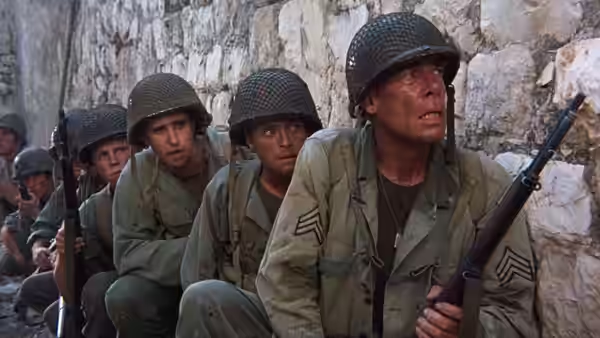
In 1918, a lone American infantryman bayonets a German who is walking towards him with his hands raised, then learns the war ended four hours earlier. Twenty-four years on that soldier is the Sergeant (Lee Marvin), and he is wading ashore in North Africa with a squad of the 1st Infantry Division. Among his riflemen are Zab (Robert Carradine), a cigar-chewing would-be novelist who narrates, Griff (Mark Hamill), the best shot in the platoon and the one man who cannot fire at a face, Vinci (Bobby Di Cicco) and Johnson (Kelly Ward). The Vichy French on the beach may fire or may not. Replacements arrive, die, and the four survivors agree not to learn their names. A German sergeant, Schroeder (Siegfried Rauch), is fighting the same war from the other side.

Plays from YouTube when you press play; nothing loads from them until then.

Fi1m review

Samuel Fuller’s account of the infantry war he fought himself is blunt, cheap in places and unsentimental to the bone, with Lee Marvin at its centre doing almost nothing and doing it perfectly. The younger men are types, and the money shows. It still lands.

Samuel Fuller served as a rifleman with the 1st Infantry Division in the Second World War, and he spent the decades afterwards trying to get its story on to a screen. The Big Red One is what he got: a sergeant and four riflemen followed from a beach in North Africa in 1942 to the last days of the war in Europe, in episodes joined by a title card and a map. It is told by a man who was there and did not think it needed dressing up. We think it is one of the best American films about that war, and we also think a newcomer may spend the first twenty minutes wondering what the fuss is about.

The opening sets the tone. In 1918 a soldier bayonets a German who is walking towards him with his hands up, then learns the war has been over for four hours. The soldier is the Sergeant, played by Lee Marvin, and the film never gives him a name. By 1942 he is leading a squad that includes Zab (Robert Carradine), who chews cigars and narrates the film as if dictating the novel he means to write, Griff (Mark Hamill), the best shot among them and the one who cannot pull the trigger on a man he can see, Vinci (Bobby Di Cicco) and Johnson (Kelly Ward). Replacements turn up, die and are forgotten. The four of them agree not to learn any more names. It sounds like a hard line. Fuller plays it as housekeeping.

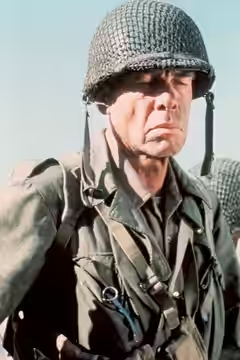
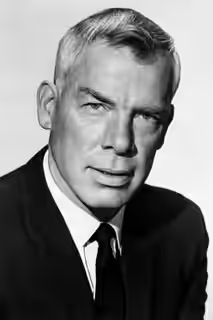
Marvin does not seem to be acting. He walks slightly stooped, speaks in a flat murmur, and when he does something kind he does it exactly as he does something brutal, without changing his face. The scene we did not expect is the one where the squad delivers a baby inside a tank, and the Sergeant, having pulled rubber over his fingers, talks a frightened woman through it in a language she does not speak. We laughed at the set-up and then the child cried and we were nearer to tears than we were ready to be, because Marvin never once lets the moment know it is moving.

Adam Greenberg shoots the desert in hard white light with almost no shadow, so that men stand out against it like targets, which is the point. On the Normandy beach he keeps the camera down in the surf, at the height of a man lying in it. The famous image there is a dead soldier’s wristwatch, returned to by editor Morton Tubor as the water rises and reddens around it. We were horrified by that watch, more than by any of the bodies, and it costs nothing; there is no wide shot of the landing because Fuller could not afford one and did not need one. Dana Kaproff’s score has the good sense to sit out the fighting.

The flaws are plain. The four young men are types more than people, and Hamill, who is given the only real arc, plays it with care while the writing does most of the work. Vinci and Johnson are barely there. Zab’s voice-over has a habit of telling us what a scene has just shown. Siegfried Rauch’s Schroeder, a German sergeant who keeps reappearing as the Sergeant’s mirror, is the one device that feels written rather than remembered.

Against that, Stéphane Audran turns up as a Walloon woman for a single sequence that is as strange as anything Fuller ever shot, and the second half arrives somewhere we will not describe. The version that reached cinemas in 1980 runs 113 minutes and was cut down against Fuller’s wishes; a longer reconstruction was assembled after his death, and several critics prefer it. We think the short one already says what it means.

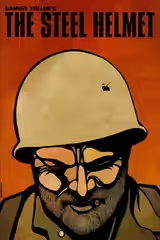
Fuller made The Steel Helmet thirty years earlier, and it is the leaner film. This one is the fuller account, and the one he wanted made. Watch it with the sound up and no phone to hand. It is a 15 certificate, and the deaths in it are quick, frequent and given no music at all.
Critical consensus AI synthesised

84
Positive
8
Mixed
1
Negative
0
Slant Magazine
28 September 2004 · ★★★★/4 · Nick Schager
100

Schager praises Fuller’s unsentimental, episodic portrayal of war as absurd, cruel, and inescapable. He singles out the film’s visceral combat sequences and its compassionate focus on soldiers and children caught in the violence.

Read the full review →
Variety
31 December 1979 · Variety Staff
90*

The critic calls it a terrific, powerfully intimate war story that also achieves great scope. They praise its fast-paced telling of the European land war through the eyes of five foot soldiers.

Read the full review →
Empire
1 January 2000 · Angie Errigo
88*

Errigo gives the film a strongly positive verdict, calling it a great and unusually immediate war film. She singles out Fuller’s intimate, unsentimental depiction of combat and the soldiers’ lived experience.

Read the full review →
Los Angeles Times
21 January 2005 · Kevin Crust
85*

Crust finds the restored cut elevates the film into a compelling epic. He especially praises Lee Marvin’s performance and the film’s tense, carefully staged action.

Read the full review →
RogerEbert.com
· Roger Ebert
85*

Ebert’s Great Movies feature treats the film as a powerful, unsentimental account of war. It especially values Fuller’s humane perspective on the soldiers’ experiences.

Read the full review →
The Guardian
29 April 2005 · Peter Bradshaw
85*

Bradshaw argues that the film’s brash, expressionistic vision makes a strong case for its status as a crazy masterpiece. He praises its superbly contrived images and ingenuous passion for conveying the madness of war.

Read the full review →

Straight answers AI written, from our review

Is The Big Red One worth watching?
The Big Red One is worth watching for anyone who wants a war film told plainly by a man who fought in it, and we scored it 82. Lee Marvin's Sergeant is the reason to see it; the younger riflemen are types, and the low budget shows in places. Give the first twenty minutes time to settle.
How long is The Big Red One, and what is it rated?
The Big Red One runs 1h 53m. It is a drama and war film.
Where can I watch The Big Red One in Switzerland?
The Big Red One is not on any streaming or rental service in Switzerland at the moment. It is available in 23 other countries; change your country at the top of the page to see where. Availability is checked daily.
How violent or frightening is The Big Red One, and is it suitable for children?
The Big Red One is a 15 certificate in the UK, and the deaths in it are quick, frequent and given no music at all. It is not frightening in a horror sense, but there is a Normandy landing shot from the surf and a dead soldier's watch that horrified us more than any body. Not for children; older teenagers should cope.

How does The Big Red One compare to Come and See?
The Big Red One is the drier and more bearable of the two; Come and See is the hardest war film we know. Fuller follows American infantrymen with a flat, unsentimental humour, while Klimov follows a Belarusian boy through terror with punishing sound. Klimov's is the greater film; Fuller's is the one you can watch twice.
What should I watch after The Big Red One?
After The Big Red One, try Come and See (1985, Fi1m 92): A Soviet boy walks through Belarus in 1943; the hardest war film we know. Then The Ascent (1977, Fi1m 88): Two Soviet partisans in the snow; Larisa Shepitko’s film is quiet and merciless.

Cast

If you liked this, try…

  1. The Steel Helmet (1951) · not on Fi1m yetFuller’s Korean War film, shot in days, meaner and faster than this one.

  2. Come and See (1985, Fi1m 92)A Soviet boy walks through Belarus in 1943; the hardest war film we know.

  3. Cross of Iron (1977) · not on Fi1m yetPeckinpah on the Eastern Front, with James Coburn as another sergeant who trusts nobody.

  4. A Walk in the Sun (1945) · not on Fi1m yetOne platoon, one morning in Italy, and the talk between the shooting.

  5. The Ascent (1977, Fi1m 88)Two Soviet partisans in the snow; Larisa Shepitko’s film is quiet and merciless.