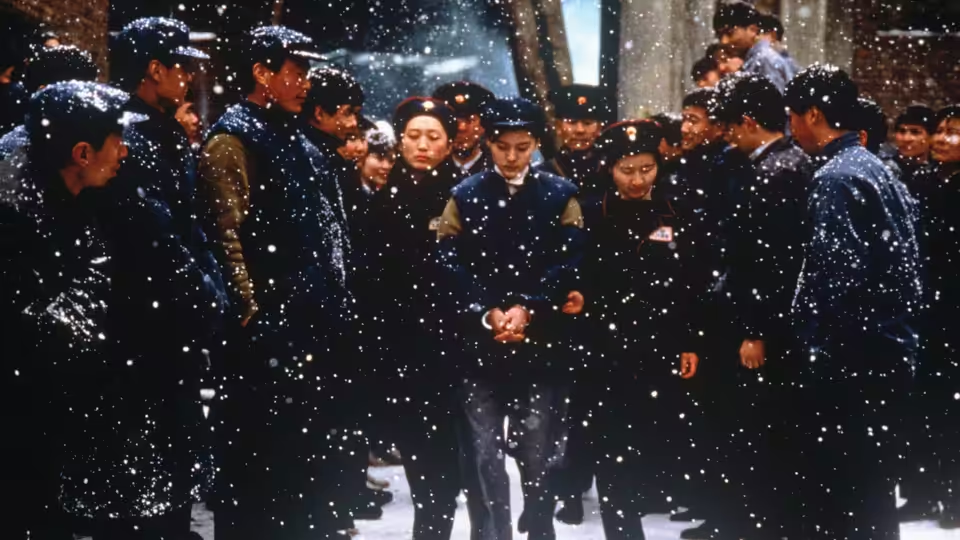
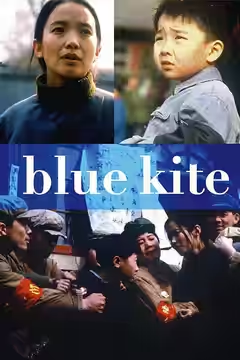
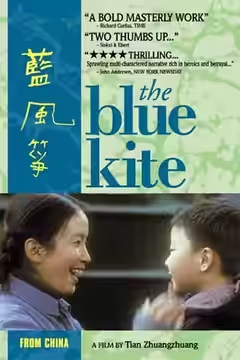
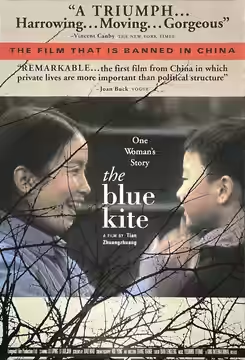
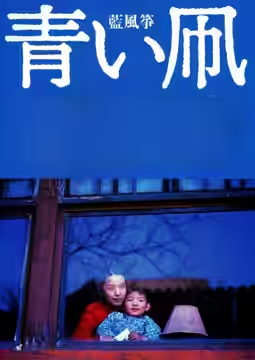
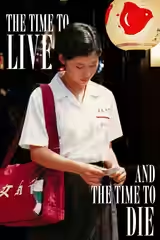
Tian Zhuangzhuang’s family drama earns its emotional force through attention to ordinary people. Its patient approach can feel protracted, but the intimate scenes give political upheaval a troubling human scale.
The Blue Kite asks us to spend time with people whose lives are being shaped by political upheaval, and to care about them individually. Tian Zhuangzhuang’s approach is patient, naturalistic and concerned with family life. We recommend it, with a warning that its 141 minutes require more sustained attention than its quiet manner might initially suggest. The intimate encounters are its strongest reason for taking that time: they give us people to think about rather than merely a historical situation to understand.
Tietou provides the film with a child’s perspective, with Tian Yi, Wenyao Zhang and Xiaoman Chen credited across his infancy, childhood and teenage years. That span invites us to consider how differently adults can appear as a child acquires the words to question them. The family scenes moved us because ordinary closeness remains important even when political circumstances threaten to dominate everything we see. There is something distressing about watching people who still need to get along with one another when the demands upon them are already difficult enough.
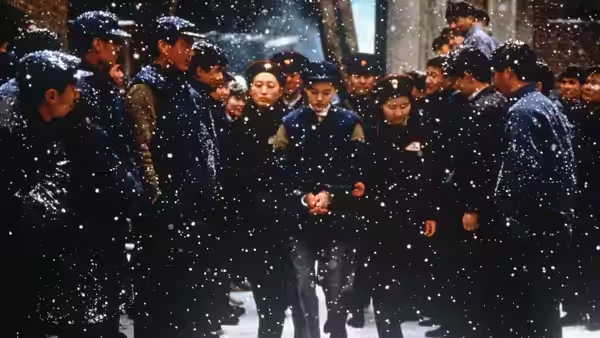
Lü Liping plays Chen Shujuan, Pu Cunxin plays Lin Shaolong and Li Xuejian plays Uncle Li. The naturalistic approach gives these adult figures room to matter without requiring every encounter to announce its historical importance. We value that restraint, particularly in a drama where it would be easy to turn each person into an example of suffering. The family material holds our attention most firmly when we are thinking about the people together, rather than looking beyond them for the film’s larger meaning.
Hou Yong’s cinematography is important to that intimacy. Its sensitivity to the people gives the family encounters their weight, and the photography works best as an invitation to look closely rather than to admire an image separately. Lengleng Qian is credited with the editing and Yoshihide Otomo with the music; neither credit, by itself, explains why the drama affects us. What matters most here is the attention paid to human behaviour, and the willingness to allow quieter material a substantial place in the film.
That patience is also our reservation. At 141 minutes, the film asks us to remain attentive to a restrained dramatic approach for a considerable stretch, and we found that concentration harder to sustain than the strongest family scenes warranted. Cui Jiajun’s writing has an important task in keeping individual lives prominent within a story of political upheaval. The intimate material is persuasive enough that we sometimes wanted a firmer pace around it, without losing the time needed to understand the people.
As a family drama, it offers a serious alternative to the kind of historical storytelling that keeps interrupting its characters to explain their significance. Its warmth towards ordinary people makes the political circumstances troubling without requiring us to admire the film’s seriousness at every moment. This is a considered recommendation rather than an unqualified one. Give it an evening when there is time to pay attention, and no expectation that a quiet family film will necessarily be a comfortable one.