Chantal Akerman’s The Captive is a rewarding, sometimes wearying study of jealousy, strongest in its carefully staged bathing scene. The patience pays off, though the repeated conversations test it.
Chantal Akerman’s The Captive makes a demanding but worthwhile evening of jealousy. The adaptation of Marcel Proust examines the desire to possess another person without making that desire attractive. There is suspense here, although anyone expecting conversations to produce brisk answers will need to adjust. At 119 minutes, the film gives its exchanges and everyday routines enough time to become uncomfortable, sometimes longer than they need.
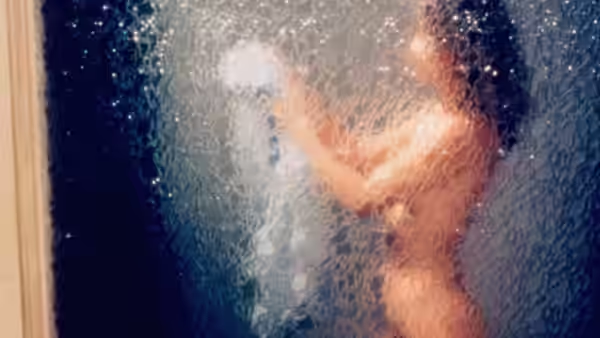
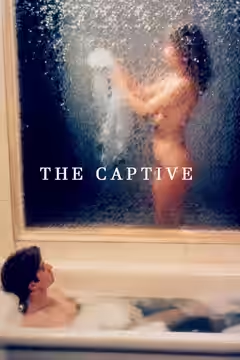
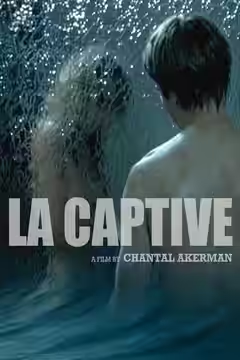
Sabine Lancelin’s cinematography is particularly effective in the bathing scene, where a glass screen makes it difficult to forget the distance between these people. We were unsettled by it: the erotic charge remains, but being near someone offers no guarantee of knowing them. Christian Marti’s production design gives that discomfort a solid, ordinary object, without requiring dialogue to explain its significance. The patient framing lets us examine the arrangement, and there is more to find there than in another conversation about the relationship.
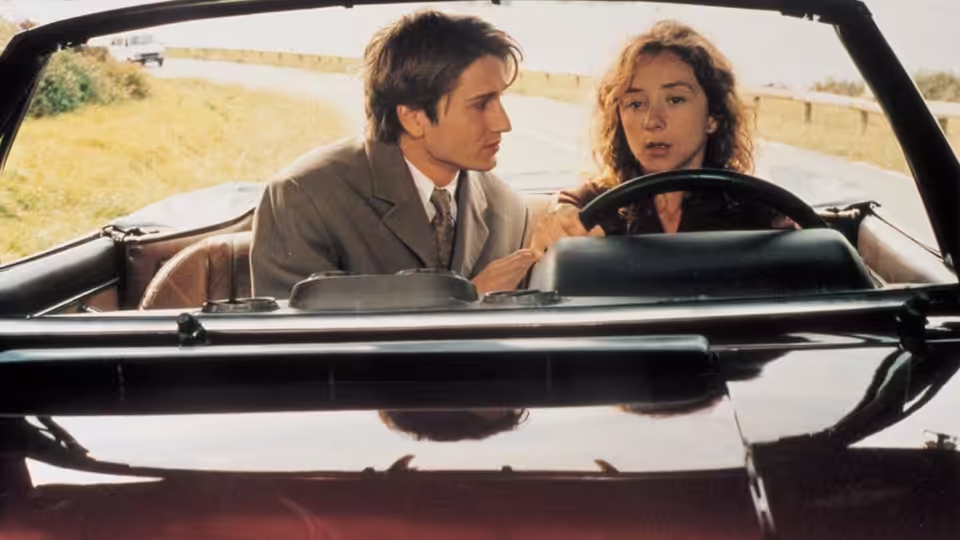
Sylvie Testud and Stanislas Merhar are persuasive within these narrow limits. The reserve of their performances suits a film suspicious of easy access to another person’s feelings, though it can make the relationship difficult to care about. Much consequently depends on how they are placed and photographed, and on our willingness to keep watching people who offer little reassurance. Their physical nearness can be uncomfortable, but there are passages when they seem too remote to warrant quite so much attention.
The screenplay, written by Chantal Akerman and Eric de Kuyper, is less consistently effective. Its repeated exchanges establish how little reassurance conversation can provide, then continue after we have understood the difficulty. Repetition has a purpose in a story about possessiveness: a satisfactory answer cannot remain satisfactory for long. Even so, we occasionally wanted a conversation to stop because it had exhausted its interest, and the film’s solemnity leaves little room for relief. The writing trusts us to tolerate more repetition than it needs.
Claire Atherton’s editing allows the long takes to exert their pressure without offering much escape through a change of shot. That patience helps us notice how closely we are looking, and how uncomfortable such scrutiny can become. It also contributes to the stretches that continue after we have understood all they seem likely to tell us. The attention begins to wander, which is a particular loss in a film whose carefully composed frames give us good reasons to attend to small differences.
Most critics disagree with us about how much this restraint achieves. The complaint that the film is too solemn has force, especially when conversation repeats itself, but calling it lifeless overlooks the unease of the bathing scene. We find a disturbing relationship worth watching here, even when it is difficult to warm to the people involved. Anyone approaching it as a romance should expect the wish to possess someone to occupy considerably more space than the pleasure of being with them.
We would keep this for an evening when patience is available and reassurance is not required. An interest in the less comfortable parts of romance helps considerably. If repeated, unresolved conversation usually sends a hand towards the remote, take the warning seriously.