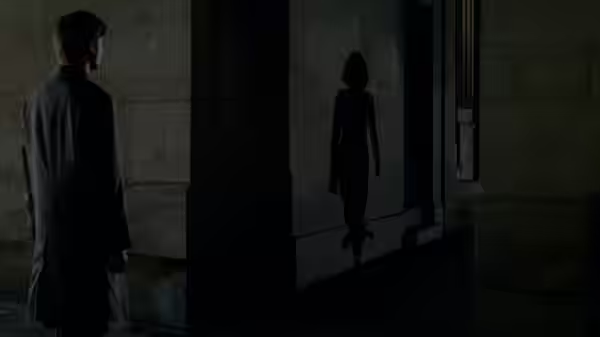
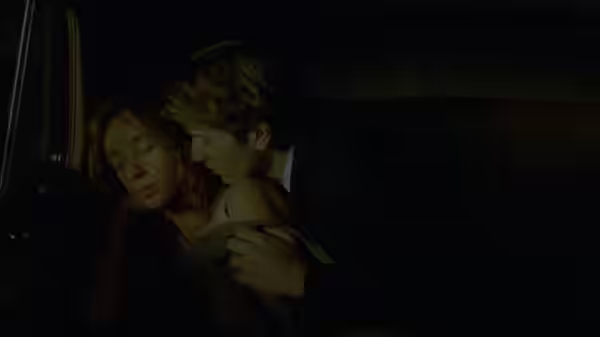
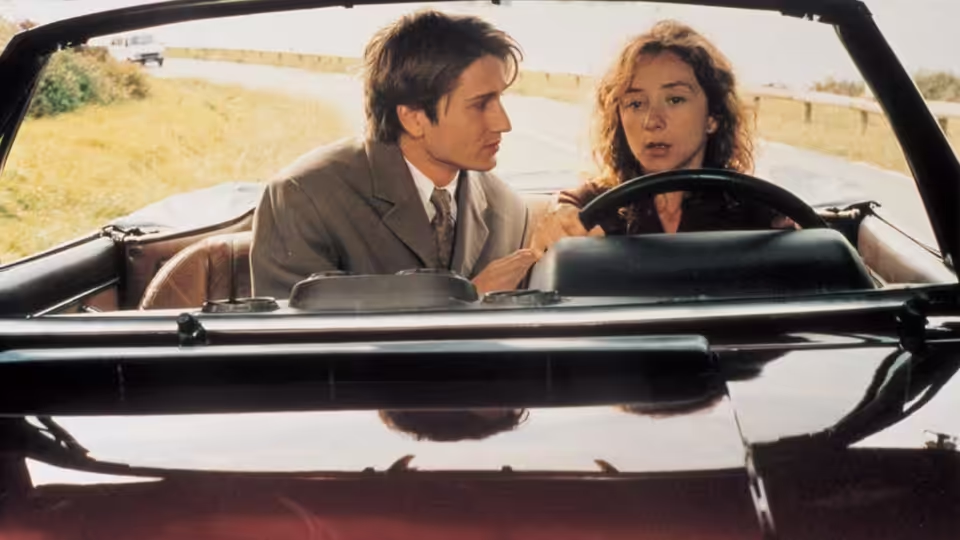
Simon (Stanislas Merhar) leans toward Ariane (Sylvie Testud) as she sits behind the wheel of a convertible
Film review

The Captive

2000 · Directed by Chantal Akerman · 1h 59m

In a sentenceA romance where a glass screen does more explaining than the dialogue

Ariane (Sylvie Testud), Simon (Stanislas Merhar) and Andrée (Olivia Bonamy) feature in a story of desire, jealousy and the urge to possess another person. Ordinary routines and repeated conversations become occasions to examine a relationship in which proximity offers little reassurance. The wish to know someone completely leaves little room for trust, and passion becomes difficult to distinguish from control. Around the central figures are Françoise, the maid (Liliane Rovère), and Léa, the actress (Aurore Clément). Chantal Akerman directs this adaptation of Marcel Proust.

Fi1m review

Chantal Akerman’s The Captive is a rewarding, sometimes wearying study of jealousy, strongest in its carefully staged bathing scene. The patience pays off, though the repeated conversations test it.

Chantal Akerman’s The Captive makes a demanding but worthwhile evening of jealousy. The adaptation of Marcel Proust examines the desire to possess another person without making that desire attractive. There is suspense here, although anyone expecting conversations to produce brisk answers will need to adjust. At 119 minutes, the film gives its exchanges and everyday routines enough time to become uncomfortable, sometimes longer than they need.

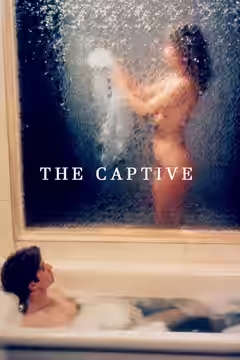
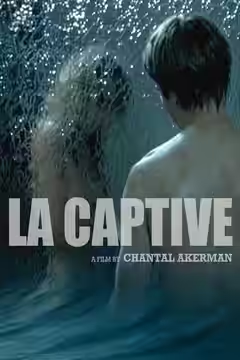
Sabine Lancelin’s cinematography is particularly effective in the bathing scene, where a glass screen makes it difficult to forget the distance between these people. We were unsettled by it: the erotic charge remains, but being near someone offers no guarantee of knowing them. Christian Marti’s production design gives that discomfort a solid, ordinary object, without requiring dialogue to explain its significance. The patient framing lets us examine the arrangement, and there is more to find there than in another conversation about the relationship.

Sylvie Testud and Stanislas Merhar are persuasive within these narrow limits. The reserve of their performances suits a film suspicious of easy access to another person’s feelings, though it can make the relationship difficult to care about. Much consequently depends on how they are placed and photographed, and on our willingness to keep watching people who offer little reassurance. Their physical nearness can be uncomfortable, but there are passages when they seem too remote to warrant quite so much attention.

The screenplay, written by Chantal Akerman and Eric de Kuyper, is less consistently effective. Its repeated exchanges establish how little reassurance conversation can provide, then continue after we have understood the difficulty. Repetition has a purpose in a story about possessiveness: a satisfactory answer cannot remain satisfactory for long. Even so, we occasionally wanted a conversation to stop because it had exhausted its interest, and the film’s solemnity leaves little room for relief. The writing trusts us to tolerate more repetition than it needs.

Claire Atherton’s editing allows the long takes to exert their pressure without offering much escape through a change of shot. That patience helps us notice how closely we are looking, and how uncomfortable such scrutiny can become. It also contributes to the stretches that continue after we have understood all they seem likely to tell us. The attention begins to wander, which is a particular loss in a film whose carefully composed frames give us good reasons to attend to small differences.

Most critics disagree with us about how much this restraint achieves. The complaint that the film is too solemn has force, especially when conversation repeats itself, but calling it lifeless overlooks the unease of the bathing scene. We find a disturbing relationship worth watching here, even when it is difficult to warm to the people involved. Anyone approaching it as a romance should expect the wish to possess someone to occupy considerably more space than the pleasure of being with them.

We would keep this for an evening when patience is available and reassurance is not required. An interest in the less comfortable parts of romance helps considerably. If repeated, unresolved conversation usually sends a hand towards the remote, take the warning seriously.

Critical consensus AI synthesised

54
Positive
3
Mixed
2
Negative
4

The reviews are sharply divided on Akerman’s Proust adaptation, with praise centred on her controlled visual style and treatment of passion and possession. Admirers find the patient camera movements and carefully composed frames compelling, while even some sceptics acknowledge the precision of individual scenes. The New Yorker sees a distinctive cinematic melodrama, finding suspense in its scenes and a productive connection to Hitchcock and Godard.

The main disagreement is over whether that formal control makes the relationship absorbing or keeps it remote. Several critics find the solemn staging emotionally distancing, with long takes and meticulous compositions suppressing the story’s fascination. Variety offers one of the strongest objections, arguing that repetitive dialogue and an uneventful narrative overwhelm the insights into possessiveness. The spread is wide: what supporters value as patient and strange, detractors find dull or lifeless, leaving little agreement about the film’s emotional force.

IndieWire
8 March 2006 · twhalliii
90*

The writer calls the film amazing and strongly admires Akerman’s distinctive, patient style. They particularly praise her camera movement and carefully composed frames.

Read the full review →
The New Yorker
13 July 2010 · Richard Brody
80*

Brody gives the film a strongly positive assessment, praising Akerman’s transformation of Proust into a distinctive cinematic melodrama. He singles out its suspenseful scenes and modernist dialogue with Hitchcock and Godard.

Read the full review →
Time Out
· GA
75*

The review says Akerman is back in top form with a strange but compelling adaptation of Proust. It singles out the film’s compelling take on the novel, set in just-about-modern-day Paris.

Read the full review →
Screen Daily
27 October 2000 · Benny Crick
64*

The available page identifies this as a review, but its critical verdict is not visible. The review’s specific praise or complaint cannot be determined from the accessible text.

Read the full review →
Radio Times
★★★ · David Parkinson
60

Parkinson finds the adaptation intriguing as a study of passion and possession, but says its solemn staging makes it hard to engage with. He praises Akerman’s controlled visual style while arguing that it distances viewers from the disturbing story.

Read the full review →
Empire
1 January 2000 · Bob McCabe
40*

McCabe finds the film’s investigation of passion intriguing but says its solemnity ultimately suppresses its fascination. He singles out the distancing effect of its long takes and meticulous compositions.

Read the full review →

Straight answers AI written, from our review

Is The Captive worth watching?
The Captive is worth watching for patient viewers interested in the uncomfortable side of romance, and we score it 72 out of 100. We find its carefully staged bathing scene unsettling, but the repeated conversations and emotionally remote characters make this a demanding evening rather than an inviting one.
How long is The Captive, and what is it rated?
The Captive runs 1h 59m. It is a drama and romance film.
Where can I watch The Captive in Poland?
The Captive is not on any streaming or rental service in Poland at the moment. It is available in 1 other country; change your country at the top of the page to see where. Availability is checked daily.
How does The Captive compare to Vertigo?
The Captive is a more emotionally remote study of possessive love than Vertigo, which we recommend more warmly for the painful conviction of its central performances. Both make a man’s confusion of control with love uncomfortable, but Akerman relies on everyday routines and repeated conversations where Hitchcock offers a detective’s fascination and a far-fetched mystery.
Is The Captive based on a true story or a book?
The Captive is adapted from a novel by Marcel Proust, rather than based on a true story. Chantal Akerman and Eric de Kuyper write the screenplay, concentrating on jealousy, possessiveness and the limits of knowing another person. We find those concerns clear without prior reading, though the repeated conversations require patience.
What should I watch after The Captive?
After The Captive, try Vertigo (1958, Fi1m 92): Another troubling study of a man mistaking control for love. Then In the Mood for Love (2000, Fi1m 91): Rooms, corridors and withheld feelings reward the same attention to small details.

Cast

Awards

European Film Award for Best Actress, 2000

Nominated
European Film Award for Best Actress

If you liked this, try…

  1. Vertigo (1958, Fi1m 92)Another troubling study of a man mistaking control for love.

  2. La Belle Noiseuse (1991) · not on Fi1m yetPatient observation makes an artist’s scrutiny of a woman increasingly uncomfortable.

  3. The Headless Woman (2008) · not on Fi1m yetCareful framing makes ordinary rooms and conversations difficult to trust.

  4. In the Mood for Love (2000, Fi1m 91)Rooms, corridors and withheld feelings reward the same attention to small details.

  5. The Servant (1963) · not on Fi1m yetA domestic interior becomes the setting for an unsettling struggle over power.