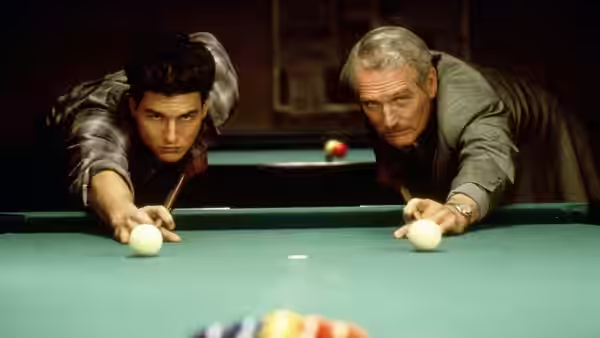
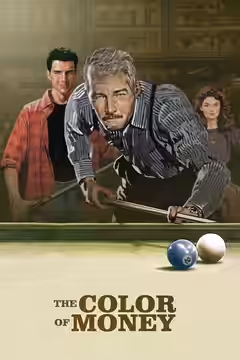
Vincent Lauria (Tom Cruise) runs alongside Eddie Felson’s car on a city street at night
Film review

The Color of Money

1986 · Directed by Martin Scorsese · 1h 59m

In a sentenceA pool table is just large enough for two men who need everyone to know how good they are

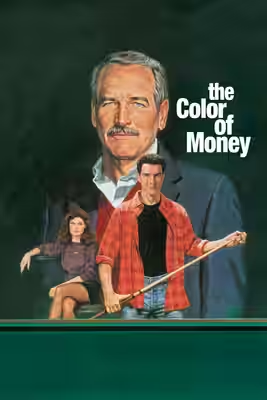
Eddie Felson (Paul Newman) is no longer the hustler he used to be, but he has found a younger talent in Vincent Lauria (Tom Cruise). The pool table brings Eddie’s experience into contact with Vincent’s youthful confidence, with Carmen (Mary Elizabeth Mastrantonio) also in the picture. Eddie wants to make use of an ability he can no longer take for granted in himself. That means dealing with the young man who possesses it, rather than simply admiring his play. The game gives them a common interest without settling what either man wants from the other.

Fi1m review

Paul Newman and Tom Cruise make this pool-hall drama worth the evening. Martin Scorsese gives their rivalry pace and pleasure, although the heavier confrontations ask the actors to sell more than the writing earns.

Eddie Felson is no longer the hustler he was, and Vincent Lauria has the talent to remind him of it. The Color of Money makes an absorbing drama out of that uncomfortable arrangement, with performances worth watching even when the writing presses too hard. Martin Scorsese treats the pool table as a place where people make themselves known. We recommend it, with a reservation about how insistently the later drama tries to give the rivalry extra weight.

Paul Newman is the reason to stay with it. His Eddie makes stillness interesting. He seems to be considering the cost of whatever is happening, including his own interest in this younger player. The performance allows vanity and good judgement to coexist without making a production of either. We were unexpectedly moved by Eddie’s effort to seem untroubled, because the strain is visible in Paul Newman’s watchfulness.

Tom Cruise makes Vincent’s eagerness entertaining without making him especially agreeable. There is a useful strain of childishness in the performance, a desire to be noticed that stops talent from becoming sufficient reason to like him. Mary Elizabeth Mastrantonio gives Carmen enough sharpness to prevent the two men from monopolising our attention. She brings a welcome impatience to material that might otherwise become too pleased with its men and their abilities.

Michael Ballhaus’s cinematography gives the pool the attention it needs: skill is legible, and showing off becomes a pleasure to watch. The table matters because the images persuade us to take an interest in what happens across it. Boris Leven’s production design keeps the pool halls convincing enough to support all that visual attention. These feel like places where a man might reasonably imagine that playing well makes him important to everyone present.

Thelma Schoonmaker’s editing gives the contrasting performances room to work; the film can enjoy Vincent’s eagerness without losing Eddie’s more guarded presence. A less patient approach would make the younger man’s energy exhausting. Robbie Robertson’s music reinforces the swagger, occasionally more insistently than the actors need. The pleasure of the game is already there in the images, and the extra encouragement can feel unnecessary when we are quite content to keep watching.

The weakness is in how much importance Richard Price’s screenplay asks us to place on the competition. Its more emphatic confrontations feel worked up to make sure we grasp what is at stake. That is a frustration rather than a fatal flaw, because these actors are capable of making a modest shift in status matter without much assistance. The film would gain from trusting that ability more consistently, especially when its dramatic ambitions become more pronounced.

For a drama about a game, it is usefully interested in how tiresome talented people can be. Martin Scorsese understands the pleasure of watching someone do something well, and the demands that person can make on everyone watching. The 119 minutes are worth giving it, provided a little forced drama does not spoil the pleasure. Watch it with someone who insists they have nothing left to prove.


Critical consensus AI synthesised

76
Positive
4
Mixed
2
Negative
0

Most critics respond warmly to The Color of Money, with praise clustering around Scorsese’s visual style and the performances. The pool-hall imagery earns particular attention for making the game lively and expressive on screen. Newman and Cruise draw praise for their performances, with Cruise’s youthful energy singled out. The positive reviews also value the film’s close observation, emotional restraint and Richard Price’s script.

The clearest reservations concern how the drama concludes. The Los Angeles Times finds that the ending falters slightly, while Radio Times considers the confrontational climax unconvincing; both remain firmly positive. The recorded scores span 64 to 85, with four positive assessments, two mixed and none negative. That suggests qualified agreement rather than a sharp divide, although the two mixed entries lack accessible review text, so their reasons for holding back cannot be established.

Empire
1 January 2000 · Angie Errigo
85*

Errigo finds the film a lively, emotionally measured follow-up, praising the ease with which Scorsese and Newman handle their work. She also singles out Cruise’s youthful energy and the vivid pool-hall imagery.

Read the full review →
Los Angeles Times
17 October 1986 · SHEILA BENSON
85*

Benson calls the film bold, exhilarating, and nearly perfect, though its ending falters slightly. She especially praises Scorsese’s inventive, electrifying camera work that turns pool into visual art.

Read the full review →
Radio Times
★★★★ · Tom Hutchinson
80

Hutchinson praises the film as a terrific drama, though he finds its confrontational climax unconvincing. He singles out Richard Price’s knockout script and Scorsese’s visual style for praise.

Read the full review →
Variety
31 December 1985 · Variety Staff
80*

The review is strongly positive, describing the film as keenly observed and immaculately crafted. It singles out the exceptional performances by Paul Newman and Tom Cruise, as well as Mary Elizabeth Mastrantonio’s hot, disturbing turn.

Read the full review →
RogerEbert.com
64*

The page appears to be a review of the specified film, but its contents could not be accessed. The critic’s verdict and any specific praise or complaint are unavailable.

Read the full review →
Time Out
· SGr
64*

The page is identified as a review of the matching 1986 film. Its verdict and any specific praise or criticism are unavailable in the supplied text.

Read the full review →

Straight answers AI written, from our review

Is The Color of Money worth watching?
The Color of Money is worth watching for Paul Newman and Tom Cruise’s absorbing pool-hall rivalry, and we score it 80 out of 100. We recommend it to anyone who enjoys character-led drama, with a reservation: the heavier confrontations force the point when the actors’ quieter shifts in confidence already do enough.
How long is The Color of Money, and what is it rated?
The Color of Money runs 1h 59m. It is a drama film.
Where can I watch The Color of Money in New Zealand?
The Color of Money is streaming on Disney+ in New Zealand, and it is also available to buy from Apple TV from NZ$11.99. Availability is checked daily; the links above go straight to each service.
How violent or frightening is The Color of Money, and is it suitable for children?
The Color of Money carries a UK 15 certificate, so it is not suitable for children under 15. That classification is the clearest suitability guide here; we cannot give a more specific warning about violence or frightening scenes from the certificate alone.
How does The Color of Money compare to The Hustler?
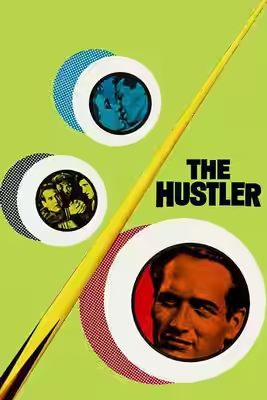
The Color of Money offers more swagger than The Hustler, whose earlier Eddie Felson has more painful self-knowledge. We favour The Hustler for the more searching character drama, though it presses its talk of losing too hard; the later film suits those drawn to the pace and pleasure of Newman and Cruise’s rivalry.
Is The Color of Money based on a true story or a book?
The Color of Money is adapted from a novel by Walter Tevis, rather than presented as a true story. We recommend it as a self-contained drama about an experienced hustler and a younger talent: their uneasy relationship gives newcomers enough to follow without reading the book first.
What should I watch after The Color of Money?
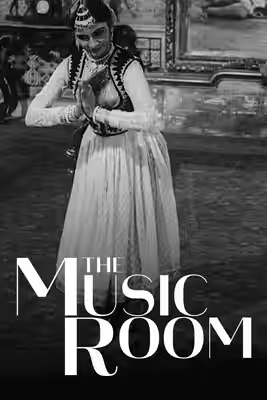
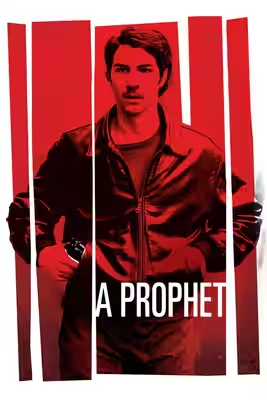
After The Color of Money, try The Hustler (1961, Fi1m 88): An earlier Eddie Felson, with less swagger and more painful self-knowledge. Then The Music Room (1958, Fi1m 88): Pride and performance trouble an ageing man who cannot stop competing; and A Prophet (2009, Fi1m 86): A harsher account of mentorship, where learning quickly becomes a survival skill.

Cast

Awards

Academy Awards, 1987

Nominated
Best Production Design
Nominated
Best Supporting Actress
Nominated
Best Writing, Adapted Screenplay
Won
Best Actor

If you liked this, try…

  1. The Hustler (1961, Fi1m 88)An earlier Eddie Felson, with less swagger and more painful self-knowledge.

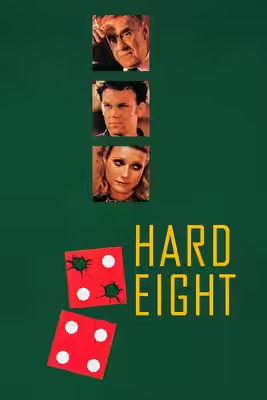
  2. Hard Eight (1996) · not reviewed yetAnother watchful older gambler finds that teaching somebody creates complications.

  3. The Music Room (1958, Fi1m 88)Pride and performance trouble an ageing man who cannot stop competing.

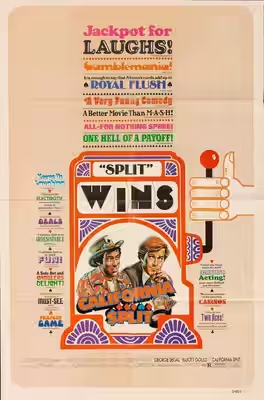
  4. California Split (1974) · not reviewed yetFor the pleasure of watching gamblers enjoy one another’s worst habits.

  5. A Prophet (2009, Fi1m 86)A harsher account of mentorship, where learning quickly becomes a survival skill.

Free account

Know what to watch tonight

Two lists that know where things are streaming, collections you can share, your own score beside ours, and Discover that remembers what you have seen.

  • Want to see, sorted by what is streaming now
  • Seen, with your score out of ten
  • No adverts, ever