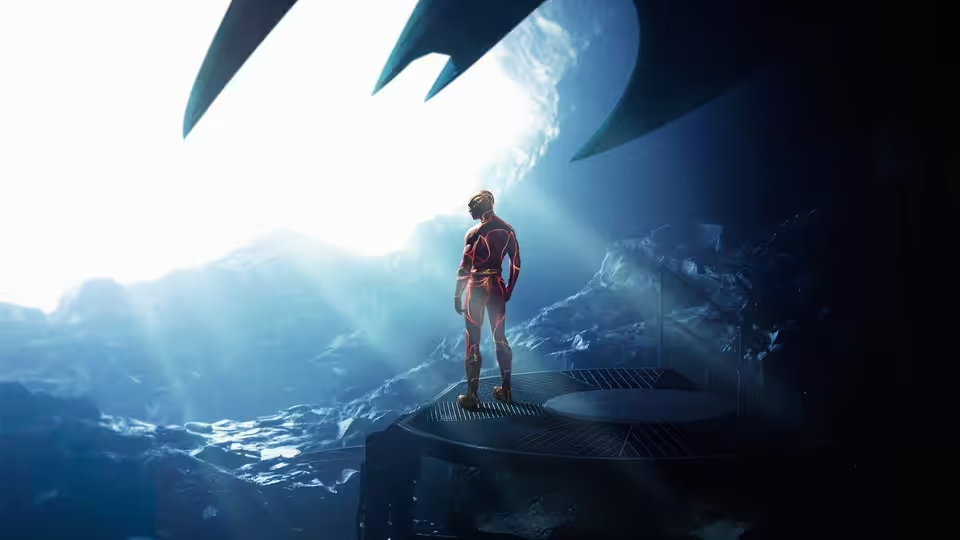
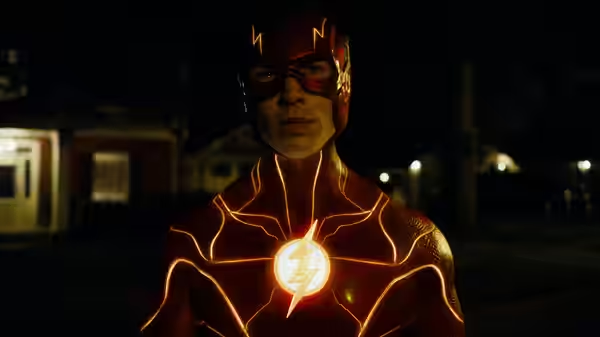
Ezra Miller’s two Barrys and Michael Keaton’s grumpy Bruce Wayne carry a bright, funny first hour about a son who wants his mother back. Then the callbacks and the computer effects arrive together and the film forgets whose story it was telling.
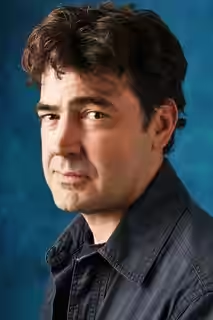
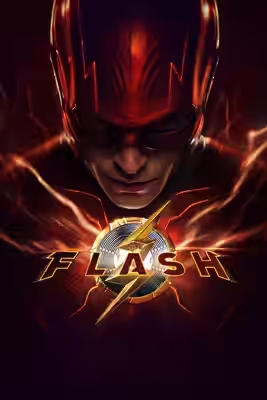
Barry Allen (Ezra Miller) can run faster than time, and Christina Hodson’s screenplay gives him one use for it. His mother Nora (Maribel Verdú) was killed when he was a boy. His father Henry (Ron Livingston) has been in prison for it ever since. Barry goes back to change one small thing and comes home to a second, younger Barry, a Bruce Wayne (Michael Keaton) who put the suit away years ago, no Superman, and General Zod (Michael Shannon) arriving regardless. The first hour of The Flash is a comedy about a man meeting himself. The second keeps stopping to point at things the studio owns, and it is longer.
Miller is the reason the comedy works. The older Barry keeps his hands in his pockets and talks fast to get the talking over with; the younger one sprawls, interrupts, and is delighted by everything, himself included. Paul Machliss and Jason Ballantine cut their scenes like a sitcom, holding on the face that has just been insulted. A sequence in which the older Barry tries to teach the younger one to run, with predictable results for his clothes, is the loosest and funniest thing here.
The scenes with Nora are the film’s quiet centre. A kitchen, a shopping list, a mother who has not yet noticed the time. Verdú plays her plainly, and Miller stops twitching the moment she is on screen. We were moved by the first of these scenes, more than we expected from a film that opens with a collapsing hospital, and the reason is that Benjamin Wallfisch’s score does almost nothing: a few notes, then the kitchen. Livingston, on a prison telephone, is patient and beaten in a way the film around him never quite deserves.
Keaton earns his billing. Paul D. Austerberry’s Wayne Manor is a house in which nobody has opened the curtains for a decade, and Keaton plays a man who has been perfectly happy about that. When he finally puts the suit back on, Alexandra Byrne has kept it heavy and armoured so that he moves like someone who remembers the weight, and Wallfisch quotes the theme from Keaton’s own Batman films. It is nostalgia, plainly, and we would be lying if we said it did not land.
The effects are poor, and the film cannot stop using them. It opens with a hospital wing falling out of the sky while Barry collects the infants dropping from it, and the infants are rendered like shop dolls in a wind tunnel. The space Barry runs through to travel in time is a brown bowl of smeared figures, and Henry Braham’s camera is sent back into it again and again. Zod lands in a flat desert under a grey sky that ends before the horizon does. Shannon gives a slower, sadder version of his Man of Steel performance, and Antje Traue, as Faora-Ul, gets less than that. Sasha Calle has a strong, angry face as Kara Zor-El, and about ten minutes to use it before the fighting begins.
The second half takes turns we will not describe. What we can say is that the story about a son and his mother gets set down, and a different film picks up, built out of things the studio has made or nearly made. The first of these got a laugh from us. By the third we were bored, and by the fifth we were angry, because the film had spent an hour earning our goodwill and was now spending it on a clip show. At 144 minutes there is room for all of it. Andy Muschietti kept a gang of children in focus for the length of It; here he cannot keep hold of two Barrys.
Most critics are split down the middle on this one and so are we. If Miller’s twitchy, likeable Barry is your kind of company, the first hour is an evening’s worth of comedy. The film will not tell you where it stops being about his mother, but you will feel the moment, and after it we would not blame anyone for going to put the kettle on.