Dan Kwan and Daniel Scheinert throw every universe they can think of at a laundrette and a tax audit. Underneath is a film about a mother and daughter, and Michelle Yeoh and Ke Huy Quan keep finding it faster than the directors can bury it.
Dan Kwan and Daniel Scheinert made Swiss Army Man, a film about a farting corpse that turned out to be about loneliness. Everything Everywhere All at Once is the same trick at forty times the scale. Evelyn Wang runs a laundrette, is being audited, and is told in a lift at the tax office that every choice she never made is being lived out by another Evelyn somewhere, and that she can reach across and borrow what those women know. From that the directors build a martial-arts film, a mother-and-daughter story, a comedy about hot-dog fingers and a 140-minute argument about whether anything matters. It is good, and it is twenty minutes too long and too pleased with itself.
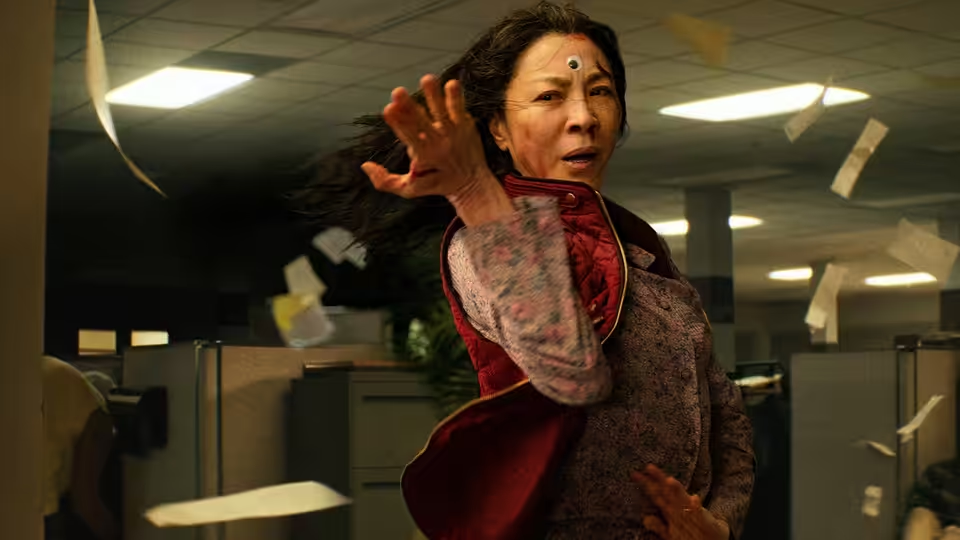
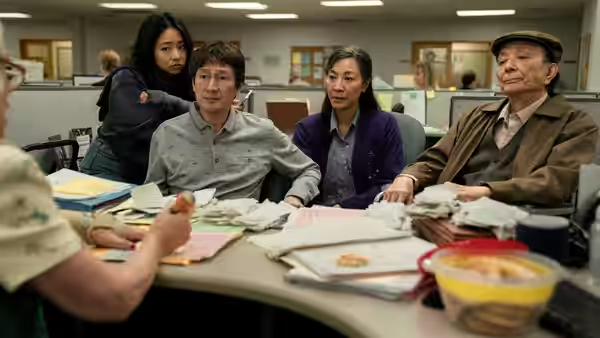
Michelle Yeoh plays Evelyn as a woman who has been interrupted for thirty years. The film asks her to be a shopkeeper, a film star, a chef, a fighter and a woman with sausages where her fingers should be, and she does all of it without visible strain. What surprised us is how good she is doing nothing. The scenes across a desk from Jamie Lee Curtis’s Deirdre Beaubeirdre, a tax inspector with a bad cardigan and a worse mood, are as sharp as anything with a kick in it. Curtis plays her with a slump and a stapler and gets most of the laughs that do not involve a bodily function.
Ke Huy Quan plays Waymond, the husband who sticks googly eyes on the laundry bags and is carrying divorce papers he cannot hand over. Quan plays gentleness as something Waymond has chosen, and the film’s whole case rests on him. There is a speech late on, which we will not quote, about why he is kind. We were not ready for it. Not long before, the film had shown us a fight conducted with a sex toy; then Quan spoke quietly to his wife across a room and we found we had stopped breathing. Stephanie Hsu has the harder double, sullen Joy and Jobu Tupaki, a being in a sequinned Elvis suit who has seen every universe and found them all dull, and she is best when you can see one inside the other. James Hong, as the grandfather Gong Gong, needs about four lines.
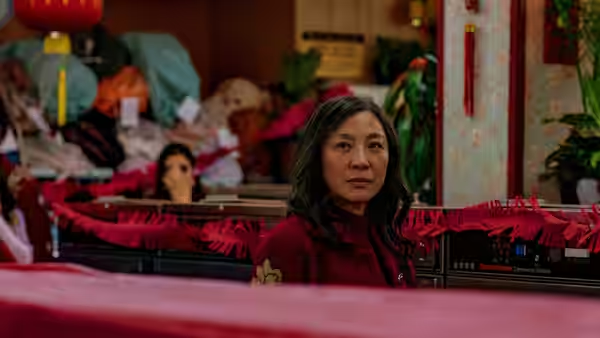
Larkin Seiple lights the laundrette in flat fluorescent and gives every other world its own look: a film-star universe of rain, neon and cigarette smoke; a universe that is nothing but sky and two boulders. Jason Kisvarday’s production design is strongest at the shabby end, in the Wangs’ flat above the shop, where every surface holds a receipt. Shirley Kurata puts Jobu in a new costume every time she appears, each sillier than the last, and the joke holds. The score by Ryan Lott, Rafiq Bhatia and Ian Chang is nervous electronics with a lullaby underneath, and it knows when to shut up.
Paul Rogers cuts the jumps between universes so fast and so cleanly that we always knew where Evelyn was and what she had just borrowed, a real feat. Then the film does it again. And again. Once the rules have been explained they are explained a second time, each fight has roughly the same shape, and the humour visits the lavatory more often than it needs to. We laughed at the hot-dog fingers. By the third or fourth visit to that universe we were aware of the runtime, and by the finale, when the characters say the lesson out loud several times over, we were annoyed on the film’s behalf. Two rocks in a canyon had already said it, in silence, and said it better.
Most critics have been warmer than we are, and a few called it the most inventive science fiction since The Matrix. That film knew when it had finished. This one is still the only recent multiverse picture to treat the idea as more than a licence for cameos, and it would be better at two hours.
See it with someone you have been meaning to talk to properly, and sit through the sausage fingers; the best part is a man with a bum bag asking everyone to be kinder.