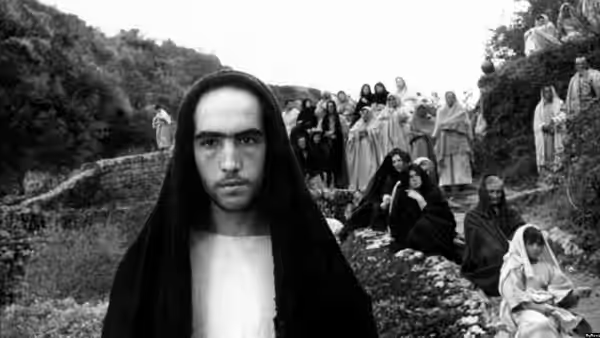
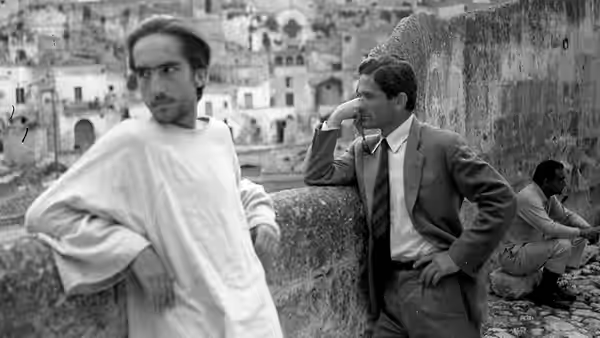
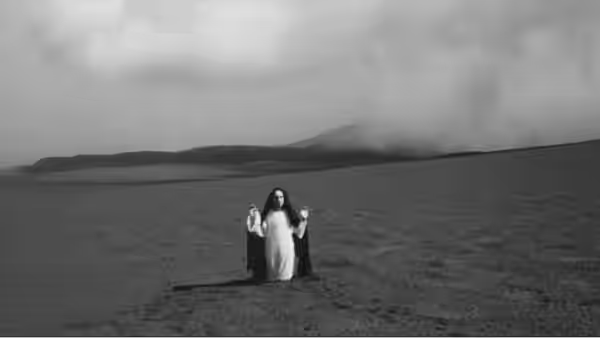
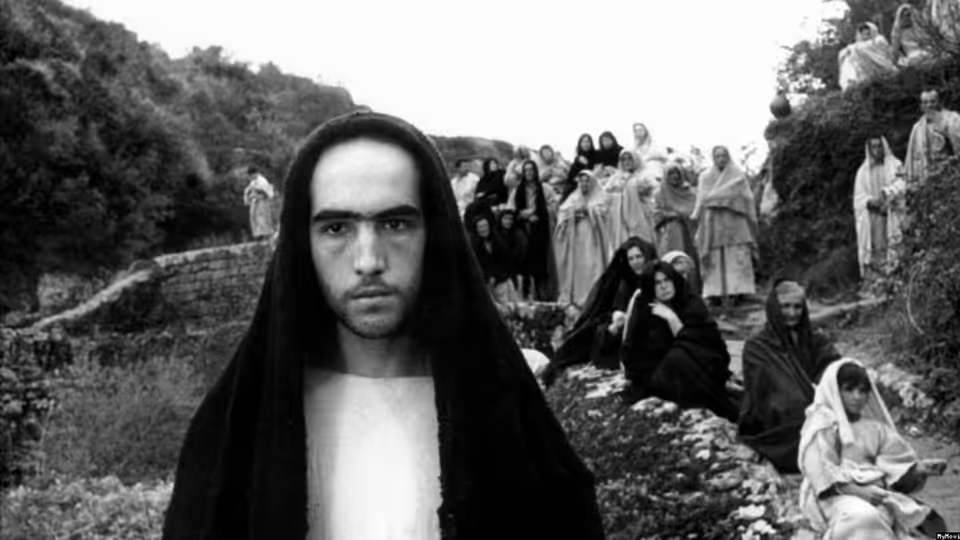
Cristo (Enrique Irazoqui) stands before a crowd gathered on a hillside
Film review

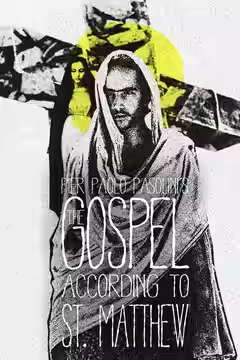
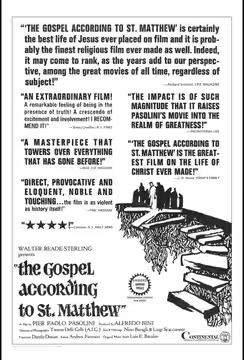
The Gospel According to St. Matthew

1965 · Directed by Pier Paolo Pasolini · 2h 17m

In a sentenceThe Son of God as a furious young man in a black cloak, walking very fast through southern Italy

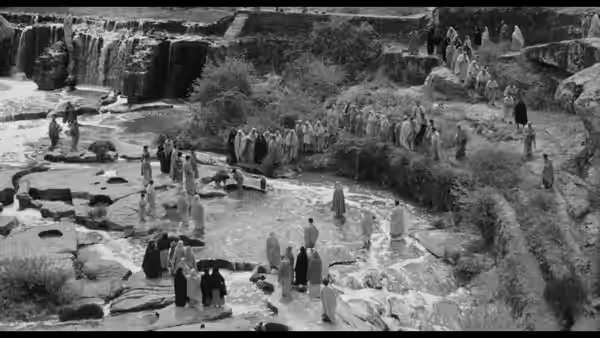
Galilee, under Roman rule, staged in the stone villages of southern Italy. A young woman, Maria (Margherita Caruso), stands pregnant before Giuseppe (Marcello Morante), who says nothing, walks away, and is told in his sleep to keep her. The child is born, wise men arrive with gifts, and Herod orders every infant in the district killed; the family flees to Egypt and returns when it is safe. Years later Giovanni Battista (Mario Socrate) is baptising in the river and telling the Pharisees exactly what he thinks of them. A grown Cristo (Enrique Irazoqui) comes to be baptised, walks into the desert, is tempted, and returns to call fishermen from their nets: Pietro (Settimio Di Porto), Andrea (Alfonso Gatto) and the others. He begins to preach, and the authorities begin to listen.

Plays from YouTube when you press play; nothing loads from them until then.

Fi1m review

Pier Paolo Pasolini films Matthew’s Gospel with no added dialogue, no professional actors and no comfort, and it is still the Jesus film we would show a sceptic. The middle hour is heavy with speeches, but the faces carry it.

Pier Paolo Pasolini was a Marxist and did not believe in God, and in 1965 he made the most convincing film about Jesus we know of. His method was to take the Gospel of Matthew and use nothing else. Every line spoken on screen comes from the text; Pasolini, credited as writer, has cut and arranged, but not invented. He shot in the poor stone towns of southern Italy, Matera among them, and filled the cast with people who had never acted. The result runs 137 minutes and looks like nothing else made about the subject before or since.

The opening tells you what kind of film it will be. Maria (Margherita Caruso), a girl of perhaps sixteen, stands in a doorway, visibly pregnant. Giuseppe (Marcello Morante) looks at her. She looks at him. Nobody speaks, and Tonino Delli Colli simply holds each face in turn until Giuseppe walks off down the road. We were moved before a word had been said, and the reason is that Pasolini has understood the story as something that happens to ordinary, frightened people who do not have the vocabulary for it. The angel, when he comes, is a boy with a haircut, standing in a field.

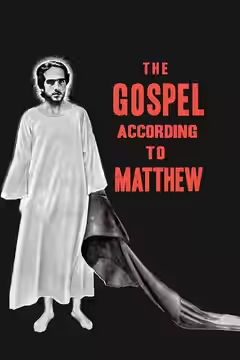
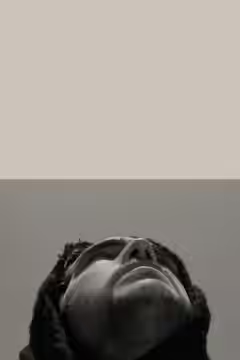
Enrique Irazoqui, a Spanish student when Pasolini cast him, plays Cristo as a thin, dark-browed young man who barely smiles and is nearly always angry. He preaches at a march, half-turned back over his shoulder, so the disciples have to hurry to hear him. The Sermon on the Mount is done as a series of close-ups against changing skies, Nino Baragli cutting from one pronouncement to the next as if they were delivered on different days in different weather, which they may have been. We found it hectoring for a few minutes, and then something turned and we were on his side. This is a Christ who is impatient with the poor being kept poor, and Pasolini plainly loves him for it.

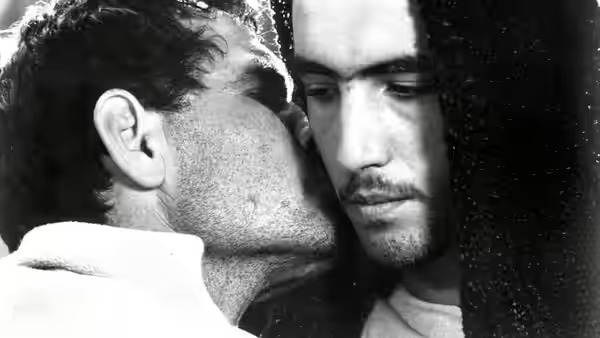
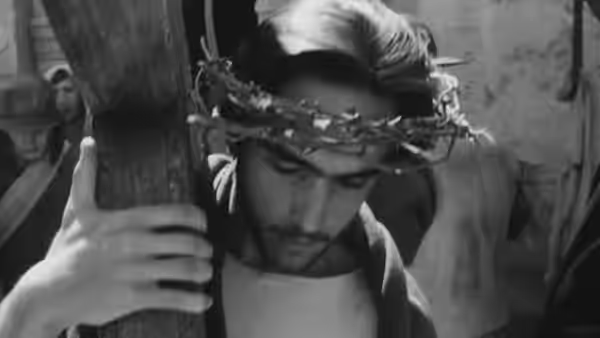
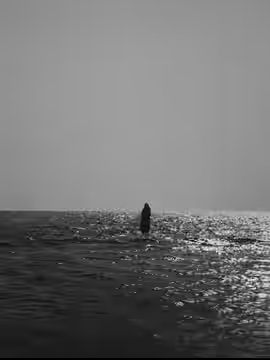
Delli Colli shoots in black and white, mostly with a handheld camera, and he uses long lenses and zooms in a way that was new for the subject and still feels reportorial, as though a newsreel crew had got into first-century Palestine. He photographs faces as landscapes and landscapes as faces: the same lined, weathered surface. Danilo Donati’s costumes and Luigi Scaccianoce’s production design take their shapes from Italian painting, the tall hats of the Pharisees, the soldiers’ odd helmets, without ever looking like a pageant. The crowds are peasants in rough wool, and their skin is the film’s texture.

Luis Bacalov is credited with the music, and the soundtrack is a collision: Bach, Mozart, a Congolese sung mass, an American spiritual, put over shots of a Galilee that is really Basilicata. It ought to be a mess. It is instead the single most persuasive argument the film makes, that this story belongs to no one country and no one century.

It is not flawless. After the disciples are called there is a long stretch that is almost entirely speech, parables and denunciations delivered straight to camera, and Pasolini’s refusal to dramatise means that the film for a while becomes a reading with pictures. The dubbing, standard for Italian cinema of the period, leaves some voices floating a little free of the mouths. The disciples, other than Pietro (Settimio Di Porto), are faces rather than people; we could not have told you which one Filippo (Giorgio Agamben) was without the credits. And Herod’s slaughter of the children, staged early and at a distance in a bare field, is brutal in a way that will surprise anyone expecting a devotional film.

The last act covers the events everyone knows, and we will say only that Pasolini does not linger, and that he gives the older Maria to his own mother, Susanna Pasolini, whose face in those scenes is the thing we carried out of the cinema. Against Hollywood’s Christs of the 1950s and 1960s, with their lighting and their orchestras, this looks like the truth. Against Pasolini’s own later work it is the calmest thing he made, and the one he made with the least contempt.

Watch it in the original Italian with subtitles, and watch it in one sitting. It is a film about a man who does not stop walking, and it should not be paused.
Critical consensus AI synthesised

77
Positive
5
Mixed
0
Negative
0
The Guardian
28 February 2013 · Peter Bradshaw
90*

Bradshaw gives the film a fiercely positive verdict, calling it brilliant and uncompromising. He singles out its stark landscape imagery and politically charged, dreamlike presentation of Jesus.

Read the full review →
Time Out
14 May 2012
80*

The description presents Pasolini’s film as a thoughtful depiction of Jesus’s life. It singles out that thoughtful approach for praise.

Read the full review →
Empire
1 January 2000 · David Parkinson
75*

Parkinson finds that Pasolini’s achievement still impresses decades later. He praises the film’s modern visual style, rooted in devotional art and European cinema.

Read the full review →
RogerEbert.com
· Roger Ebert
72*

This is Roger Ebert’s Great Movies essay on Pasolini’s film. The page could not be accessed, so its verdict and specific praise cannot be verified.

Read the full review →
Sight and Sound
70*

The piece presents the film as a lucid, politically minded work that resists reverential spectacle. It praises Pasolini’s attention to ordinary faces and landscapes, alongside the spare realism and exalted soundtrack.

Read the full review →

Straight answers AI written, from our review

Is The Gospel According to St. Matthew worth watching?
The Gospel According to St. Matthew is worth watching for anyone curious about the story of Jesus, believer or sceptic, and we scored it 88. Pasolini uses only Matthew's words, non-professional actors and the stone villages of southern Italy, and the faces carry it. The middle hour is heavy with speeches delivered straight to camera, so it asks for patience and one uninterrupted sitting.
How long is The Gospel According to St. Matthew, and what is it rated?
The Gospel According to St. Matthew runs 2h 17m. It is a drama film.
Where can I watch The Gospel According to St. Matthew in Iceland?
The Gospel According to St. Matthew is streaming on Amazon Prime Video in Iceland. Availability is checked daily; the links above go straight to each service.
How does The Gospel According to St. Matthew compare to The Passion of Joan of Arc?
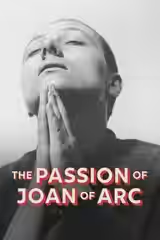
The Gospel According to St. Matthew and The Passion of Joan of Arc both build their films from faces in close-up, and Pasolini's camera is plainly answering Dreyer's. Dreyer's film is the more concentrated and the more punishing, a single trial held tight on Falconetti; Pasolini's is looser, longer and warmer, a story told by peasants under changing skies. We recommend both, Dreyer for intensity, Pasolini for the more forgiving evening.
What should I watch after The Gospel According to St. Matthew?
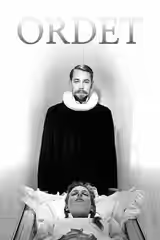
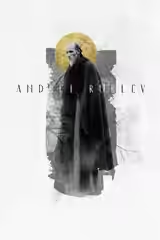
After The Gospel According to St. Matthew, try The Passion of Joan of Arc (1928, Fi1m 94): Dreyer’s faces in close-up; the film Pasolini’s camera is plainly answering. Then Ordet (1955, Fi1m 86): Danish farmhouse faith, slow and severe, with an ending that dares you to doubt; and Andrei Rublev (1966, Fi1m 86): A medieval icon painter, mud, bells and war; belief as hard physical labour.

Cast

Awards

Academy Awards, 1967

Nominated
Best Art Direction, Black and White
Nominated
Best Costume Design, Black-and-White
Nominated
Best Score, Adaptation or Treatment

Grand Jury Prize of the Venice Film Festival, 1964

Won
Grand Jury Prize of the Venice Film Festival

If you liked this, try…

  1. The Passion of Joan of Arc (1928, Fi1m 94)Dreyer’s faces in close-up; the film Pasolini’s camera is plainly answering.

  2. Ordet (1955, Fi1m 86)Danish farmhouse faith, slow and severe, with an ending that dares you to doubt.

  3. Andrei Rublev (1966, Fi1m 86)A medieval icon painter, mud, bells and war; belief as hard physical labour.

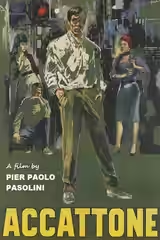
  4. Accattone (1961) · not on Fi1m yetPasolini’s first film: a Roman pimp shot with the same tenderness as a saint.

  5. Jesus of Montreal (1989) · not on Fi1m yetA Passion play in modern Quebec; wry, secular and quietly devastating.