Karim Amer and Jehane Noujaim offer a useful, unsettling introduction to data harvesting. Their documentary is worth considering for its account of lost privacy, but it never properly establishes how much political persuasion the stolen information achieved.
Karim Amer and Jehane Noujaim want us to stop thinking of personal data as harmless scraps of information. The Great Hack follows the Cambridge Analytica scandal with enough clarity to make that change of mind possible. It is a useful, unsettling introduction, though its confidence about political manipulation runs ahead of the evidence it presents. We learn why the collection of our information matters, but the film becomes much less careful when it considers what that information can achieve.
David Carroll gives the film its clearest question: can he obtain his own data? An associate professor at Parsons School of Design, he provides a way into the subject that does not depend on accepting the company’s claims about its influence. We were unsettled by his search, because the film makes asking for information about himself feel like an investigation. Staying close to that request gives the documentary something concrete to pursue, and its explanation of data harvesting is useful.
Brittany Kaiser is a more difficult choice of centre, and that difficulty supplies much of the film’s interest. A former director of business development at Cambridge Analytica, she gives the directors someone whose account cannot be separated from her own involvement. Her conflicted position is absorbing, and the film is right to spend time on it. The trouble comes when attention to her personal standing displaces questions about the company’s methods; too much of the explanation rests on her authority as an insider.
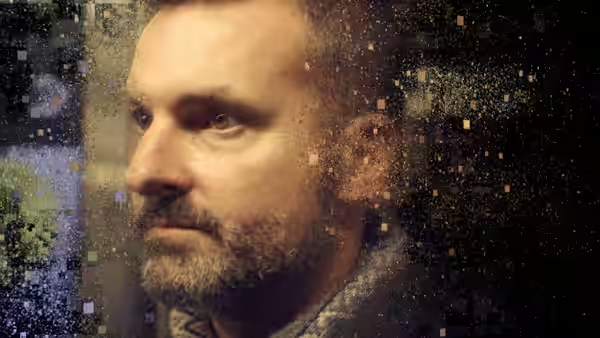
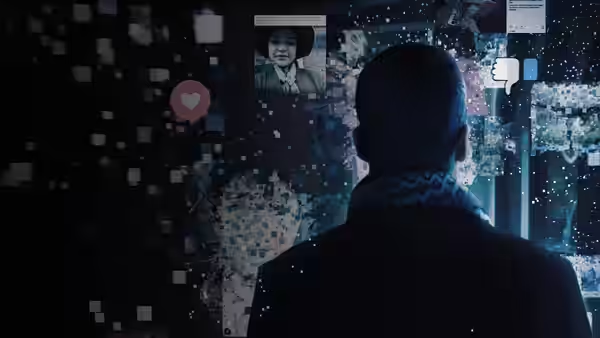
The animated graphics give a visible form to the personal data people leave behind, and this is where the explanation becomes easiest to follow. The photography by Ian Moubayed and Basil Childers has a quieter job, keeping us engaged with the people describing a largely invisible process. With Kaiser, that attention works because her account invites scrutiny as well as interest. But the graphic illustrations sometimes make the methods seem more fully explained than they are.
Editors Carlos Rojas Felice and Erin Barnett move between Carroll’s search, Kaiser’s account and the wider political story, with some strain in the changes of direction. Repeated warnings begin to cost more time than they earn across 114 minutes. Gil Talmi’s music reinforces the urgency, although we would have welcomed less encouragement to be alarmed. There is enough here to hold our attention without insisting quite so often that the stakes are high.
The largest unanswered question is how effectively Cambridge Analytica changed anyone’s mind. Explaining that personal information can be collected and used to target voters does not establish what made those voters choose as they did. The directors give us too little detail about the methods to assess the company’s supposed powers for ourselves. We needed a clearer examination of what would count as evidence of success, and of how much of that evidence actually exists.
An investigative documentary has to be willing to slow down over the evidence, even when the larger story is alarming. Here, the eagerness to convey danger sometimes makes a necessary follow-up question seem like a distraction. There is enough clear explanation to reward an interest in data rights, especially in Carroll’s search. If that is what brings you here, it is worth an evening, provided you keep a little scepticism for the company’s powers of persuasion.