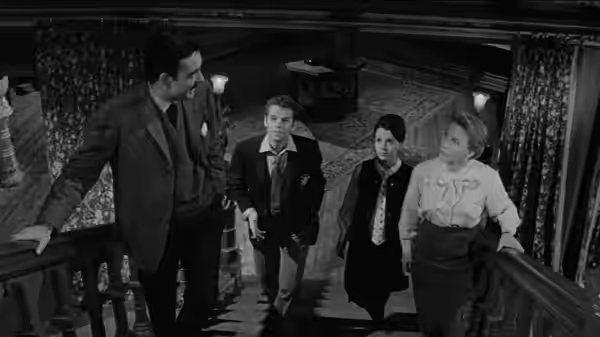
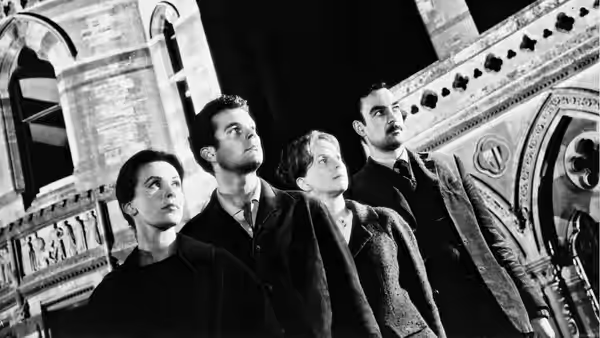
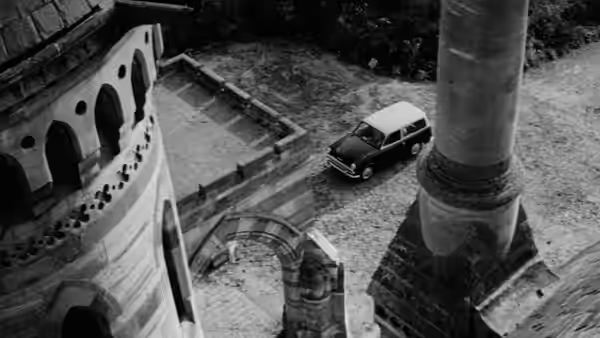
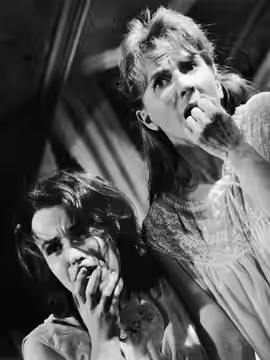
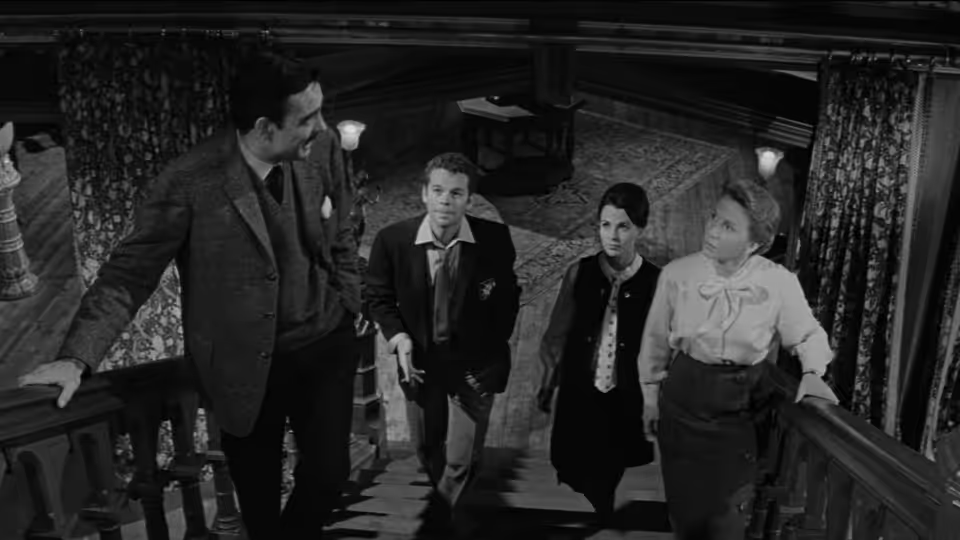
Four visitors climb the staircase inside a dark, ornate mansion
Film review

The Haunting

1963 · Directed by Robert Wise · 1h 52m

In a sentenceNobody is ever seen, nothing is ever shown, and we still checked the hall door twice before bed

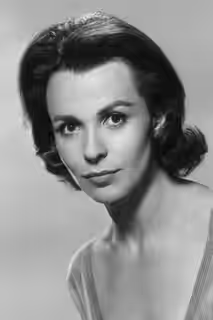
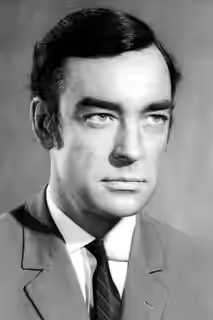
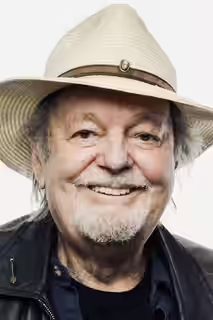
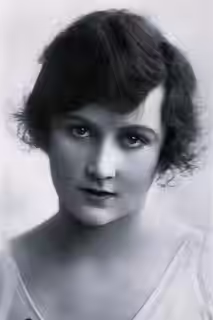
Dr John Markway (Richard Johnson), an anthropologist who investigates the supernatural, persuades the owner of Hill House, Mrs Sanderson (Fay Compton), to let him spend a summer there. The house has a history: dead wives, a locked nursery, a companion who hanged herself from the library staircase. He recruits Eleanor Lance (Julie Harris), who nursed her mother for eleven years and now sleeps on her sister’s sofa, and Theodora (Claire Bloom), who knows things about people she has not been told. Luke Sanderson (Russ Tamblyn), who will inherit the place, comes to disbelieve. Eleanor takes the car without asking, drives up past Mr Dudley at the gate, and is told by Mrs Dudley (Rosalie Crutchley) that nobody will hear if she screams in the night. Something knocks on the walls before morning.

Plays from YouTube when you press play; nothing loads from them until then.

Fi1m review

Robert Wise’s haunted-house film shows us nothing and frightens us anyway, with a swelling door, a knocking wall and Julie Harris coming apart in whispers. The script explains too much and the men are dull, but the house is not.

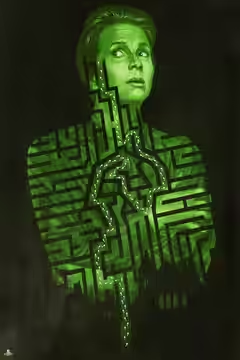
Robert Wise takes Shirley Jackson’s novel The Haunting of Hill House and does the thing horror films almost never trust themselves to do. He shows nothing. No ghost, no figure at a window, no face in the mirror. Four people move into a house that does not want them, and for 112 minutes the film frightens with a door, a wall, a cold patch of corridor and the inside of one woman’s head. It is a fine film with a talky middle and two dull men in it.

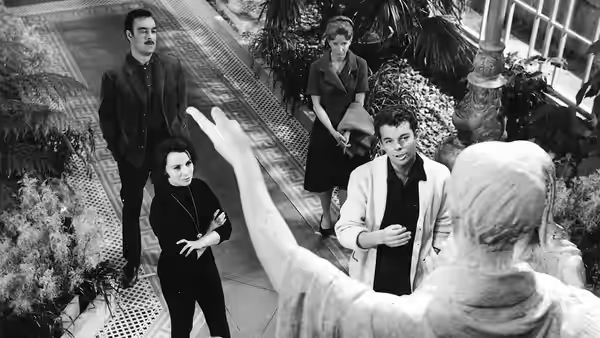
Davis Boulton shoots the rooms through wide lenses, so the corners bow and a corridor looks longer than the walk down it. Outside, the house is photographed against a nearly black sky, its stone chalk-white, and Wise returns to it again and again, tilting up at the same windows until we have decided for ourselves that the place is looking back. Elliot Scott fills the interiors with pattern and statuary: a nursery door with cherubs on it, a library with an iron spiral staircase nobody should climb, walls whose plaster is worked into faces if you look long enough. Nothing about any of this is explained. It is simply there when the camera turns.

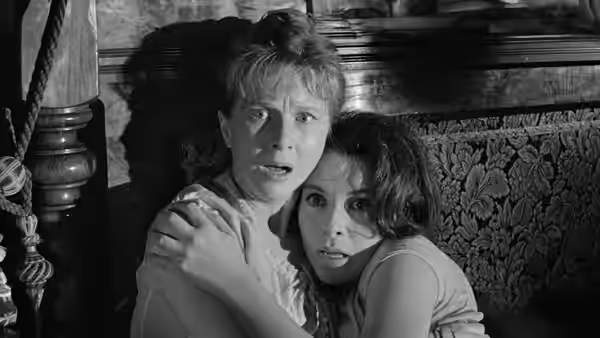
The frightening is done with noise. Humphrey Searle’s score is held back for most of the running time and what fills the space is the house itself: a pounding that starts at the far end of a corridor and works along the wall to the bedroom door, a child’s giggle, a murmur that might be words. In the film’s best scene Eleanor and Theodora sit up in bed and watch a door bend inwards, the panels swelling as if something on the other side had leaned on it with its whole weight. We watched that door on a sofa, in daylight, and it frightened us badly. What did it was that Wise holds the shot and lets the wood breathe rather than cutting away, and Ernest Walter’s edit goes only to the two women’s faces and back. Nothing comes through. That is worse.

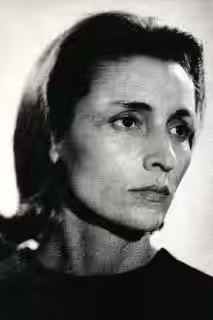
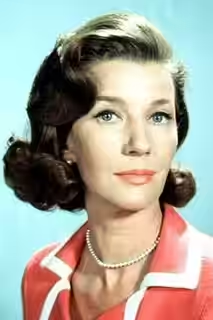
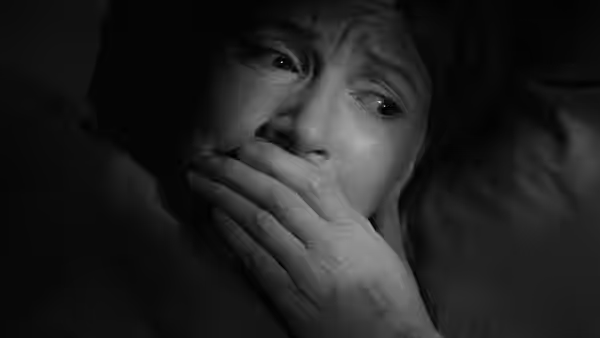
Julie Harris carries it. Eleanor has never had a life of her own, and Harris plays her as a guest at a house party who cannot stop apologising for being there. Nelson Gidding’s script gives her a running interior voice, whispered on the soundtrack. At its best it lets us hear the exact moment a frightened woman decides the house wants her and is flattered. At its worst it tells us what Harris’s face has already said. Claire Bloom’s Theodora is sleek, amused and cruel when bored, and the scenes between the two women, in which affection and spite change places by the line, are where the film is most alive. It hints at what Theodora is and then decides it has said enough.

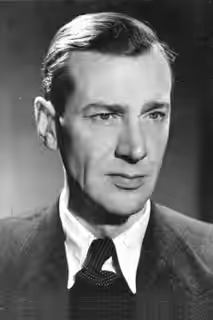
The men are the trouble. Richard Johnson’s Markway is upright, decent and a lecture in a tweed jacket; Gidding has him explain the supernatural in paragraphs, with a tape measure and a theory, and the film stops dead each time. Russ Tamblyn’s Luke is there to disbelieve and to eye the drinks, and Tamblyn plays him as a man who has wandered in from a lighter picture. Rosalie Crutchley, by contrast, gets two scenes as the housekeeper Mrs Dudley and takes both, with a speech about what happens here after dark that she delivers like a bus timetable. Fay Compton has one scene as the owner and makes it count.

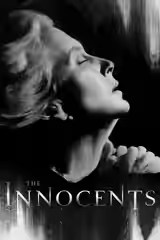
Wise is not a director anyone associates with horror; the films either side of this one are West Side Story (1961) and The Sound of Music (1965). That is part of why it works. He approaches the haunting as a craftsman rather than a believer, testing each effect and keeping only those that still work with the lights on. Against Jack Clayton’s The Innocents (1961), the obvious comparison, this is rougher, and it frightened us more. Jackson’s novel is better on the inside of Eleanor’s head, which is the one room a camera cannot enter, and the voice-over is the film’s admission of that.

The second half we will leave alone, except to say that the script’s fondness for explanation catches up with it and the final stretch is busier than the house needed it to be. Watch it at night with the sound up, because the sound is where the film lives. It runs 112 minutes and carries a 12, which is about right: there is nothing in it to see, and a great deal to hear.
Critical consensus AI synthesised

70
Positive
5
Mixed
2
Negative
2

Most critics rate The Haunting highly, and the praise clusters around Robert Wise’s decision to keep the horror unseen. Reviewers return to the same devices: the sound design, the disorienting camerawork, and the patience with which suggestion is allowed to do the work a monster would otherwise do. Several single out Julie Harris as Eleanor, whose vulnerability is credited with giving the scares somewhere to land. The positive notices are strongly positive rather than merely approving.

The reservations are about the writing and the pitch. Variety finds the artistry cannot rescue a screenplay that does not follow through on its ideas, while still admiring how the cinematography turns the house into a character. Time Out thinks the performances often overwrought, and Empire, though admiring, concedes the film sometimes strains. The Hollywood Reporter feels it explains its mysteries too readily. The spread is wide, from dismissal to near-unqualified praise, and two of the earliest notices survive only as citations.

Radio Times
★★★★★ · Alan Jones
100

The review calls it one of the best supernatural chillers ever made. It praises Robert Wise’s unseen, atmospheric horrors and Julie Harris’s performance.

Read the full review →
The AV Club
11 August 2003 · Keith Phipps
85*

Phipps praises the film as an effective, unsettling haunted-house story. He singles out Wise’s use of sound, disorienting camerawork, and unseen threats to sustain its ambiguity.

Read the full review →
Empire
1 January 2000 · Ian Freer
82*

The review regards the film as an exceptionally terrifying, highly wrought ghost story, though sometimes overwrought. It especially praises the eerie visual design and sound, which make the unseen threat feel ever-present.

Read the full review →
The Hollywood Reporter
31 October 2018 · James Powers
75*

Powers finds the film an effective, sophisticated ghost story, though it sometimes overexplains its mysteries. He particularly praises the terror unleashed when the spirits are allowed to overwhelm rational explanation.

Read the full review →
The New Yorker
28 September 1963 · Brendan Gill
65*

The issue identifies Brendan Gill’s “Current Cinema” as reviewing The Haunting, but this page does not expose his verdict. No specific praise or complaint is available in the accessible text.

Read the full review →
The New York Times
19 September 1963 · Bosley Crowther
64*

The archival page is inaccessible, so the critic’s verdict cannot be verified. No specific praise or complaint is available in the supplied text.

Read the full review →

Straight answers AI written, from our review

Is The Haunting worth watching?
The Haunting is worth watching for anyone who likes a ghost story that shows nothing and frightens anyway, and we scored it 84. The house, the sound and Julie Harris are the reasons; the men are dull and the script explains too much in the middle. Watch it at night with the sound up, because the sound is where the film lives.
How long is The Haunting, and what is it rated?
The Haunting runs 1h 52m. It is a horror film.
Where can I watch The Haunting in the Philippines?
The Haunting is not on any streaming or rental service in the Philippines at the moment. It is available in 22 other countries; change your country at the top of the page to see where. Availability is checked daily.
How violent or frightening is The Haunting, and is it suitable for children?
The Haunting carries a UK 12 certificate and contains no violence, no gore and no ghost ever seen on screen; the fear is all in noise, a bending door and one woman's unravelling mind. It frightened us badly on a sofa in daylight, so nervous children and the easily unsettled should be warned, but teenagers will find nothing graphic in it.
How does The Haunting compare to The Others?
The Haunting and The Others are both dark-house ghost stories that trust silence and waiting over anything shown, and both rest on a strained woman at their centre. Wise's film is rougher, talkier in the middle and frightened us more; Amenábar's is the more controlled and slower, and its deliberate pace will test anyone impatient for a scare.
Is The Haunting based on a true story or a book?
The Haunting is based on Shirley Jackson's novel The Haunting of Hill House, not on a true story. The film follows the book's set-up of four people spending a summer in a house that does not want them, though the novel is better on the inside of Eleanor's head, which the film tries to reach with whispered voice-over. You need not have read it to be frightened.

Cast

If you liked this, try…

  1. The Innocents (1961) · not on Fi1m yetDeborah Kerr, two children and a country house; the other great ghost story of its decade.

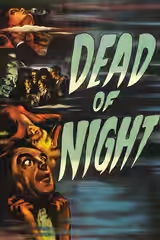
  2. Dead of Night (1945) · not on Fi1m yetFive stories told at a house party; the one with the ventriloquist’s dummy still does damage.

  3. Kwaidan (1964) · not on Fi1m yetFour Japanese ghost tales, slow and painted, in which a bowl of water is terrifying.

  4. The Others (2001, Fi1m 80)Nicole Kidman keeps the curtains drawn; a house film that trusts silence as this one does.

  5. Lake Mungo (2008) · not on Fi1m yetAn Australian mock documentary about a drowned girl that frightens with photographs.