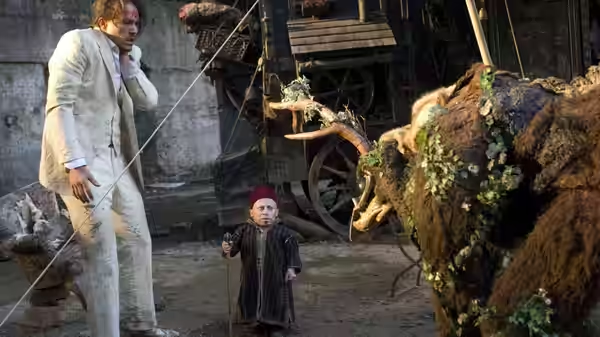
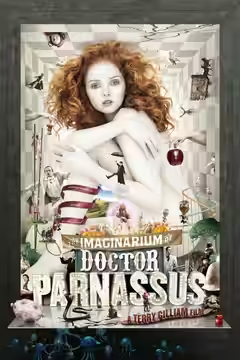
Valentina (Lily Cole) reclines on patterned cushions beside a fantastical landscape
Film review

The Imaginarium of Doctor Parnassus

2009 · Directed by Terry Gilliam · 2h 03m · MPA PG-13

In a sentenceTom Waits makes the Devil seem like the sensible person to sit beside

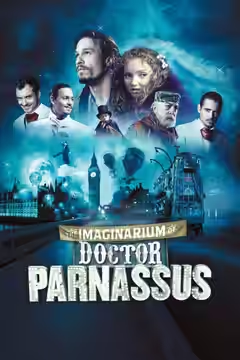
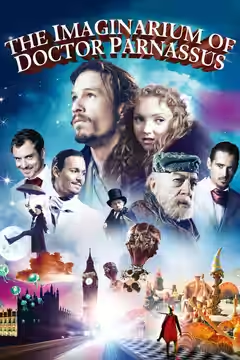
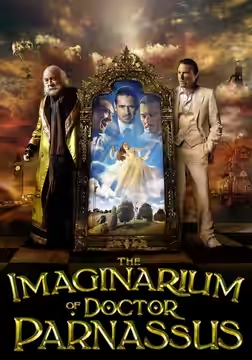
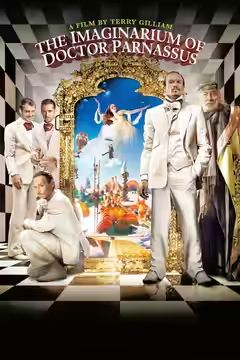
Doctor Parnassus (Christopher Plummer), Valentina (Lily Cole) and Tony (Heath Ledger) are among the characters in this fantasy adventure directed by Terry Gilliam. Andrew Garfield plays Anton, Verne Troyer plays Percy, and Tom Waits plays the Devil. Johnny Depp, Jude Law and Colin Farrell also feature in the cast. Terry Gilliam writes the screenplay with Charles McKeown. Combining adventure, fantasy and mystery, The Imaginarium of Doctor Parnassus has a running time of 123 minutes and carries a 12A certificate.

Plays from YouTube when you press play; nothing loads from them until then.

Fi1m review

Terry Gilliam’s fantasy has enough invention and warmth to make its muddle frustrating. Christopher Plummer and Tom Waits give it a human scale, but the crowded storytelling keeps getting in their way.

Terry Gilliam’s The Imaginarium of Doctor Parnassus is worth considering if extravagant fantasy matters more than a well-shaped story. There is pleasure in its appetite for strange images, and an affection for its characters that keeps the muddle from becoming merely tiresome. But the screenplay by Terry Gilliam and Charles McKeown keeps demanding fresh attention before the previous idea has had time to matter. We can enjoy individual passages without feeling much urgency about the next one.

Christopher Plummer gives Doctor Parnassus a grandeur that looks difficult to maintain, and his weariness is more affecting than the film’s busier attempts to enchant. We were moved by him: the effort beneath that grand manner makes his disappointment feel ordinary and recognisable. Tom Waits, playing the Devil, is amusing without seeming remotely reassuring, and his ease is welcome in a film that can feel strained. Their interplay gives us something simple to attend to, two actors who know how much can be done without hurrying.

Heath Ledger’s Tony is engaging enough to make us wish the writing around him were less restless. Lily Cole gives Valentina a directness that helps when the film threatens to become wholly absorbed in its own cleverness. Andrew Garfield works hard to give Anton similar weight, but the character remains thinly conceived. The performances often persuade us to stay with a scene that the script itself has not made especially compelling; too much of the film’s emotional work is left to the cast.

Cinematographer Nicola Pecorini gives the fantasy images a richness that rewards looking around the frame, even when the story has loosened its hold. Production designers David Warren and Anastasia Masaro supply more visual invention than the screenplay can comfortably accommodate. The density is enjoyable at first, with enough competing detail to make the eye keep searching. Yet we kept wanting longer to look, rather than another change of visual direction, and the accumulation eventually becomes tiring.

Mick Audsley’s editing cannot quite make the film’s changes of direction feel necessary, though individual passages have energy. Too often, we find ourselves catching up when we ought to be becoming more involved. The music by Jeff Danna and Mychael Danna suits the extravagance, but adds to the feeling that the film rarely knows when it has given us enough. A little less insistence would help the quieter performances, which already have a fair amount to contend with.

Fantasy can tolerate loose ends, but it still needs a clear reason to carry us from one scene to the next. Terry Gilliam asks for more patience than these 123 minutes consistently repay, although the affection in the performances makes the indulgence understandable. Admirers of crowded, unruly fantasy will find things to enjoy; those hoping the cast will make the story easy to follow should lower their expectations. Watch it for Christopher Plummer and Tom Waits, and be prepared to do some of the sorting out.


Critical consensus AI synthesised

62
Positive
11
Mixed
5
Negative
6

The reviews lean favourable on The Imaginarium of Doctor Parnassus, though enthusiasm is far from uniform. Praise centres on Terry Gilliam’s elaborate fantasy worlds and visual invention, qualities that even several detractors acknowledge. Tom Waits and Christopher Plummer attract repeated praise, particularly for their interplay, while some critics also single out Andrew Garfield. Several reviews find the handling of Heath Ledger’s role resourceful and affecting despite the film’s unevenness.

The main disagreement is over how much the imagery compensates for the storytelling. Admirers find the unruly fantasy compelling or moving; detractors describe a confused, sluggish film whose whimsy wears thin. The spread is wide: /Film praises the coherence of its visual world with unusual enthusiasm, while The Hollywood Reporter finds the effects incoherent. The Guardian admires Gilliam’s visual creativity but argues that the drama struggles to hold attention. Even favourable reviews often concede that the story needs firmer shaping.

The AV Club
23 December 2009 · B+ · Tasha Robinson
83

Robinson finds the film ambitious and energetic, with a tragic majesty that carries it past its flaws. She singles out Tom Waits’s performance and Gilliam’s gorgeous cinematography, while criticizing the undisciplined execution and sloppy storyline.

Read the full review →
Los Angeles Times
25 December 2009 · Kenneth Turan
80*

Turan finds the film one of Terry Gilliam’s most original and accessible works, recommending it to viewers seeking extravagant fantasy. He especially praises the imaginative visuals and the entertaining interplay between Tom Waits and Christopher Plummer.

Read the full review →
Slant Magazine
22 December 2009 · ★★★/4 · Fernando F. Croce
75

Croce finds the film unwieldy but deeply felt, and ultimately moving. He especially praises its near-sublime imagery and Christopher Plummer’s portrait of artistic endurance.

Read the full review →
Empire
1 October 2009 · Olly Richards
70*

Richards finds the film scrappy but ultimately compelling, with flashes of Gilliam returning to form. He especially praises Gilliam’s resourceful reworking of the story after Ledger’s death and the performances of Lily Cole and Andrew Garfield.

Read the full review →
Variety
22 May 2009 · festival review · Todd McCarthy
70*

McCarthy finds the film a pretty good recovery from its troubled production, with strong curiosity value and commercial appeal. He praises its visual effects and lively action, while criticizing overbearing pratfalls and the weakly conceived Anton.

Read the full review →
Screen Daily
24 May 2009 · Allan Hunter
64*

The page identifies this as Allan Hunter’s review, but the paywall prevents access to his verdict. No specific praise or complaint is visible in the supplied text.

Read the full review →

Straight answers AI written, from our review

Is The Imaginarium of Doctor Parnassus worth watching?
The Imaginarium of Doctor Parnassus is worth considering for admirers of extravagant fantasy, and we score it 65 out of 100. Christopher Plummer and Tom Waits give the crowded spectacle warmth and humour, but the restless storytelling becomes tiring. We recommend it to those happy to enjoy performances and strange images without a consistently compelling story.
How long is The Imaginarium of Doctor Parnassus, and what is it rated?
The Imaginarium of Doctor Parnassus runs 2h 03m and is rated PG-13 by the MPA in the US. It is an adventure and fantasy film.
Where can I watch The Imaginarium of Doctor Parnassus in the US?
The Imaginarium of Doctor Parnassus is streaming on Amazon Prime Video in the US, and it is also available to rent from Apple TV and Amazon Prime Video from $3.99. Availability is checked daily; the links above go straight to each service.
How violent or frightening is The Imaginarium of Doctor Parnassus, and is it suitable for children?
The Imaginarium of Doctor Parnassus carries a UK 12A certificate, so it is not automatically suitable for younger children; under-12s need an accompanying adult at the cinema. The certificate alone does not establish how violent or frightening individual scenes are, so we would advise parental judgement rather than assume that a fantasy adventure means gentle family viewing.
How does The Imaginarium of Doctor Parnassus compare to Pan's Labyrinth?
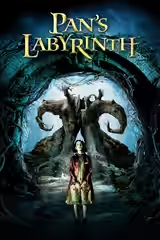
The Imaginarium of Doctor Parnassus offers crowded, unruly fantasy, while Pan's Labyrinth is darker and the dangers beneath its elaborate imagery remain clearer. We recommend Pan's Labyrinth more strongly for its more coherent combination of fairy tale and historical setting, though not for children. Parnassus is worth considering for its warmer performances, provided its muddled storytelling is not a deal-breaker.
What should I watch after The Imaginarium of Doctor Parnassus?
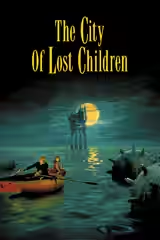
After The Imaginarium of Doctor Parnassus, try Pan's Labyrinth (2006, Fi1m 87): For darker fantasy whose dangers remain painfully clear beneath the elaborate imagery. Then The Red Shoes (1948, Fi1m 92): Another consuming devotion to performance, with firmer storytelling and less forgiving consequences; and The City of Lost Children (1995, Fi1m 78): For elaborate fantasy settings that make even the quieter passages feel strange.

Cast

Awards

Academy Awards, 2010

Nominated
Best Costume Design
Nominated
Best Production Design

If you liked this, try…

  1. Pan's Labyrinth (2006, Fi1m 87)For darker fantasy whose dangers remain painfully clear beneath the elaborate imagery.

  2. The Red Shoes (1948, Fi1m 92)Another consuming devotion to performance, with firmer storytelling and less forgiving consequences.

  3. The City of Lost Children (1995, Fi1m 78)For elaborate fantasy settings that make even the quieter passages feel strange.

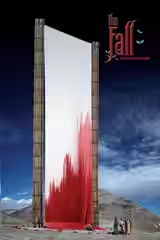
  4. The Fall (2006) · not on Fi1m yetFor extravagant imagined worlds held together by a more affecting human connection.

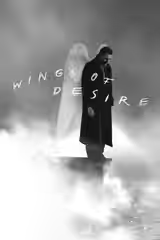
  5. Wings of Desire (1987, Fi1m 88)A gentler supernatural film, patient enough to let its people become familiar.