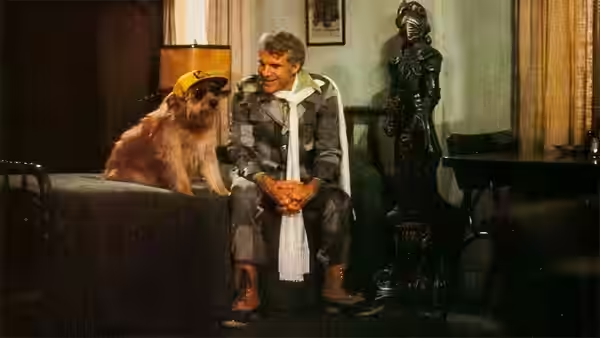
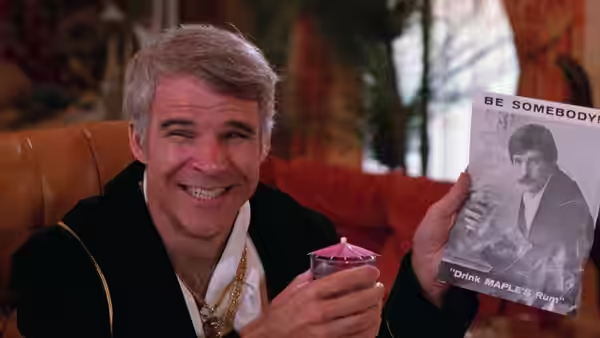
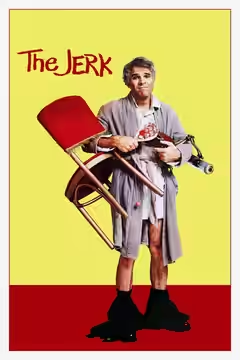
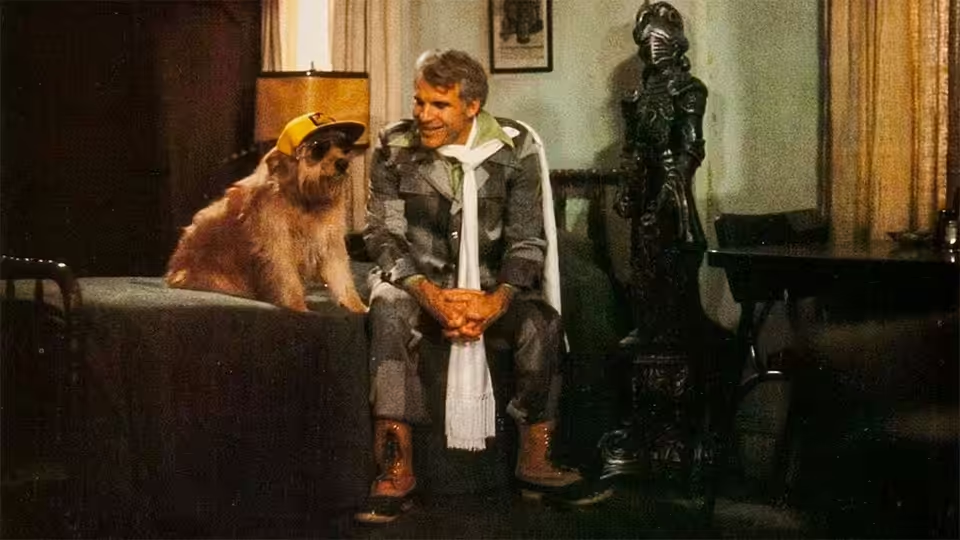
Navin (Steve Martin) sits beside a dog in a furnished room
Film review

The Jerk

1979 · Directed by Carl Reiner · 1h 34m

In a sentenceA man who cannot clap in time leaves home to find the beat, and finds a sniper who hates cans

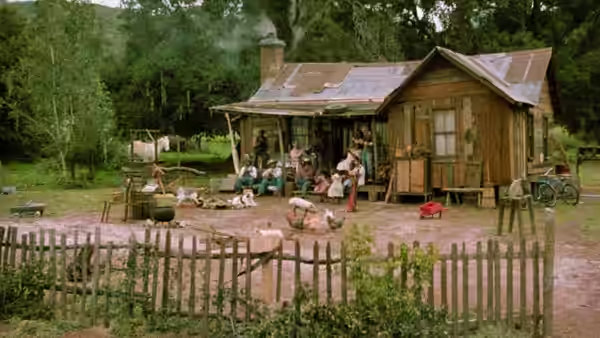
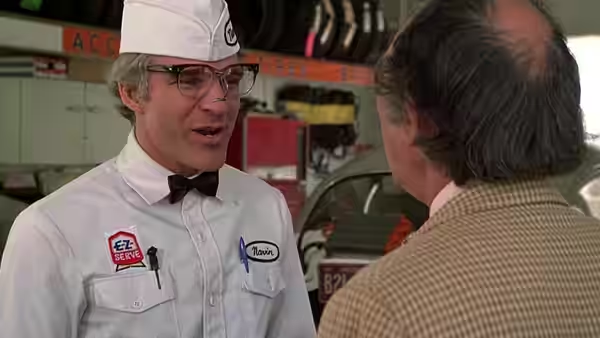
Navin R. Johnson (Steve Martin) lives on his family’s farm in Mississippi. On his birthday his Mother (Mabel King) tells him he was left on the doorstep as a baby, which explains why he is the only white face at the table and cannot clap in time on the porch. When a song on the radio gives him a beat, he sets off to find where it came from, his Father (Richard Ward) sending him off with practical advice. He pumps petrol at a station where a Madman (M. Emmet Walsh) picks his name from the telephone book and comes to shoot him. He runs, and ends up guessing weights at a carnival for Frosty (Dick O’Neill), where stunt rider Patty Bernstein (Catlin Adams) takes an interest.

Plays from YouTube when you press play; nothing loads from them until then.

Fi1m review

Steve Martin’s first film as a lead is a string of daft sketches held together by his face, and for an hour that is enough. It sags once Navin gets rich, but the best jokes have outlasted most of the decade’s serious films.

The Jerk begins with its hero in the gutter. Navin R. Johnson (Steve Martin) sits on a Hollywood pavement in a torn suit, tells the camera he is not a bum but a jerk, and explains how he got there. The tagline promises rags to riches to rags, and Carl Reiner’s film delivers that, with little interest in the middle part. For an hour it is as funny as anything American cinema made that decade; for the last half hour it is a man in a big house running out of things to do.

The script, by Martin, Michael Elias and Carl Gottlieb, puts its best material first. Mabel King, as Mother, breaks the news of Navin’s adoption as gently as a woman who has put it off for years, and Richard Ward, as Father, sends him off with a speech of advice delivered without a flicker. Dick Anthony Williams’s Taj and the family sing on the porch while Navin claps on the wrong beat; Reiner holds the shot, and the joke gets better the longer it runs. At the petrol station, M. Emmet Walsh’s Madman picks a name from the telephone book and opens fire on the oil cans behind Navin’s head. We laughed until it hurt, and we cannot explain why. Something to do with Martin’s conviction that the man’s quarrel is with the cans.

Victor J. Kemper shoots it flat and bright, like a television comedy. Nothing in the frame competes with the gag. Jack T. Collis’s production design gives Navin a series of boxes to be innocent in: a petrol station, a carnival trailer, a mansion with a fountain. Theadora Van Runkle dresses him in trousers that stop above the ankle and, later, in white suits with the sheen of a car showroom. Jack Elliott’s score keeps out of the way. Ron Spang and Bud Molin cut fast and do not wait for laughs, which is a kindness in the first half and a problem in the second, when the scenes have no shape.

Martin had been a stand-up comedian for years, and Navin is his stage persona given a body and a birthplace: the man in the white suit delighted by everything and understanding none of it. Navin is not stupid so much as new, and Martin plays every scene as though it were the first thing ever to happen to him. Bernadette Peters, as Marie, the cosmetologist he meets at the carnival, matches him by playing it straight. Their duet on the beach, the old song Tonight You Belong to Me on ukulele and horn, is the tenderest thing in the film, and it caught us off guard. Two absurd people are being sincere at each other, and the film lets them.

The carnival section brings in Catlin Adams as Patty Bernstein, a stunt rider who takes Navin in hand, and Dick O’Neill as Frosty, who runs the weight-guessing stall. Each is given one joke and plays it well. What follows, and how the money arrives, we will leave alone; once Navin has everything, the film has nothing for him to want. The set-pieces get larger and slower, and Reiner starts to rely on Martin doing funny things in expensive rooms. It is still amusing. It is not what came before, and at 94 minutes the drop is over quickly.

One more thing. The opening act gets a good deal of its comedy from a white man not knowing he is white in a Black family, and the jokes work because the joke is always on Navin’s blindness and never on the family, who are the sanest people in the picture. Mostly that holds. Once or twice the film reaches for an easier laugh, and the laugh does not come.

Against the run of plotless American comedies, The Jerk sits high because of the first hour and no higher for the last. The loudest praise since has called it one of the funniest films ever made; we would stop at the first hour and mean it. Watch it with someone who has never seen it, and watch their face when the new telephone books arrive.

Critical consensus AI synthesised

76
Positive
4
Mixed
2
Negative
0

Most critics like The Jerk, and they like it for the same reason: Steve Martin. Four of the six reviews are positive, and the praise clusters around his performance, which the reviews describe as manic and broad, the widest he has played on screen. Several reviewers rank the film near the top of his comedies, and one or two go further and place it among the funniest films they know. The jokes get credit too, with Navin’s absurd invention for spectacles and the early scenes with his family singled out.

The reservations are about consistency. Variety finds the comedy uneven, at its best in the opening family scenes and thinner once Navin’s fortunes fall. The AV Club, though warm, calls it only occasionally hilarious and says Martin has to carry it. The New Yorker’s notice offers no clear verdict either way. The spread is fairly wide, from complete enthusiasm to a shrug, though nobody actually dislikes it.

Time Out
20 September 2024 · ★★★★★ · Tom Huddleston
100

The review calls the film a late-’70s comedy masterclass and the funniest, most quotable film of Martin’s career. It singles out the comedy crafted by Steve Martin and Carl Reiner for praise.

Read the full review →
Empire
1 January 2000 · William Thomas
90*

Thomas calls the film a strong contender for the funniest film of all time. He praises its loud, ludicrous comedy.

Read the full review →
Radio Times
★★★★ · Tom Hutchinson
80

Hutchinson presents it as a very funny comedy, with Steve Martin in manic form. He particularly praises the heavenly jokes, including Navin’s absurd invention for spectacles.

Read the full review →
The AV Club
9 August 2005 · Josh Modell
75*

Modell finds the film an occasionally hilarious, charming comedy that Steve Martin’s performance carries. He singles out Martin’s goofball performance as the best and broadest of his comedic screen career.

Read the full review →
The New Yorker
17 December 1979 · Roger Angell
64*

Roger Angell’s Current Cinema entry includes The Jerk among two films reviewed. The page provides no critical verdict or specific praise or complaint.

Read the full review →
Variety
31 December 1978 · Variety Staff
45*

The review finds the film’s comedy uneven, though it sometimes lands hilariously. It singles out the opening family scenes as among the best and says the humor fades during Martin’s decline.

Read the full review →

Straight answers AI written, from our review

Is The Jerk worth watching?
The Jerk is worth watching for anyone who likes daft, sketch-built comedy, and we scored it 77. Steve Martin’s first hour as Navin, the innocent who cannot clap in time, is as funny as anything American cinema made that decade. It sags once Navin gets rich, but at 94 minutes the drop is over quickly.
How long is The Jerk, and what is it rated?
The Jerk runs 1h 34m. It is a comedy film.
Where can I watch The Jerk in Colombia?
The Jerk is available to rent from Apple TV from CO$9900.00. Availability is checked daily; the links above go straight to each service.
How violent or frightening is The Jerk, and is it suitable for children?
The Jerk is rated 12 in the UK and R in the US, and its violence is cartoonish: a Madman shoots at oil cans behind Navin’s head and nobody is hurt. Nothing in it is frightening, and the 12 reflects adult jokes rather than anything grim. Older children should be fine; younger ones will miss most of the humour.
How does The Jerk compare to Being There?
The Jerk and Being There are the same year’s two innocents let loose among the rich, one played loud and one played quiet. Steve Martin’s film is a string of sketches, funnier gag for gag but shapeless once the money arrives; Hal Ashby’s is a patient, warm satire that sometimes repeats itself. Pick The Jerk for laughs, Being There for something that lingers.
What should I watch after The Jerk?
After The Jerk, try Being There (1979, Fi1m 84): The same year’s other innocent let loose among the rich, played quiet instead of loud. Then Duck Soup (1933, Fi1m 88): The plotless comedy this descends from, with more jokes per minute and no mansion; and Toni Erdmann (2016, Fi1m 86): A German father in bad false teeth proves sincerity is the funniest thing in a room.

Cast

If you liked this, try…

  1. The Man with Two Brains (1983) · not on Fi1m yetMartin and Reiner again, sillier still, with a brain in a jar for a love interest.

  2. Being There (1979, Fi1m 84)The same year’s other innocent let loose among the rich, played quiet instead of loud.

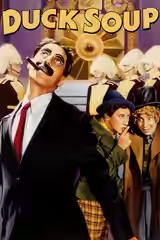
  3. Duck Soup (1933, Fi1m 88)The plotless comedy this descends from, with more jokes per minute and no mansion.

  4. Playtime (1967) · not on Fi1m yetTati’s bewildered man in a modern city, the gags built into the architecture.

  5. Toni Erdmann (2016, Fi1m 86)A German father in bad false teeth proves sincerity is the funniest thing in a room.