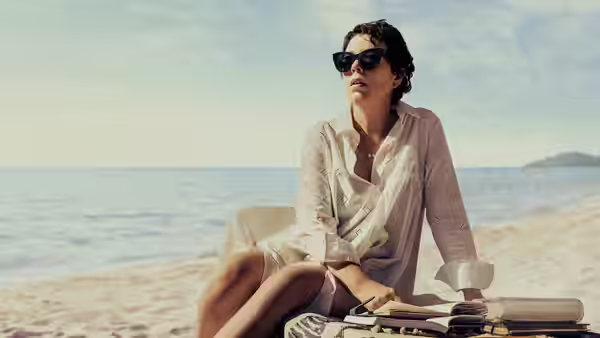
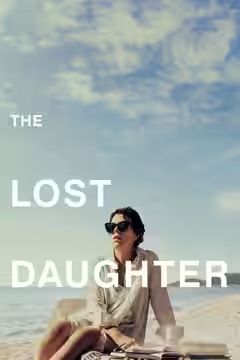
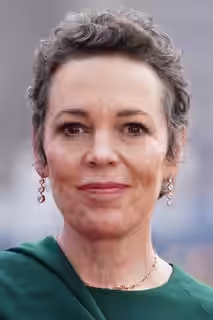
Leda Caruso (Olivia Colman) sits beside her books on the beach, looking out to sea
Film review

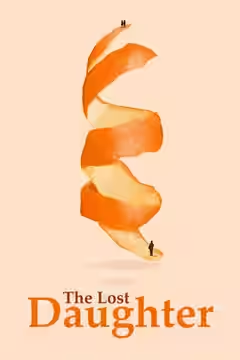
The Lost Daughter

2021 · Directed by Maggie Gyllenhaal · 2h 02m · FSK 12

In a sentenceOlivia Colman makes keeping your feelings to yourself look exhausting

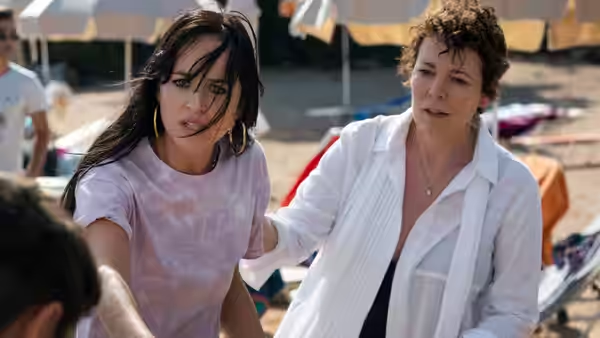
Leda Caruso (Olivia Colman) confronts feelings about motherhood that she has not put behind her. Her connection with Nina (Dakota Johnson) draws her attention towards another woman’s experience of being a mother, while her own past returns through flashbacks. Young Leda Caruso (Jessie Buckley) faces the competing demands of motherhood and personal ambition. The story moves between these two versions of Leda as she considers the choices that have shaped her life. With Leda and Nina coming to understand one another, the question of what a mother owes her children becomes personal for both women.

Plays from YouTube when you press play; nothing loads from them until then.

Fi1m review

Olivia Colman and Jessie Buckley make this study of maternal frustration painful, funny and worth the discomfort. The flashbacks sometimes explain feelings the performances have already made clear, but Maggie Gyllenhaal gives both actors room to be difficult.

The Lost Daughter is a perceptive, unsettling drama with two performances worth making time for, even when its flashbacks explain more than they need to. Maggie Gyllenhaal, writing and directing an adaptation of Elena Ferrante’s novel, takes a mother’s mixed feelings seriously without making her plead for our approval. She allows affection, frustration and ambition to remain inconveniently tangled. That gives Olivia Colman’s Leda Caruso a freedom that screen mothers are not always granted: she can be difficult without the film immediately correcting her.

Olivia Colman makes that difficulty engrossing. Her expressiveness keeps changing our sense of how much Leda understands about herself, and how much she is prepared to acknowledge. We felt uneasy watching her face, because shame and resentment become visible before we have decided what to make of them. There is dark comedy in this uncertainty too, and the performance lets us laugh at Leda without encouraging the comfortable belief that we would handle her feelings better.

Jessie Buckley plays Young Leda Caruso with a more exposed sense of strain, particularly where motherhood presses against ambition. The two performances need not look identical to feel connected, although their shared gestures help. What convinces us is that both actors allow tenderness and impatience to seem possible at any moment. The younger woman’s frustration remains sufficiently complicated that the flashbacks are worth watching even when their place in the story feels too carefully explained.

Dakota Johnson’s Nina matters because her growing understanding with Leda gives the film a relationship through which to explore those feelings. Her performance holds its own in a drama whose attention could easily have stayed with its two versions of Leda. Maggie Gyllenhaal does not turn their connection into a reassuring lesson about women understanding one another. We remain interested in how far their sympathy extends, and how much each woman can recognise in the other without knowing her well.

Hélène Louvart’s intimate framing keeps us close to the performances, making small changes of expression worth attending to. The images have a physical immediacy that suits a story about feelings people would prefer to leave unspoken. Inbal Weinberg’s production design is effective in a quieter way: the surroundings never compete with our attention to the women. The visual approach rewards watching closely, particularly when a face gives us reason to reconsider what we thought we understood.

The main reservation concerns the flashbacks. Affonso Gonçalves’s editing makes the movement between the two Ledas readable, but some returns to the past tell us what the present performance has already suggested. Those interruptions leave us waiting for the story to get back to feelings that were more interesting before they were explained. Dickon Hinchliffe’s music helps maintain the unease across those shifts, though it cannot make each return equally necessary.

That reservation matters, but it does not undo the film’s unusual patience with a mother’s divided loyalties. Family dramas often hurry to explain difficult behaviour; here, the actors are allowed to leave us uncertain about how generously to judge it. We recommend the film for those performances and for the seriousness with which it treats feelings that can be embarrassing to admit. Leave it for another evening if the requirement is a sympathetic lead who explains herself.

Critical consensus AI synthesised

79
Positive
21
Mixed
5
Negative
0

Most critics respond warmly to The Lost Daughter, with praise centred on Olivia Colman’s conflicted, expressive performance and Jessie Buckley’s portrayal of the younger Leda. Maggie Gyllenhaal’s direction also draws approval for its intimacy and its willingness to examine motherhood, ambition and regret without judging the women involved. The reviews repeatedly credit the film with turning ordinary frustrations into psychological tension, while finding its close attention to women’s experience unusually perceptive.

The spread runs from enthusiastic praise to mixed assessments, with no outright negative verdicts. Reservations cluster around an unwieldy structure, flashbacks that explain too much and an ending several critics find weak or unconvincing. Slant Magazine regards the adaptation as reductive despite Colman’s performance, while Radio Times departs from the broad admiration for Buckley by finding her miscast. Even among the positive reviews, the film’s ambiguity and lack of firm answers are not always considered strengths.

Evening Standard
16 December 2021 · ★★★★★ · Charlotte O'Sullivan
100

O'Sullivan praises the adaptation as a powerful achievement that elevates its source material. She especially singles out Olivia Colman's darkly comic, award-worthy performance.

Read the full review →
Time Out
24 December 2021 · ★★★★★ · Phil de Semlyen
100

The critic gives the film a strongly positive verdict, calling the adaptation dizzyingly brilliant. Olivia Colman and Jessie Buckley are singled out for sharing the acting honours.

Read the full review →
Los Angeles Times
16 December 2021 · Guy Lodge
90*

Lodge finds Gyllenhaal’s directorial debut thrilling, empathetic and bold in its portrayal of unorthodox femininity. He especially praises Olivia Colman and Jessie Buckley’s performances and their uncanny physical and gestural mirroring.

Read the full review →
The Hollywood Reporter
3 September 2021 · festival review · David Rooney
90*

Rooney calls the film a highly accomplished, mesmerizing debut and an uncompromising character study. He praises the performances, especially Jessie Buckley’s portrayal of Leda’s conflicted feelings about motherhood and ambition.

Read the full review →
Variety
3 September 2021 · Peter Debruge
90*

Debruge praises the film as a brilliant, subversive drama, while noting its risks. He singles out Gyllenhaal’s nuanced direction and the performances of Olivia Colman and Jessie Buckley for conveying the story’s rich subtext.

Read the full review →
Vulture
31 December 2021 · Alison Willmore
90*

Willmore calls the film an incredible debut and an unusually adult, precisely observed work. She particularly praises Olivia Colman and Jessie Buckley’s seamless performances and the film’s nuanced depiction of maternal ambivalence.

Read the full review →

Straight answers AI written, from our review

Is The Lost Daughter worth watching?
The Lost Daughter is worth watching for Olivia Colman and Jessie Buckley’s performances and its frank treatment of maternal frustration; we score it 84 out of 100. We recommend it to anyone comfortable with a difficult lead, though the flashbacks sometimes explain feelings the actors have already made clear.
How long is The Lost Daughter, and what is it rated?
The Lost Daughter runs 2h 02m and is rated 12 by the FSK in Germany. It is a drama film.
Where can I watch The Lost Daughter in Germany?
The Lost Daughter is streaming on Netflix in Germany. Availability is checked daily; the links above go straight to each service.
How violent or frightening is The Lost Daughter, and is it suitable for children?
The Lost Daughter has a UK 15 certificate and is not suitable for children under 15; its treatment of maternal shame and resentment makes it emotionally unsettling. We found Colman’s expressions troubling because those feelings surface before we know how to judge them, but that discomfort does not establish how graphic any violence is.
How does The Lost Daughter compare to We Need to Talk About Kevin?
The Lost Daughter is our preference for a more nuanced account of maternal frustration, while We Need to Talk About Kevin makes maternal guilt more immediately frightening. Both have compelling central performances, but we find Kevin’s characterisation too monstrous to remain convincing; Leda’s mixture of tenderness, impatience and ambition allows more room for uncertainty.
Is The Lost Daughter based on a true story or a book?
The Lost Daughter is adapted from Elena Ferrante’s novel, rather than presented as a true story, with Maggie Gyllenhaal writing and directing. We find its movement between younger and older Leda clear enough without knowing the book, although the flashbacks sometimes explain more than the performances need.
What should I watch after The Lost Daughter?
After The Lost Daughter, try We Need to Talk About Kevin (2011, Fi1m 81): Another unsparing account of maternal estrangement, with discomfort built into every image. Then Certain Women (2016, Fi1m 84): Patient attention to women whose private disappointments rarely receive this much screen time; and Petite Maman (2021, Fi1m 88): A gentler encounter with motherhood and childhood, equally careful about what remains unspoken.

Cast

If you liked this, try…

  1. Autumn Sonata (1978) · not reviewed yetA mother and daughter find that musical discipline has not helped them listen.

  2. We Need to Talk About Kevin (2011, Fi1m 81)Another unsparing account of maternal estrangement, with discomfort built into every image.

  3. Certain Women (2016, Fi1m 84)Patient attention to women whose private disappointments rarely receive this much screen time.

  4. Maborosi (1995) · not reviewed yetGrief and motherhood observed through patient images, with little appetite for easy reassurance.

  5. Petite Maman (2021, Fi1m 88)A gentler encounter with motherhood and childhood, equally careful about what remains unspoken.

The Lost Daughter (2021) review: fine leads carry an uneasy drama (Germany) | Fi1m