Olivia Colman and Jessie Buckley make this study of maternal frustration painful, funny and worth the discomfort. The flashbacks sometimes explain feelings the performances have already made clear, but Maggie Gyllenhaal gives both actors room to be difficult.
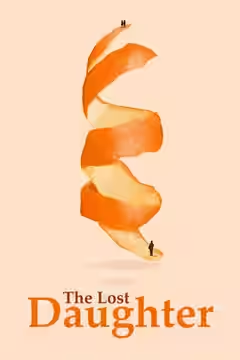
The Lost Daughter is a perceptive, unsettling drama with two performances worth making time for, even when its flashbacks explain more than they need to. Maggie Gyllenhaal, writing and directing an adaptation of Elena Ferrante’s novel, takes a mother’s mixed feelings seriously without making her plead for our approval. She allows affection, frustration and ambition to remain inconveniently tangled. That gives Olivia Colman’s Leda Caruso a freedom that screen mothers are not always granted: she can be difficult without the film immediately correcting her.
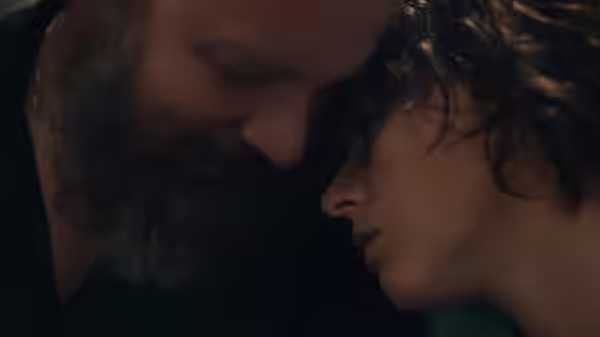
Olivia Colman makes that difficulty engrossing. Her expressiveness keeps changing our sense of how much Leda understands about herself, and how much she is prepared to acknowledge. We felt uneasy watching her face, because shame and resentment become visible before we have decided what to make of them. There is dark comedy in this uncertainty too, and the performance lets us laugh at Leda without encouraging the comfortable belief that we would handle her feelings better.
Jessie Buckley plays Young Leda Caruso with a more exposed sense of strain, particularly where motherhood presses against ambition. The two performances need not look identical to feel connected, although their shared gestures help. What convinces us is that both actors allow tenderness and impatience to seem possible at any moment. The younger woman’s frustration remains sufficiently complicated that the flashbacks are worth watching even when their place in the story feels too carefully explained.
Dakota Johnson’s Nina matters because her growing understanding with Leda gives the film a relationship through which to explore those feelings. Her performance holds its own in a drama whose attention could easily have stayed with its two versions of Leda. Maggie Gyllenhaal does not turn their connection into a reassuring lesson about women understanding one another. We remain interested in how far their sympathy extends, and how much each woman can recognise in the other without knowing her well.
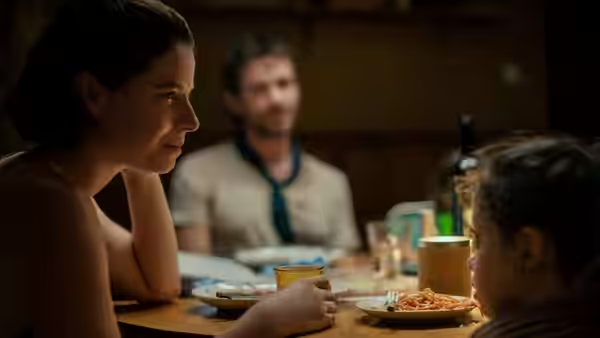
Hélène Louvart’s intimate framing keeps us close to the performances, making small changes of expression worth attending to. The images have a physical immediacy that suits a story about feelings people would prefer to leave unspoken. Inbal Weinberg’s production design is effective in a quieter way: the surroundings never compete with our attention to the women. The visual approach rewards watching closely, particularly when a face gives us reason to reconsider what we thought we understood.
The main reservation concerns the flashbacks. Affonso Gonçalves’s editing makes the movement between the two Ledas readable, but some returns to the past tell us what the present performance has already suggested. Those interruptions leave us waiting for the story to get back to feelings that were more interesting before they were explained. Dickon Hinchliffe’s music helps maintain the unease across those shifts, though it cannot make each return equally necessary.
That reservation matters, but it does not undo the film’s unusual patience with a mother’s divided loyalties. Family dramas often hurry to explain difficult behaviour; here, the actors are allowed to leave us uncertain about how generously to judge it. We recommend the film for those performances and for the seriousness with which it treats feelings that can be embarrassing to admit. Leave it for another evening if the requirement is a sympathetic lead who explains herself.