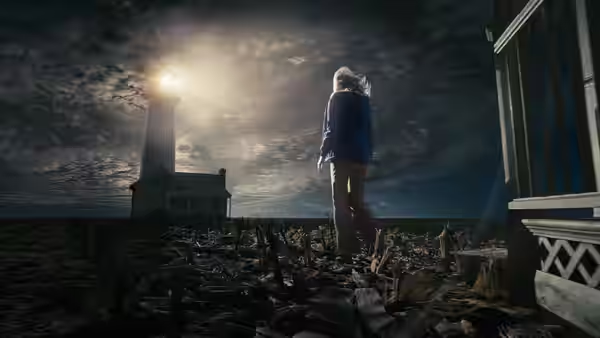
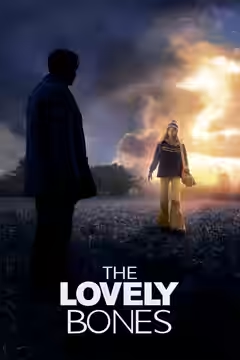
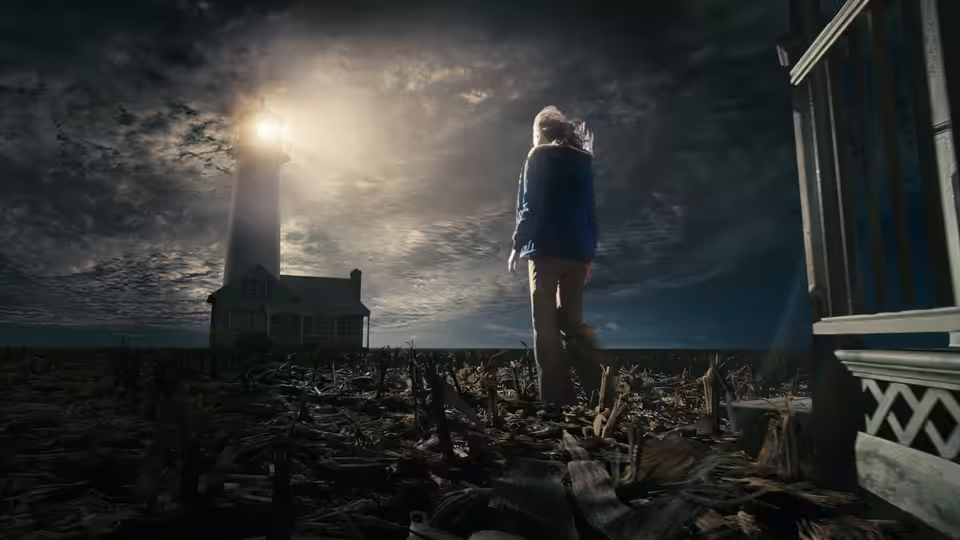
A girl in a blue coat stands among dark branches beneath a glowing lighthouse
Film review

The Lovely Bones

2009 · Directed by Peter Jackson · 2h 16m · MPA PG-13

In a sentenceThe afterlife gets another makeover while the grieving family waits

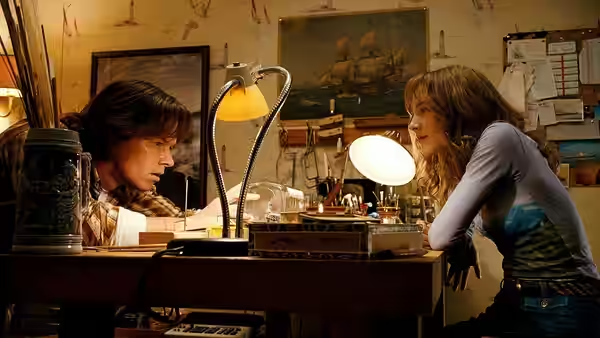
Susie Salmon (Saoirse Ronan) is murdered, leaving Jack Salmon (Mark Wahlberg) and Abigail Salmon (Rachel Weisz) grieving in the family home. For Susie, a run through town gives way to an afterlife of changing landscapes, shaped by her feelings. She wants to remain close to the family she has lost, but cannot return to their ordinary routines. George Harvey (Stanley Tucci) brings a threat that the living still have to face. Susie’s story follows both the Salmons’ attempts to cope with her death and her own experience of a place beyond their reach.

Plays from YouTube when you press play; nothing loads from them until then.

Fi1m review

Peter Jackson’s grief drama has a touching centre in Saoirse Ronan, but its busy afterlife keeps interrupting the people left behind. There is too little room for the family.

The Lovely Bones is an uneven, often frustrating grief drama, despite a central performance that makes its losses matter. Adapting Alice Sebold’s novel, Peter Jackson, Fran Walsh and Philippa Boyens give Susie’s afterlife a prominence the living struggle to match. We need time with the family to understand what her death has done to them. Instead, the fantasy repeatedly demands attention just as those relationships begin to matter. At 136 minutes, this is not a shortage of time.

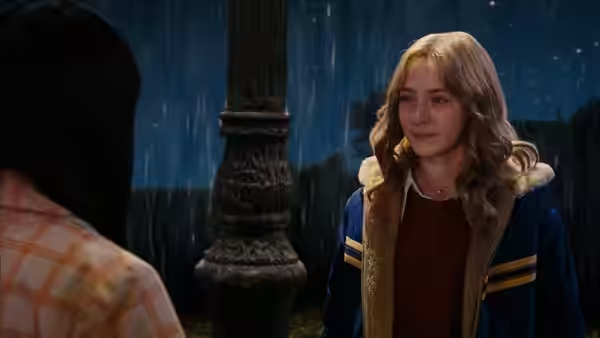
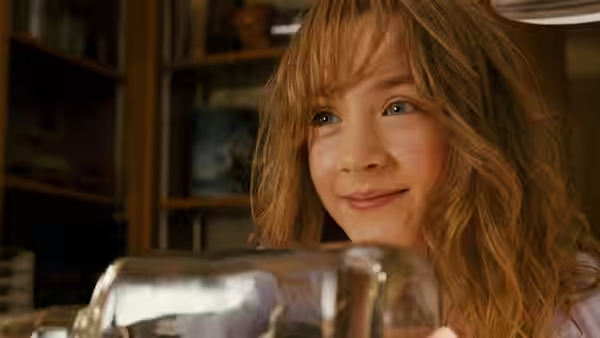
Saoirse Ronan makes Susie Salmon feel like a girl whose life we might have wanted to follow without a crime. There is curiosity in the performance, and enough youthful energy to make the interruption of that life painful. The small moments with her family let us see the person whose absence the rest of the film asks us to feel. The early family scenes allow ordinary affection to do the work. They establish how much the film can achieve simply by staying with its actors.

Stanley Tucci brings a different kind of precision to George Harvey, and his menace makes the scenes on earth more compelling than many of the fantasies. The performance is carefully controlled, giving Peter Jackson something disturbing to watch without needing to exaggerate it. Suspense also suits the director’s habit of making us look closely and wait. The difficulty is that the attention paid to danger does not extend with equal patience to the family.

Naomi Shohan’s production design makes the changing landscapes feel like places a girl might imagine; Andrew Lesnie photographs them with a softness that becomes oppressive. Some have an appealing strangeness, and the idea that Susie’s surroundings might change with her feelings makes sense. Yet their prettiness becomes a distraction when we ought to be thinking about her isolation. We were unsettled by the sequence in which Susie runs through town, because her confusion makes familiar surroundings feel unsafe. That is where the visual invention helps us understand her.

Brian Eno’s score is more persuasive, supplying a haunting unease that the pictures do not always sustain. Jabez Olssen’s editing has the thankless job of moving between grief, threat and the changing fantasy settings, and too often the emotional shift feels imposed. A scene can ask us to feel afraid, then leave us looking at something pretty before that fear has settled. The family scenes suffer most from these interruptions.

Mark Wahlberg and Rachel Weisz have too little room as Jack Salmon and Abigail Salmon. Their grief is clear, but the screenplay does not spend enough time on the relationships through which we might understand it. That is a serious limitation in a film asking us to care about a family trying to live after a murder. The fantasy is meant to help us bear that experience, yet its repeated interruptions make it easier to stop thinking about it.

Fantasy can be a useful way of approaching bereavement, especially when ordinary conversation seems inadequate. Here, Peter Jackson reaches for another imagined landscape before the ordinary conversation has had much chance to happen. There is enough in Saoirse Ronan’s performance and Brian Eno’s music to make the film worth considering for their admirers. For the family drama, we would look elsewhere.
Critical consensus AI synthesised

47
Positive
4
Mixed
5
Negative
11

Most critics find The Lovely Bones emotionally weakened by Peter Jackson’s emphasis on fantasy spectacle, though the performances attract more consistent approval. Praise centres on Saoirse Ronan’s small, human moments, with Stanley Tucci’s menace also drawing favourable notices. Several reviews admire the shifting afterlife landscapes and the suspense of the earthbound scenes, even when they find the adaptation uneven or its treatment of grief unconvincing.

The sharpest division concerns whether those images deepen the emotion or get in its way. Detractors repeatedly fault the sentimental tone, thin family relationships and awkward shifts between grief, fantasy and thriller. The spread is wide rather than cautiously mixed: Total Film finds the film touching and entertaining, with energetic direction, while Eye for Film responds to its emotional pull, suspense and Brian Eno’s score. For the negative majority, however, the visual invention cannot compensate for the loss of intimacy.

Total Film
24 November 2009 · ★★★★ · Jamie Graham
80

The critic finds the film touching and entertaining, though it risks tipping into schmaltz. They praise Jackson’s energetic direction and the vivid, emotionally shifting fantasy landscapes.

Read the full review →
Empire
30 December 2009 · Ian Freer
75*

Freer finds the film bold, emotionally alive and largely successful despite some unevenness. He particularly praises Stanley Tucci’s meticulous performance and the suspenseful detective work by Susie’s sister.

Read the full review →
Screen Daily
24 November 2009 · Mike Goodridge
64*

The page identifies this as Mike Goodridge’s review of the 2009 film, but the review text is unavailable. Its verdict and any specifically praised or criticized element cannot be determined from the accessible page.

Read the full review →
The New York Times
10 December 2009 · A.O. Scott
64*

The page content is inaccessible, so the critic’s verdict cannot be verified. No specific praise or complaint can be established from the available text.

Read the full review →
RogerEbert.com
10 December 2009 · ★★½/4 · Roger Ebert
62

Ebert finds the film visually accomplished but emotionally misjudged. He singles out its striking fantasy imagery, while faulting the story’s handling of its subject.

Read the full review →
Slant Magazine
6 December 2009 · ★★½/4 · Ed Gonzalez
62

Gonzalez calls the film an exciting but compromised vision, an interesting failure. He praises Saoirse Ronan’s performance and the film’s convincing portrayal of grief, while faulting its underthought storytelling and glossy afterlife imagery.

Read the full review →

Straight answers AI written, from our review

Is The Lovely Bones worth watching?
The Lovely Bones is difficult to recommend beyond admirers of Saoirse Ronan or Brian Eno; we score it 46 out of 100. Ronan gives the grief a touching centre and Eno’s music supplies unease, but the changing afterlife landscapes repeatedly interrupt the family drama just as it begins to matter.
How long is The Lovely Bones, and what is it rated?
The Lovely Bones runs 2h 16m and is rated PG-13 by the MPA in the US. It is a fantasy and drama film.
Where can I watch The Lovely Bones in the US?
The Lovely Bones is streaming on Paramount+, Peacock, Amazon Prime Video, Apple TV, The Roku Channel and Hulu in the US, and it is also available to rent from Apple TV and Amazon Prime Video from $3.99. It leaves Paramount+ on 1 November. Availability is checked daily; the links above go straight to each service.
How violent or frightening is The Lovely Bones, and is it suitable for children?
The Lovely Bones has a UK 12A certificate, but its story of a girl’s murder, family grief and continuing menace calls for caution with younger children. We find Stanley Tucci’s controlled threat disturbing, and Susie’s confused run through town makes familiar surroundings feel unsafe; the concern is frightening subject matter rather than fantasy alone.
How does The Lovely Bones compare to Heavenly Creatures?
The Lovely Bones is the less satisfying of these two Peter Jackson fantasy dramas; we recommend Heavenly Creatures for its closer attention to recognisable human behaviour. Its consuming teenage friendship makes the fantasy frightening, whereas Susie’s changing afterlife too often distracts from her family’s grief, though the restless camera in Heavenly Creatures can overstate what the performances already convey.
Is The Lovely Bones based on a true story or a book?
The Lovely Bones is adapted from Alice Sebold’s novel, with Peter Jackson, Fran Walsh and Philippa Boyens responsible for the screenplay. We find that the adaptation gives Susie’s afterlife too much attention and her grieving family too little; that criticism concerns how the film works, rather than how faithfully it follows the book.
What should I watch after The Lovely Bones?
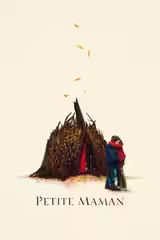
After The Lovely Bones, try Heavenly Creatures (1994, Fi1m 84): Adolescent fantasy becomes frightening through its closeness to recognisable human behaviour. Then Petite Maman (2021, Fi1m 88): Childhood, grief and impossible encounters, handled with patience rather than spectacle.

Cast

Awards

Academy Awards, 2010

Nominated
Best Supporting Actor

If you liked this, try…

  1. Heavenly Creatures (1994, Fi1m 84)Adolescent fantasy becomes frightening through its closeness to recognisable human behaviour.

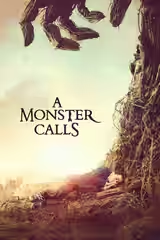
  2. A Monster Calls (2016) · not on Fi1m yetA child’s encounters with fantasy give difficult feelings time to develop.

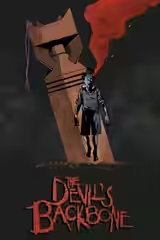
  3. The Devil's Backbone (2001) · not on Fi1m yetA ghost story that gives its children lives beyond their suffering.

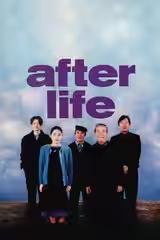
  4. After Life (1998) · not on Fi1m yetAn afterlife built from ordinary memories, with room for uncertainty and tenderness.

  5. Petite Maman (2021, Fi1m 88)Childhood, grief and impossible encounters, handled with patience rather than spectacle.