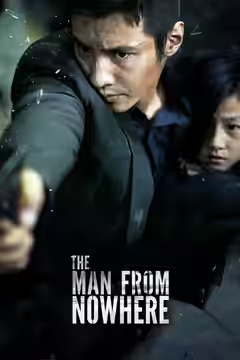
Lee Jeong-beom’s revenge thriller tells a story the genre has told many times, and tells it with a care the genre rarely bothers with. Won Bin is quietly commanding, Kim Sae-ron is better, and the last fight is worth the evening on its own.
Lee Jeong-beom’s film takes the oldest plot in the revenge drawer, a damaged man, a child who adopts him, a gang that takes her, and does not apologise for any of it. Cha Tae-sik (Won Bin) keeps a pawnshop and keeps to himself. So-mi (Kim Sae-ron), the girl upstairs, has decided he is her friend. Her mother steals from the wrong people, both of them are taken, and he goes to get her back. Nothing in that outline is new. What makes The Man from Nowhere worth 119 minutes is how carefully each familiar piece has been made.
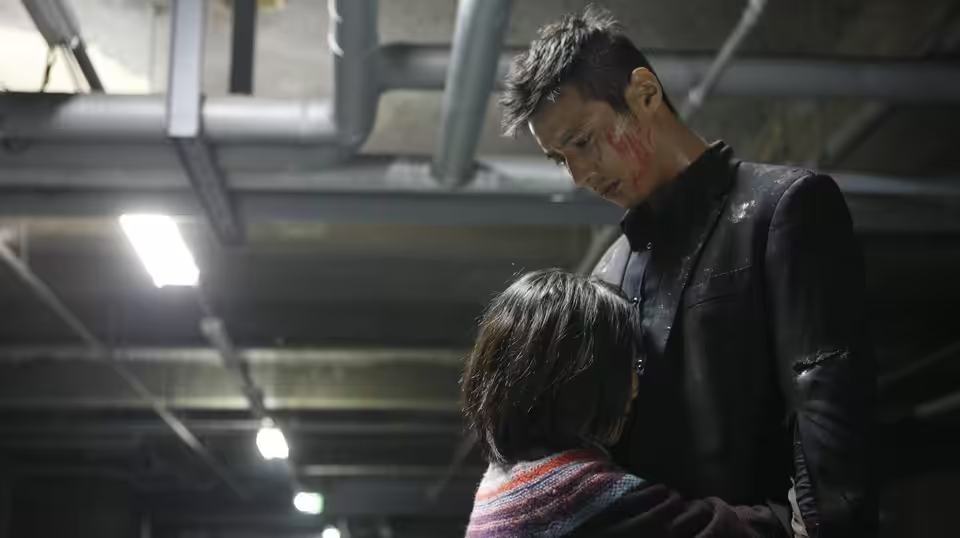
Won Bin plays Tae-sik turned down to a murmur. In the early scenes he barely speaks and barely moves, and the film lets Kim Sae-ron do the talking: she paints her nails in his shop, lies about where her mother is, and asks him for food in the voice of a child who has learned not to expect any. There is not a trace of cuteness in the performance, which is rarer than it should be. Then, in front of a bathroom mirror, Tae-sik takes a pair of scissors to his own fringe, and Won Bin changes the way he stands. The film changes with him.
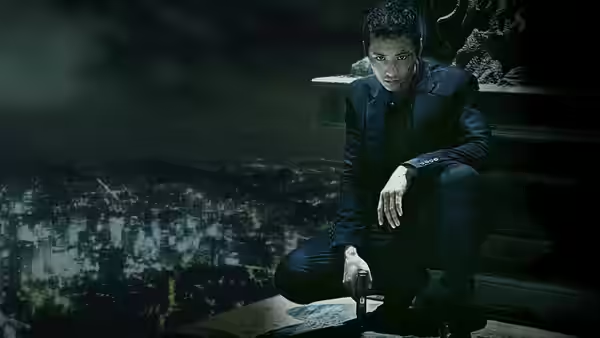
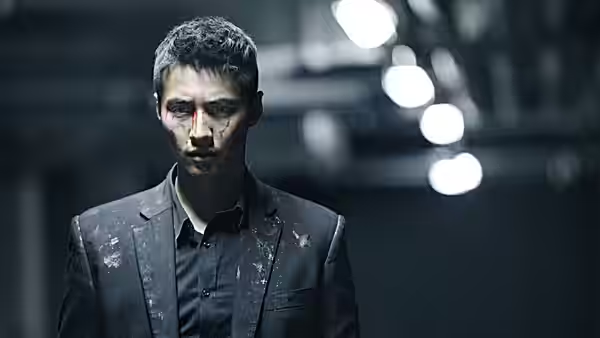
Lee Tae-yoon shoots the pawnshop and the tenement stairwells in brown and low light, and the gang’s world in nightclub neon and strip lighting, so that Tae-sik visibly crosses from one into the other. Yang Hong-sam gives the brothers a loft of bare concrete and tiled bathrooms, rooms built to be hosed down. Jang Joo-hee dresses Tae-sik in a shapeless hoodie for the first hour and a black suit for the second, and the suit does a good deal of the acting. Shim Hyun-jung’s score is mostly piano, sparing and sad, kept under the scenes with the child and almost entirely out of the fights, which is the right decision.
The fights are the reason the film is remembered. Kim Sang-bum and Kim Jae-beom cut the last one in takes long enough that we can see where the knife goes and what it does when it gets there, and when Tae-sik goes out of a window the camera goes with him and does not cut until he has landed and kept running. We held our breath through the final fight and found afterwards that our hands were fists. What did it was the quiet: no music, every blow audible, and two men, Tae-sik and Ramrowan (Thanayong Wongtrakul), the gang’s hired knife, who have each recognised the other as the only opponent worth taking seriously.
What surrounds the fights is less sure. Kim Hee-won and Kim Seung-oh play the brothers Man-seok and Jong-seok at a pitch, cackling and preening, that belongs to a cruder film, and Lee Jeong-beom’s script never lets them be quiet long enough to become frightening rather than loud. The police, led by Kim Tae-hun’s Kim Chi-gon with Lee Jong-pil’s Detective No at his elbow, exist to pull Tae-sik’s file and tell each other what we had already guessed. And the gang’s second trade, which involves what it does with the children it uses as couriers, is shown with less tact than the rest. There is one scene we found hard to sit through, and we are not sure the film needed it to make its point.
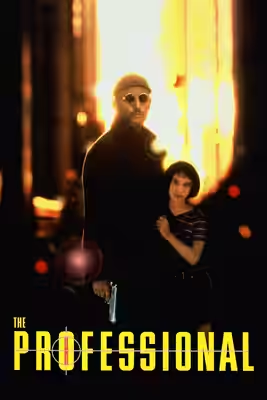
Luc Besson’s Léon (1994) and Tony Scott’s Man on Fire (2004) are the obvious parents, and this is better built than either, right up until the final ten minutes, when Shim’s piano comes back and the film asks for tears it had already earned. Lee Jeong-beom shoots action so that you can see it. That sounds like a small thing. Most of the films this one will remind you of could not manage it.
Watch it with the lights down and do not expect to be surprised. Expect, instead, a story you know told by people who have thought about every corner of it, a child actor who outplays most of the adults, and one fight you will still be describing a week later.