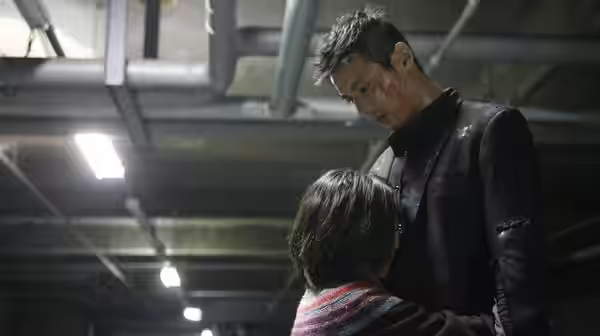
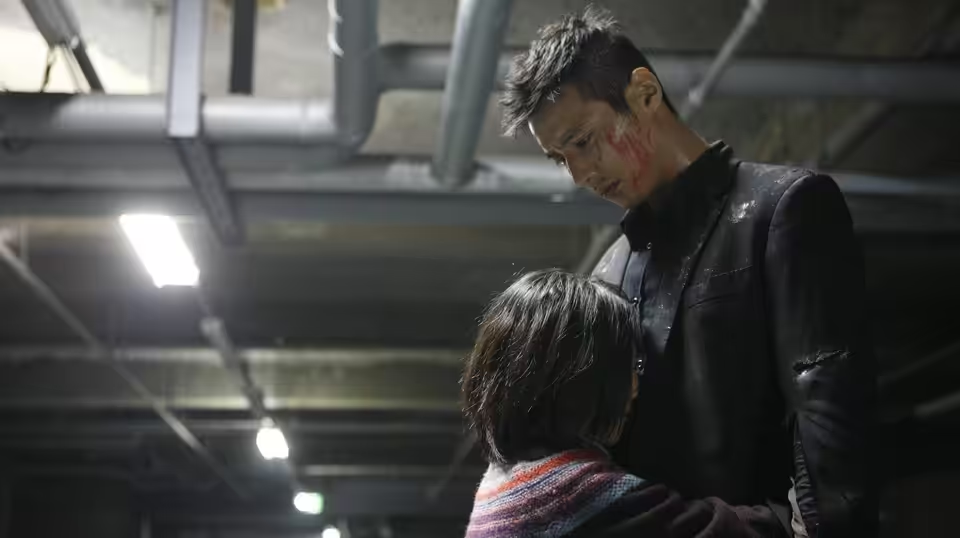
Cha Tae-sik (Won Bin) stands beside Jeong So-mi in a low-ceilinged underground room
Film review

The Man from Nowhere

2010 · Directed by Lee Jeong-beom · 1h 59m

In a sentenceA quiet pawnbroker cuts his own fringe in a bathroom mirror and twenty gangsters should have left town

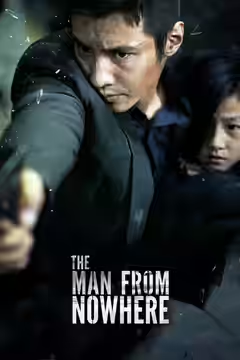
Cha Tae-sik (Won Bin) runs a pawnshop in a Seoul back street and keeps his hair over his eyes and his door mostly shut. The only person who gets past it is Jeong So-mi (Kim Sae-ron), the neglected girl from the flat upstairs, who calls him ‘mister’ and treats his shop as a refuge from her mother, Hyo-jeong (Kim Hyo-seo), a nightclub dancer with a heroin habit. Hyo-jeong steals a bag of drugs from the brothers Man-seok (Kim Hee-won) and Jong-seok (Kim Seung-oh) and hides it in a camera she pawns to Tae-sik. The brothers come for the drugs and take mother and daughter with them. Tae-sik is given a job to do if he wants So-mi back, and the police begin to wonder who the quiet pawnbroker actually is.

Fi1m review

Lee Jeong-beom’s revenge thriller tells a story the genre has told many times, and tells it with a care the genre rarely bothers with. Won Bin is quietly commanding, Kim Sae-ron is better, and the last fight is worth the evening on its own.

Lee Jeong-beom’s film takes the oldest plot in the revenge drawer, a damaged man, a child who adopts him, a gang that takes her, and does not apologise for any of it. Cha Tae-sik (Won Bin) keeps a pawnshop and keeps to himself. So-mi (Kim Sae-ron), the girl upstairs, has decided he is her friend. Her mother steals from the wrong people, both of them are taken, and he goes to get her back. Nothing in that outline is new. What makes The Man from Nowhere worth 119 minutes is how carefully each familiar piece has been made.

Won Bin plays Tae-sik turned down to a murmur. In the early scenes he barely speaks and barely moves, and the film lets Kim Sae-ron do the talking: she paints her nails in his shop, lies about where her mother is, and asks him for food in the voice of a child who has learned not to expect any. There is not a trace of cuteness in the performance, which is rarer than it should be. Then, in front of a bathroom mirror, Tae-sik takes a pair of scissors to his own fringe, and Won Bin changes the way he stands. The film changes with him.

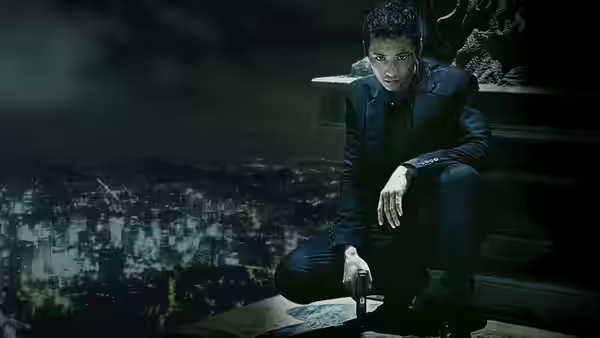
Lee Tae-yoon shoots the pawnshop and the tenement stairwells in brown and low light, and the gang’s world in nightclub neon and strip lighting, so that Tae-sik visibly crosses from one into the other. Yang Hong-sam gives the brothers a loft of bare concrete and tiled bathrooms, rooms built to be hosed down. Jang Joo-hee dresses Tae-sik in a shapeless hoodie for the first hour and a black suit for the second, and the suit does a good deal of the acting. Shim Hyun-jung’s score is mostly piano, sparing and sad, kept under the scenes with the child and almost entirely out of the fights, which is the right decision.

The fights are the reason the film is remembered. Kim Sang-bum and Kim Jae-beom cut the last one in takes long enough that we can see where the knife goes and what it does when it gets there, and when Tae-sik goes out of a window the camera goes with him and does not cut until he has landed and kept running. We held our breath through the final fight and found afterwards that our hands were fists. What did it was the quiet: no music, every blow audible, and two men, Tae-sik and Ramrowan (Thanayong Wongtrakul), the gang’s hired knife, who have each recognised the other as the only opponent worth taking seriously.

What surrounds the fights is less sure. Kim Hee-won and Kim Seung-oh play the brothers Man-seok and Jong-seok at a pitch, cackling and preening, that belongs to a cruder film, and Lee Jeong-beom’s script never lets them be quiet long enough to become frightening rather than loud. The police, led by Kim Tae-hun’s Kim Chi-gon with Lee Jong-pil’s Detective No at his elbow, exist to pull Tae-sik’s file and tell each other what we had already guessed. And the gang’s second trade, which involves what it does with the children it uses as couriers, is shown with less tact than the rest. There is one scene we found hard to sit through, and we are not sure the film needed it to make its point.

Luc Besson’s Léon (1994) and Tony Scott’s Man on Fire (2004) are the obvious parents, and this is better built than either, right up until the final ten minutes, when Shim’s piano comes back and the film asks for tears it had already earned. Lee Jeong-beom shoots action so that you can see it. That sounds like a small thing. Most of the films this one will remind you of could not manage it.

Watch it with the lights down and do not expect to be surprised. Expect, instead, a story you know told by people who have thought about every corner of it, a child actor who outplays most of the adults, and one fight you will still be describing a week later.

Critical consensus AI synthesised

66
Positive
2
Mixed
5
Negative
0

Most critics land on mild approval: two positive, five mixed, none negative, and the spread is narrow. The praise clusters on the action. The fight sequences, and one knife fight in particular, are described as kinetic, well shot and tightly paced, with Lee Jeong-beom credited for keeping them tense. Won Bin’s central performance is the other point of agreement; several reviews call it commanding, and more than one singles out his bond with the child, So-mi, as the part of the film that holds.

The reservations cluster on the story. Nearly every review calls the plot familiar or predictable, and the melodrama is noted more than once. Variety finds the violence excessive enough to limit the film’s appeal, and Den of Geek goes furthest, calling it lacklustre and short on excitement despite the well-delivered action. Two of the seven reviews could not be fully read, so the consensus rests on the five whose verdicts are clear.

Slant Magazine
5 October 2010 · festival review · Sean Axmaker
70*

The critic finds the film slick and well constructed, though not a transcendent action film. He praises its visceral scenes and dark atmosphere, while noting that its plot is predictable.

Read the full review →
Time Out
15 March 2012
65*

The page is identified as a review, but the article text is unavailable, so its verdict cannot be established. The available description highlights Won Bin’s striking presence, without revealing what the critic praises overall.

Read the full review →
Variety
26 October 2010 · festival review · Russell Edwards
65*

Edwards finds the Korean thriller dynamic and commercially polished, though its familiar genre elements and excessive violence limit its appeal. He praises Won Bin’s commanding action-hero performance and Lee Jeong-beom’s tense, well-paced fight sequences.

Read the full review →
Screen Daily
24 August 2010 · Darcy Paquet
64*

The page identifies this as a review, but its text is unavailable behind the access prompt. No critical verdict or praised or criticized element can be established from the visible material.

Read the full review →
Eye for Film
7 November 2010 · festival review · Owen Van Spall
75*

The critic finds it gripping, kinetic entertainment despite familiar clichés and flaws. He singles out the slick, visceral fight choreography and the bond between Tae-sik and So-mi.

Read the full review →
Den of Geek
26 April 2011 · ★★★ · Joseph Ewens
60

Ewens finds the film watchable but ultimately lacklustre, with its story and setting failing to live up to their potential. He praises the well-shot, effectively delivered action, while noting it lacks excitement and the child’s early performance is impressive.

Read the full review →

Straight answers AI written, from our review

Is The Man from Nowhere worth watching?
The Man from Nowhere is worth watching for anyone who likes a revenge thriller made with more care than the genre usually bothers with, and we scored it 72. The plot is the old one, a quiet man and the child upstairs who is taken from him, but Won Bin, Kim Sae-ron and one long final knife fight make it an evening well spent.
How long is The Man from Nowhere, and what is it rated?
The Man from Nowhere runs 1h 59m. It is an action and thriller film.
Where can I watch The Man from Nowhere in Finland?
The Man from Nowhere is not on any streaming or rental service in Finland at the moment. It is available in 8 other countries; change your country at the top of the page to see where. Availability is checked daily.
How violent or frightening is The Man from Nowhere, and is it suitable for children?
The Man from Nowhere is not suitable for children: it has no UK certificate and carries an R rating in the US, and it earns it. The violence is shown clearly and at length, particularly in a final knife fight with no music to soften it, and the gang's use of children as drug couriers includes one scene we found hard to sit through.
How does The Man from Nowhere compare to Léon: The Professional?
The Man from Nowhere is the better built of the two, with action you can follow and a child performance free of cuteness, while Léon: The Professional is the warmer and more sentimental film. Besson's treatment of a child inside the violence is harder to accept; Lee Jeong-beom's has its own uncomfortable moments, but keeps the girl at a distance from the killing. Choose Léon for tenderness and The Man from Nowhere for craft.
What should I watch after The Man from Nowhere?
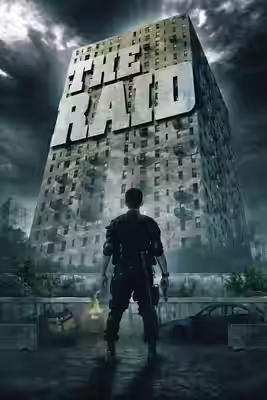
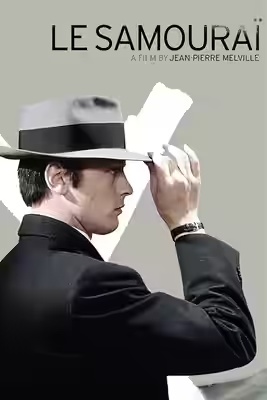
After The Man from Nowhere, try Léon (1994, Fi1m 74): The hitman and the child next door, done first and with more sentiment. Then The Raid (2011, Fi1m 83): Indonesian tower-block siege with fights shot so you can see every blow land; and Le Samouraï (1967, Fi1m 88): Alain Delon says almost nothing for ninety minutes and holds the screen anyway.

Cast

If you liked this, try…

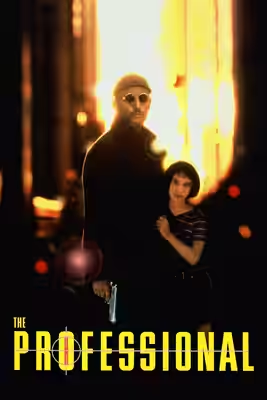
  1. Léon (1994, Fi1m 74)The hitman and the child next door, done first and with more sentiment.

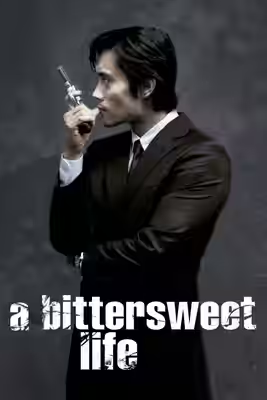
  2. A Bittersweet Life (2005) · not reviewed yetAnother Korean enforcer in a good suit, undone by one small act of mercy.

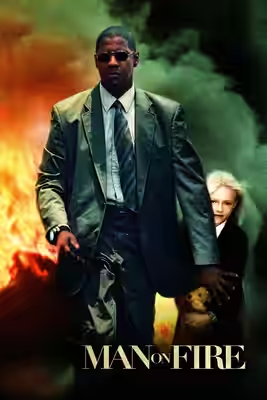
  3. Man on Fire (2004) · not reviewed yetDenzel Washington’s bodyguard loses a girl in Mexico City and burns the city down.

  4. The Raid (2011, Fi1m 83)Indonesian tower-block siege with fights shot so you can see every blow land.

  5. Le Samouraï (1967, Fi1m 88)Alain Delon says almost nothing for ninety minutes and holds the screen anyway.

Free account

Know what to watch tonight

Two lists that know where things are streaming, collections you can share, your own score beside ours, and Discover that remembers what you have seen.

  • Want to see, sorted by what is streaming now
  • Seen, with your score out of ten
  • No adverts, ever