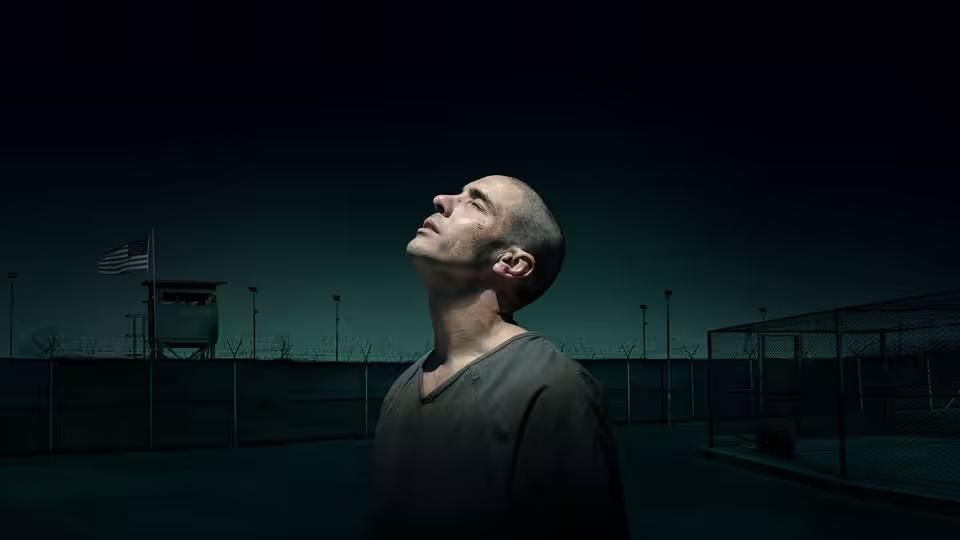
Kevin Macdonald’s The Mauritanian is a frustrating legal drama with a moving central performance. Tahar Rahim gives Mohamedou Ould Slahi humour and individuality; the film keeps interrupting him for a less interesting account of the lawyers.
Kevin Macdonald’s The Mauritanian has a persuasive central performance and a legal story that repeatedly loses its way. It wants to make the abuses at Guantánamo comprehensible through the people trying to establish what happened there. That is a reasonable approach, but the repeated attention to legal procedure leaves too little room for Mohamedou Ould Slahi. We kept wanting the film to let him talk for longer, rather than send us back to the case.
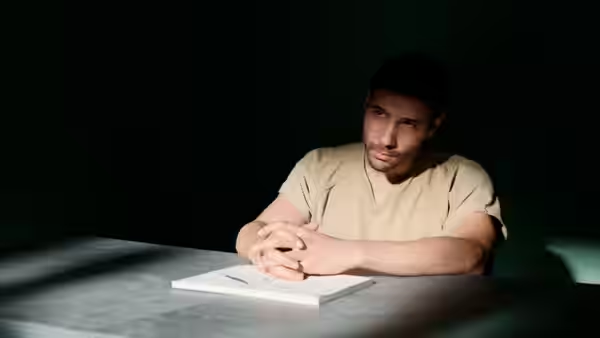
Tahar Rahim gives Slahi enough humour and personality to resist the narrow role of a man whose suffering must instruct us. His account matters because we become interested in the person giving it, whose life cannot be reduced to what has been done to him. We were moved by his wryness in the exchanges with Nancy Hollander, played by Jodie Foster. He makes that humour feel like something Slahi has chosen to retain, and the effort matters.
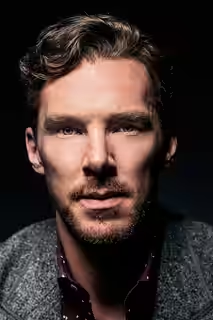
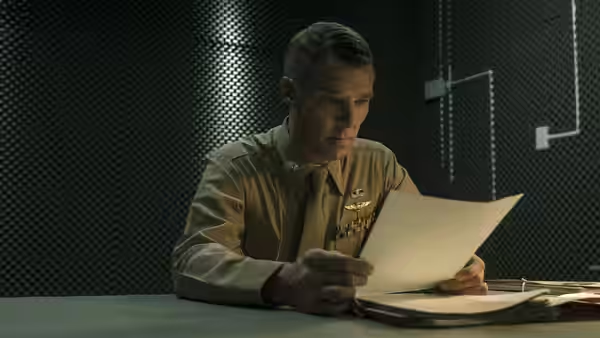
Jodie Foster is effective at keeping Hollander’s professional determination from becoming a request for our admiration. Her exchanges with Slahi have an ease the rest of the film struggles to find. Benedict Cumberbatch, as Lt. Stuart Couch, gives the military lawyer’s concern with the truth some weight, though the writing supplies him with too little complication. The supporting characters too often seem to exist to state a position and leave it at that.
The screenplay by Michael Bronner, Sohrab Noshirvani and Rory Haines never makes the legal work as absorbing as the presence of its central prisoner. Documents and arguments should give a procedural its movement, but here the explanations accumulate without enough sense of discovery. Justine Wright’s editing has to negotiate both the legal narrative and Slahi’s backstory, and the movement between them becomes wearing. We can understand why the lawyers matter without needing to spend quite so much time being reminded of it.
Alwin H. Küchler’s cinematography is most effective when our attention stays with Tahar Rahim, whose performance needs little visual assistance. Michael Carlin’s production design makes the detention camp convincing, though we rarely learn much about the people working there. The surroundings cannot make an underwritten encounter interesting. Tom Hodge’s music contributes to the prevailing seriousness, sometimes pressing for an emotional response that the acting has already earned.
The depiction of abuse is forceful, although the emphasis can feel badly judged. The harsher material is distressing, but its insistence risks making Slahi’s ordeal more vivid than Slahi himself. Tahar Rahim’s restraint is often more affecting, because we can attend to how he responds rather than simply endure another illustration of cruelty. The film has already established enough of his character for his suffering to matter; it does not need to work quite so hard.
A legal thriller can make us feel the difficulty of proving something we already believe. This one too often treats our agreement about the wrongness of abuse as sufficient drama, and 129 minutes gives that weakness time to become a problem. There is enough feeling in the central performance to make the missed opportunities frustrating. Approach it for the acting, with limited expectations of the investigation.