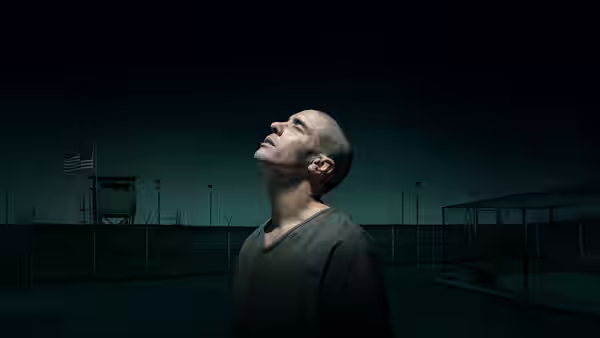
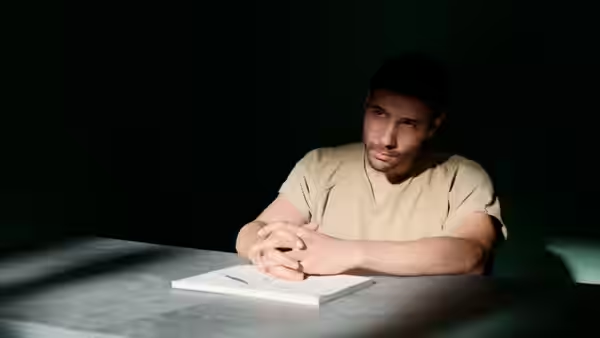
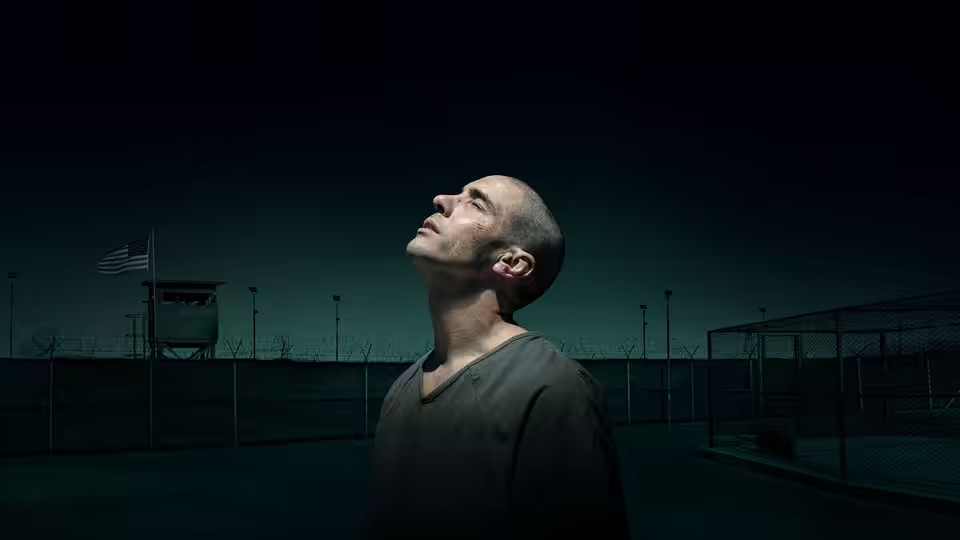
Mohamedou Ould Slahi (Tahar Rahim) stands in a detention yard, looking upward beneath perimeter fencing
Film review

The Mauritanian

2021 · Directed by Kevin Macdonald · 2h 09m

In a sentenceTahar Rahim makes us care, then the lawyers start talking again

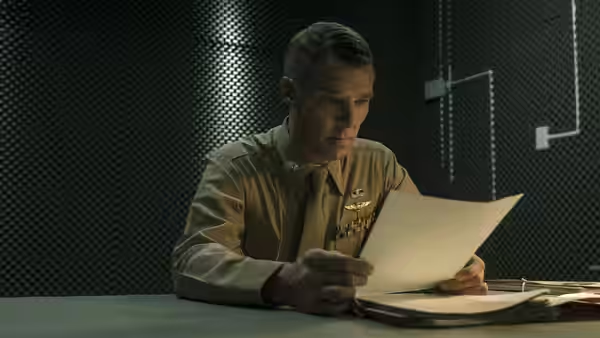
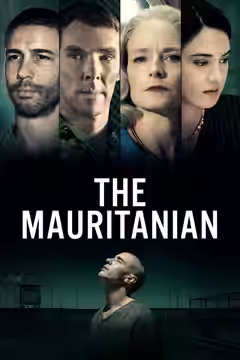
At Guantánamo, Mohamedou Ould Slahi (Tahar Rahim) wants to get out of detention and have his account heard. Nancy Hollander (Jodie Foster) takes up his case, while military lawyer Lt. Stuart Couch (Benedict Cumberbatch) approaches it from the opposing side. The dispute turns on what can be established about Slahi and his treatment, and on the documents the lawyers can obtain. Slahi has to tell his story within a process controlled by the authorities holding him. Hollander and Couch face the task of establishing what those authorities have done and what the evidence can support.

Plays from YouTube when you press play; nothing loads from them until then.

Fi1m review

Kevin Macdonald’s The Mauritanian is a frustrating legal drama with a moving central performance. Tahar Rahim gives Mohamedou Ould Slahi humour and individuality; the film keeps interrupting him for a less interesting account of the lawyers.

Kevin Macdonald’s The Mauritanian has a persuasive central performance and a legal story that repeatedly loses its way. It wants to make the abuses at Guantánamo comprehensible through the people trying to establish what happened there. That is a reasonable approach, but the repeated attention to legal procedure leaves too little room for Mohamedou Ould Slahi. We kept wanting the film to let him talk for longer, rather than send us back to the case.

Tahar Rahim gives Slahi enough humour and personality to resist the narrow role of a man whose suffering must instruct us. His account matters because we become interested in the person giving it, whose life cannot be reduced to what has been done to him. We were moved by his wryness in the exchanges with Nancy Hollander, played by Jodie Foster. He makes that humour feel like something Slahi has chosen to retain, and the effort matters.

Jodie Foster is effective at keeping Hollander’s professional determination from becoming a request for our admiration. Her exchanges with Slahi have an ease the rest of the film struggles to find. Benedict Cumberbatch, as Lt. Stuart Couch, gives the military lawyer’s concern with the truth some weight, though the writing supplies him with too little complication. The supporting characters too often seem to exist to state a position and leave it at that.

The screenplay by Michael Bronner, Sohrab Noshirvani and Rory Haines never makes the legal work as absorbing as the presence of its central prisoner. Documents and arguments should give a procedural its movement, but here the explanations accumulate without enough sense of discovery. Justine Wright’s editing has to negotiate both the legal narrative and Slahi’s backstory, and the movement between them becomes wearing. We can understand why the lawyers matter without needing to spend quite so much time being reminded of it.

Alwin H. Küchler’s cinematography is most effective when our attention stays with Tahar Rahim, whose performance needs little visual assistance. Michael Carlin’s production design makes the detention camp convincing, though we rarely learn much about the people working there. The surroundings cannot make an underwritten encounter interesting. Tom Hodge’s music contributes to the prevailing seriousness, sometimes pressing for an emotional response that the acting has already earned.

The depiction of abuse is forceful, although the emphasis can feel badly judged. The harsher material is distressing, but its insistence risks making Slahi’s ordeal more vivid than Slahi himself. Tahar Rahim’s restraint is often more affecting, because we can attend to how he responds rather than simply endure another illustration of cruelty. The film has already established enough of his character for his suffering to matter; it does not need to work quite so hard.

A legal thriller can make us feel the difficulty of proving something we already believe. This one too often treats our agreement about the wrongness of abuse as sufficient drama, and 129 minutes gives that weakness time to become a problem. There is enough feeling in the central performance to make the missed opportunities frustrating. Approach it for the acting, with limited expectations of the investigation.

Critical consensus AI synthesised

55
Positive
6
Mixed
9
Negative
7

The reviews are mixed, but praise for Tahar Rahim is remarkably consistent. Critics across the divide find that his performance gives Mohamedou Ould Slahi humour, dignity and humanity, keeping the personal cost of detention in view even when the drama falters. The more favourable reviews describe a compelling account of abuses of power, with the Evening Standard particularly valuing the attention paid to Slahi’s personality and storytelling.

The disagreement centres on whether the film gives that performance enough support. Reservations recur around a formulaic legal narrative, sluggish pacing and a lack of dramatic tension. The spread is wide: some critics find the treatment forceful and accessible, while others see worthy material reduced to a conventional procedural. The Los Angeles Times makes the sharper objection that the legal-thriller focus sidelines Slahi himself. Even several of the least persuaded critics regard Rahim as a strong reason to remain engaged.

Evening Standard
30 March 2021 · ★★★★ · Charlotte O'Sullivan
80

The critic finds the film compelling, led by a mesmerising performance from Tahar Rahim. She especially praises how the film keeps Mohamedou Ould Slahi’s personality and storytelling at its centre.

Read the full review →
Radio Times
★★★★ · Andrew Collins
80

Collins presents the film as a forceful reminder that Guantánamo remains open. He praises its full-blooded representation of the detention camp’s victims.

Read the full review →
Sight and Sound
26 March 2021 · BFI
78*

The critic finds the film powerful and authentic, with a quiet dignity at its centre. Tahar Rahim’s performance is singled out for conveying Slahi’s integrity and wry humour through the abuse he endures.

Read the full review →
Variety
12 January 2021 · Peter Debruge
75*

Debruge finds the film a tough but ultimately gripping argument against abuses of power. He singles out Tahar Rahim’s gentle, dignified performance as its emotional anchor.

Read the full review →
Screen Daily
12 January 2021 · Tim Grierson
64*

The accessible page does not reveal the critic’s verdict. It provides no details about what the critic praised or criticized.

Read the full review →
The New York Times
11 February 2021
64*

The page could not be read, so the critic’s verdict is unavailable. No specific praise or complaint can be confirmed from the accessible text.

Read the full review →

Straight answers AI written, from our review

Is The Mauritanian worth watching?
The Mauritanian is worth considering for Tahar Rahim’s moving performance, but we find it a frustrating legal drama and score it 58 out of 100. It suits viewers drawn to character and acting more than those seeking a gripping investigation: the repeated legal explanations interrupt the film’s strongest scenes and make its 129 minutes feel long.
How long is The Mauritanian, and what is it rated?
The Mauritanian runs 2h 09m. It is a drama and thriller film.
Where can I watch The Mauritanian in Greece?
The Mauritanian is not on any streaming or rental service in Greece at the moment. It is available in 33 other countries; change your country at the top of the page to see where. Availability is checked daily.
How violent or frightening is The Mauritanian, and is it suitable for children?
The Mauritanian has a UK 15 certificate and contains forceful, distressing depictions of abuse, making it unsuitable for children under 15. We find the repeated emphasis on cruelty sometimes excessive; older teenagers and adults sensitive to suffering in detention should approach with caution, even though much of the film concerns legal procedure.
How does The Mauritanian compare to In the Name of the Father?
The Mauritanian is the less satisfying legal-injustice drama; we recommend In the Name of the Father for the difficult father-and-son relationship that makes its imprisonment story painfully immediate. Both feature affecting performances and sometimes press too hard for emotion, but The Mauritanian repeatedly draws attention away from its central prisoner towards less absorbing legal explanations.
What should I watch after The Mauritanian?
After The Mauritanian, try In the Name of the Father (1993, Fi1m 83): A prison drama whose family relationships make the legal injustice painfully immediate. Then The Battle of Algiers (1966, Fi1m 93): For a harder examination of state violence, without reassuring legal heroes; and The Lives of Others (2006, Fi1m 84): For another account of conscience struggling inside an institution built on coercion.

Cast

Awards

European Film Award for Best Actor, 2021

Nominated
European Film Award for Best Actor

If you liked this, try…

  1. In the Name of the Father (1993, Fi1m 83)A prison drama whose family relationships make the legal injustice painfully immediate.

  2. The Battle of Algiers (1966, Fi1m 93)For a harder examination of state violence, without reassuring legal heroes.

  3. The Report (2019) · not reviewed yetAnother investigation of sanctioned abuse, more attentive to the labour of uncovering it.

  4. The Lives of Others (2006, Fi1m 84)For another account of conscience struggling inside an institution built on coercion.

  5. Court (2014) · not reviewed yetFor a quieter, sharper look at how ordinary legal procedure can sustain injustice.