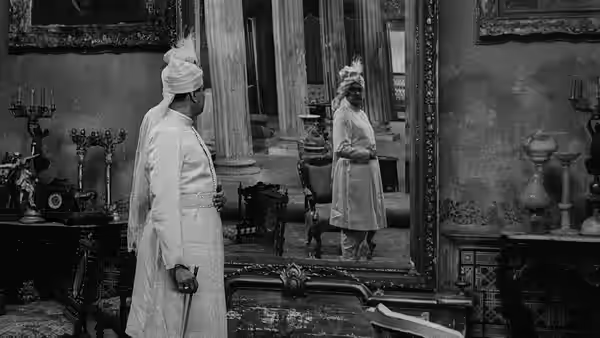
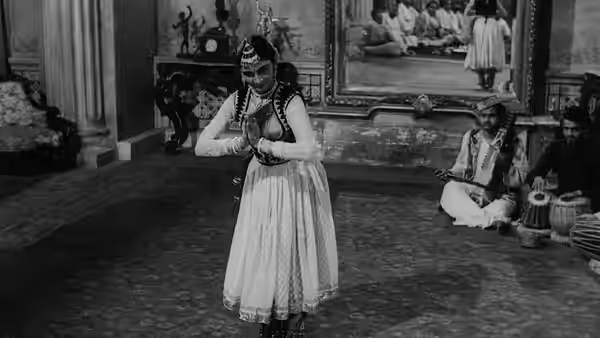
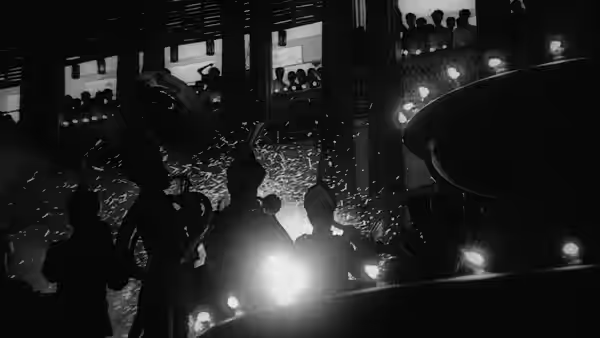
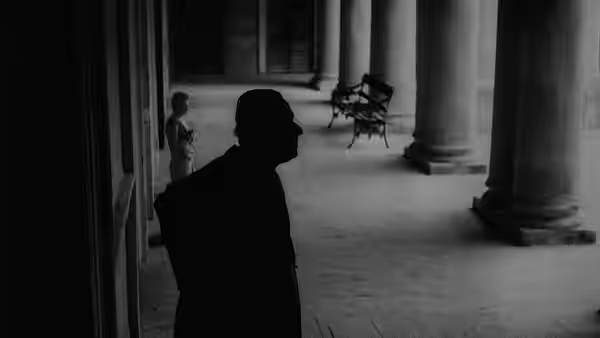
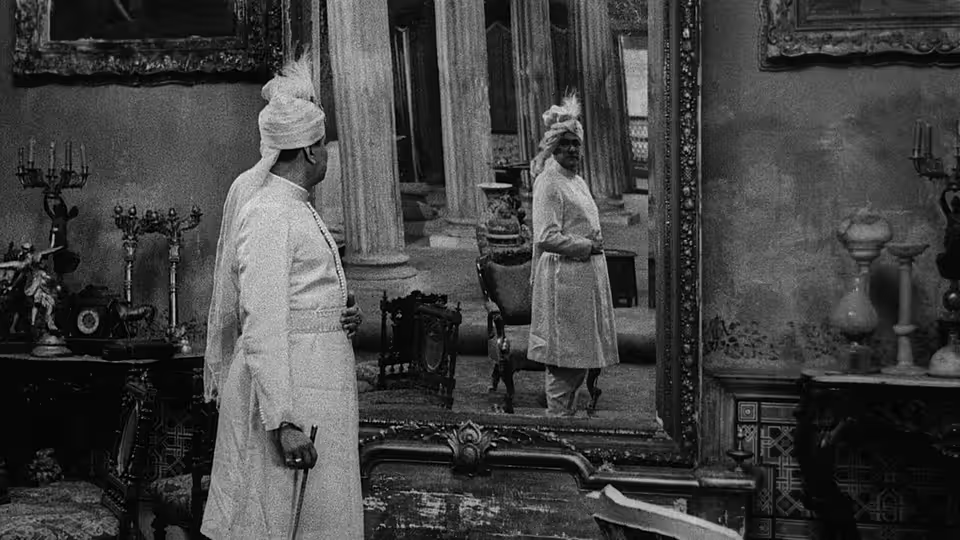
A turbaned man stands in an ornate music room, facing his reflection in a large mirror
Film review

The Music Room

1958 · Directed by Satyajit Ray · 1h 40m

In a sentenceThe aristocrat needs advice, but we would rather not interrupt the music

Biswambhar Roy (Chhabi Biswas) is an aristocrat watching his way of life decline. Music remains central to the standing he wants to preserve, even as progress makes inherited privilege less secure. Mahim Ganguli (Gangapada Basu), Anantha (Kali Sarkar) and Mahamaya Roy (Padma Devi) are among the people around him. Roy clings to the musical performances that give his life purpose and sustain his pride. His attachment to the music room becomes part of a struggle to maintain his position while the conditions that supported it continue to change.

Fi1m review

Satyajit Ray makes an aristocrat’s decline moving without excusing his pride. Chhabi Biswas and the musical performances earn our patience, though the drama between them sometimes feels too firmly fixed in place.

The Music Room is a patient, affecting film about a man whose love of music gives us a reason to care about his decline. Satyajit Ray takes aristocratic pride seriously without asking us to wish inherited privilege back into good health. We recommend it warmly, provided there is room in the evening for sustained listening. The dramatic pace can feel stiff, but the musical performances give that slowness a purpose beyond the solemn examination of a difficult man.

Chhabi Biswas makes Biswambhar Roy’s pride bearable to watch because his attachment to music feels so deep. There is selfishness in that attachment, and the performance allows us to recognise it without reducing him to a cautionary example. We were moved by his absorption in the musical performances; for those stretches, we could understand why he would resist anything that threatened them. That feeling gives his decline a sadness that a simple portrait of aristocratic foolishness would struggle to achieve.

Subrata Mitra’s cinematography is especially persuasive in the musical passages, where watching the performers becomes a pleasure in itself. Their concentration matters, as does the sense of people doing demanding work before us. The care given to their presence makes Roy’s enthusiasm comprehensible, including to those who do not share his tastes. These passages also provide a welcome opportunity to look beyond the central character, whose troubles can otherwise make the film feel rather airless.

Bansi Chandragupta’s production design makes the music room convincing as a place someone might build a life around. Its formality suits Roy, and it also makes his attachment feel restrictive; we can admire the setting and still want some air. That is useful work in a film whose central character regards cultural refinement as a reason to hold his ground. The space helps us understand why leaving an established way of life behind might be difficult, even when staying seems foolish.

The music, credited to Robin Majumdar and Ustad Vilayat Khan, has to do more here than announce sadness or supply atmosphere. The sustained performances require attention, and they repay it by making Roy’s devotion something we can share for a while. We do not need to know the musical tradition to recognise concentration, skill or the pleasure of listening. Familiarity with Indian classical music will add to the experience, but treating it as an entrance requirement would shut out people the film can reach perfectly well.

Dulal Dutta’s editing is most convincing when it gives the music time without making us impatient for the story to resume. Between performances, the drama can feel over-insistent about Roy’s decline, and his pride is established more quickly than it is complicated. There are stretches when we understand his resistance and find ourselves waiting to learn something else about him. This is a limitation, though making everything move faster would risk losing the patience that serves the music so well.

Stories about fading aristocrats can make decay seem so tasteful that we forget what their subjects are defending. This one keeps Roy’s selfishness in view while allowing his love of art to be credible. We would have welcomed a little more dramatic movement, but we would not shorten the musical passages to get it. Choose it for an evening when a singer or dancer can have your full attention.

Critical consensus AI synthesised

78
Positive
6
Mixed
3
Negative
0

Most critics respond warmly to The Music Room, with praise clustering around its musical performances and its sympathetic but unsentimental portrait of a declining aristocrat. The strongest notices see the music as essential to the tragedy, expressing the protagonist’s pride and distress rather than merely accompanying the story. The photography and haunting atmosphere also draw praise. Across the fuller reviews, a recurring strength is the balance between affection for the central figure and criticism of the feudal values he represents.

The recorded scores range from qualified approval to strong enthusiasm, with no negative verdicts. Radio Times offers the clearest reservation: it admires the lead performance but finds the film less cohesive than Ray’s strongest work, suggesting that full appreciation requires an ear for Indian classical music. Three reviews provide no verifiable account of their reasoning, which limits how precisely the less enthusiastic end of the consensus can be described.

The AV Club
27 July 2011 · A · Scott Tobias
95

Tobias praises the film as a masterpiece that brings music and story together with tragic force. He singles out the ecstatic, unsettling finale, where a dancer’s movements express the aristocrat’s turmoil.

Read the full review →
The Guardian
14 January 1999 · Derek Malcolm
90*

Malcolm argues that The Music Room is among Ray’s greatest films and a profound expression of his connection to Indian culture. He especially praises Subrata Mitra’s cinematography and Ray’s score, while noting the film’s affectionate but clear-eyed portrayal of a lonely, declining aristocrat.

Read the full review →
The New Yorker
90*

The critic finds the film a rapturous, aesthetically rich tragedy about art as a necessary luxury. They single out the climactic dance sequence as uncomplicated yet visionary.

Read the full review →
Slant Magazine
21 July 2011 · ★★★★ · Glenn Heath Jr.
80

The review regards Ray’s film as a haunting portrait of pride and feudal decline. It praises the beautiful musical performances and the way their presentation deepens the film’s themes.

Read the full review →
RogerEbert.com
75*

The URL identifies this as a Great Movies review of Satyajit Ray’s film. The page is blocked, so its verdict and any specific praise or complaint cannot be verified.

Read the full review →
Time Out
15 March 2012
65*

The page identifies a review of Satyajit Ray’s 1958 film, but the review text is unavailable. Its verdict and any specific praise or complaint cannot be determined from the accessible page.

Read the full review →

Straight answers AI written, from our review

Is The Music Room worth watching?
The Music Room is well worth watching for its musical performances and Chhabi Biswas’s affecting portrait of aristocratic pride; we score it 88. We recommend it for an evening of patient listening, with the caveat that the drama between performances sometimes feels stiff and repeats what we already understand about its central character.
How long is The Music Room, and what is it rated?
The Music Room runs 1h 40m. It is a drama and music film.
Where can I watch The Music Room in Japan?
The Music Room is not on any streaming or rental service in Japan at the moment. It is available in 3 other countries; change your country at the top of the page to see where. Availability is checked daily.
How does The Music Room compare to Late Spring?
The Music Room centres on aristocratic decline and sustained musical performances, while Late Spring finds its quiet pain in a father-and-daughter relationship and family duty. We recommend both: Late Spring is the better choice for closely observed family pressures, while The Music Room suits an evening given over to listening; neither offers a brisk pace.
Is The Music Room based on a true story or a book?
The Music Room is adapted from a novel by Tarasankar Bandyopadhyay, rather than presented as a true story. We find Roy’s pride and devotion to music understandable on their own, so knowing the source is not an entrance requirement, nor is familiarity with Indian classical music.
What should I watch after The Music Room?
After The Music Room, try Late Spring (1949, Fi1m 92): Family duty and social change become quietly painful through closely observed behaviour. Then Distant Voices, Still Lives (1988, Fi1m 90): Songs carry family feeling that ordinary conversation can barely bring into words; and The Piano (1993, Fi1m 88): Music gives a stubborn central character a means of expression beyond speech.

Cast

Awards

National Film Award for Best Bengali Feature Film, 1959

Won
National Film Award for Best Bengali Feature Film

National Film Award for Second Best Feature Film, 1959

Won
National Film Award for Second Best Feature Film

If you liked this, try…

  1. The Leopard (1963) · not on Fi1m yetAnother aristocrat faces change, with greater spectacle and equally stubborn pride.

  2. The Chess Players (1977) · not on Fi1m yetSatyajit Ray returns to privileged men finding absorbing ways to ignore change.

  3. Late Spring (1949, Fi1m 92)Family duty and social change become quietly painful through closely observed behaviour.

  4. Distant Voices, Still Lives (1988, Fi1m 90)Songs carry family feeling that ordinary conversation can barely bring into words.

  5. The Piano (1993, Fi1m 88)Music gives a stubborn central character a means of expression beyond speech.