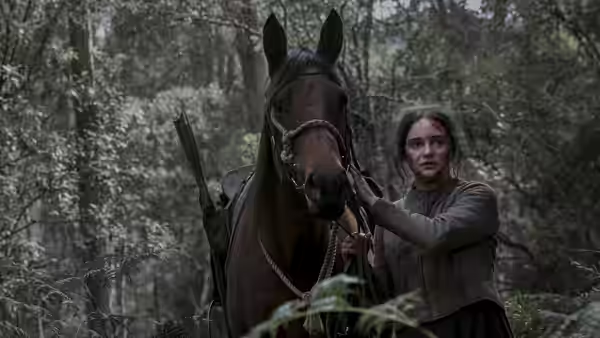
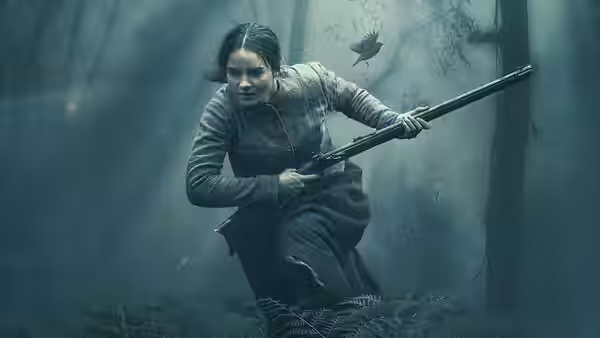
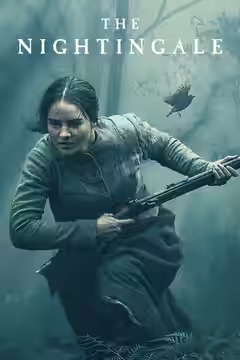
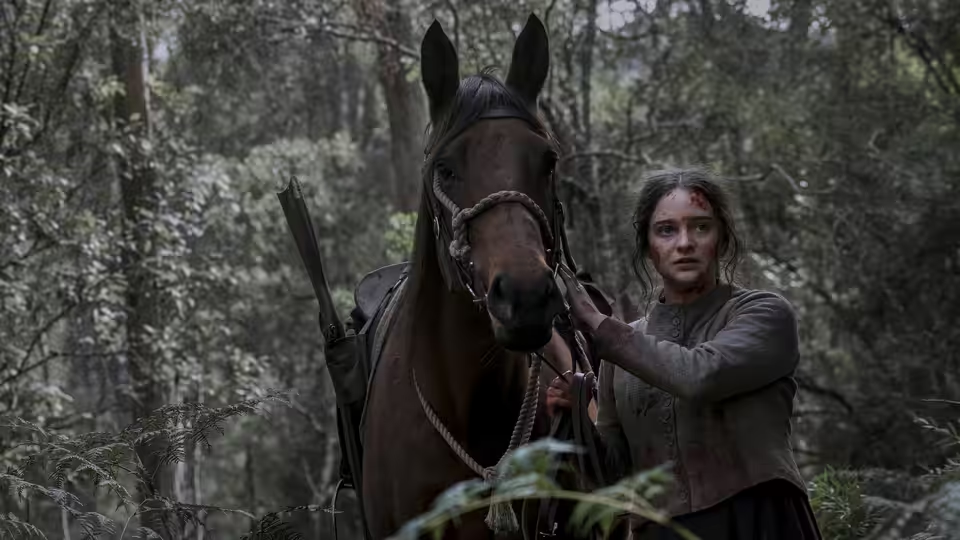
Clare (Aisling Franciosi) stands beside a saddled horse in a forest
Film review

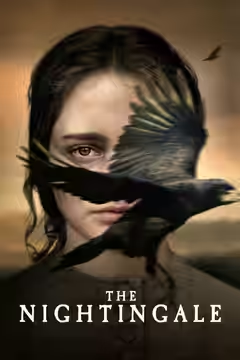
The Nightingale

2018 · Directed by Jennifer Kent · 2h 16m · MPA R

In a sentenceRed coats, green bush, square frame, and nowhere in any of it to look away

Van Diemen’s Land, 1825. Clare (Aisling Franciosi), an Irish convict, has served her sentence and is still held at a British garrison by Lieutenant Hawkins (Sam Claflin), who has her sing for his officers at night and will not let her go. Her husband Aidan (Michael Sheasby) wants her out of the barracks. Hawkins wants a promotion and a posting to Launceston, and his men Ruse (Damon Herriman) and Jago (Harry Greenwood) do what he tells them. One night the soldiers come for her. By morning Clare has nothing left. When Hawkins rides north through the bush, she pays an Aboriginal tracker, Billy (Baykali Ganambarr), to follow him.

Plays from YouTube when you press play; nothing loads from them until then.

Fi1m review

Jennifer Kent’s revenge western, set in the Tasmanian bush in 1825, is serious, well made and hard to sit through. The middle hour, with Aisling Franciosi and Baykali Ganambarr, is as good as the reviews say; the last third repeats itself.

Jennifer Kent’s second film, after The Babadook, moves out of a suburban house and into the Tasmanian bush in 1825, and leaves the ghosts behind. Nothing in it is imagined. Clare (Aisling Franciosi) is an Irish convict kept past her sentence by Lieutenant Hawkins (Sam Claflin), who has her sing for his officers and calls her his nightingale. When he is refused the promotion he wants, he takes it out on her and her family, then rides north for Launceston. She hires a tracker, Billy (Baykali Ganambarr), and follows. It is a revenge western, a good one, and half an hour longer than it needs to be.

The first act is the hard part. Kent stages the attack on Clare’s home at close quarters, in a frame that barely holds the walls, and does not cut away when a kinder director would. We were horrified, and we were meant to be. The camera stays on Franciosi’s face while things happen at the edge of the shot, so that it feels as though we are there too. Everything Clare does afterwards has to be weighed against what we saw, and Kent does not want us to have looked away.

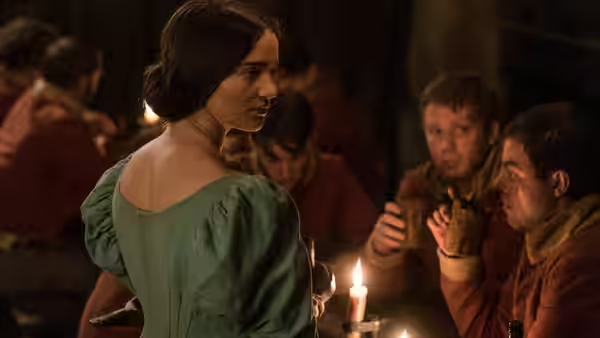
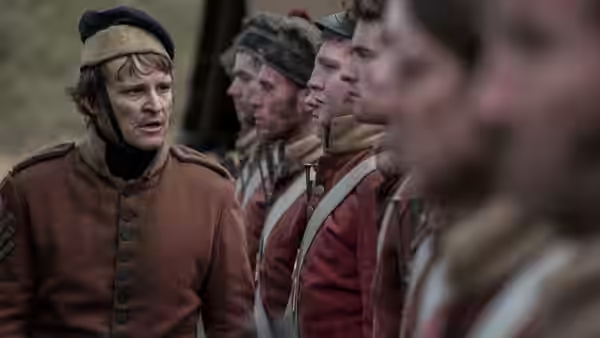
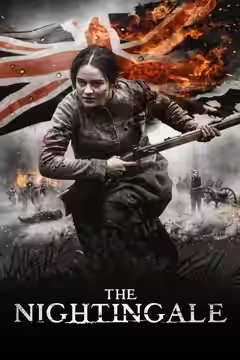
Radosław Ładczuk shoots it in the old square Academy ratio, so the sky is mostly cut off and the trees crowd in from both sides. The bush is a wet dark green, and the red of the soldiers’ coats, muddied and torn by Margot Wilson within a day’s march, is the only colour that reads across a clearing. Alex Holmes gives the garrison low ceilings and Hawkins’s quarters a table, a bottle and a piano. Jed Kurzel’s score is a low drone, absent for long stretches. The singing does the work instead: Clare’s Irish songs, and later Billy’s, in his own language, sung to the birds.

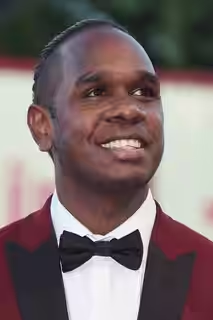
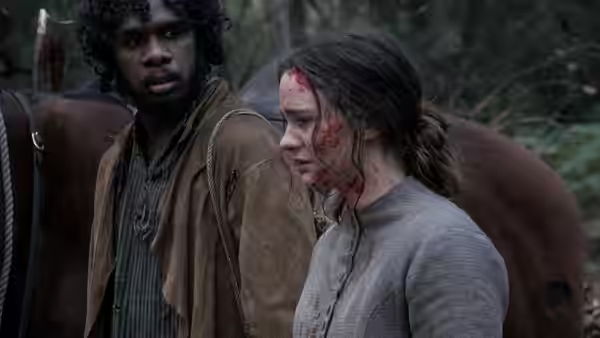
The middle is the best of it, and it belongs to Ganambarr. Billy has his own dead and his own reasons to hate a red coat, and no interest at first in Clare’s grief, which she assumes outranks his. Ganambarr plays him lightly, with a humour the film badly needs, and the slow business of two people who despise each other learning to walk in step is written without a single speech about understanding. The scene that got us was small: a fire at night, Clare singing to stay awake, and Billy, after a while, answering with a song of his own. It moved us more than we expected anything in this film to. Simon Njoo holds both faces and lets the songs finish.

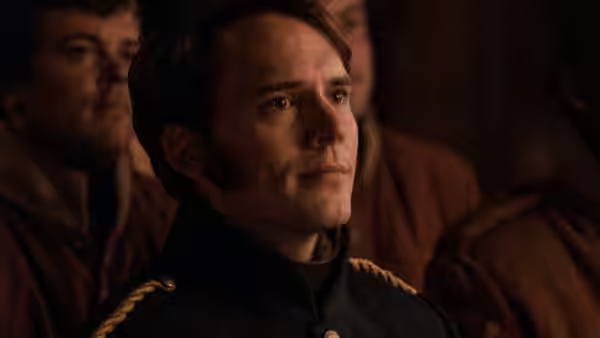
Franciosi is excellent and has the harder job. Clare is not softened by loss; she is made reckless and cruel by it, and Franciosi lets her be unlikeable for long stretches. Claflin plays Hawkins as a vain, frightened man who needs to be admired, and the film shows us his vanity in every scene and his doubt in none. He is a monster from the first minute and stays one; Damon Herriman’s Ruse and Harry Greenwood’s Jago are the bully and the boy who follow him. Kent wants us to see that the colony made these men. The film never shows how.

The last third has the problem most critics have noticed, and it is real. The soldiers stop, move on, stop again. Clare’s nightmares, cut in hard and black, come round until they lose their force. There is a scene involving Lowanna (Magnolia Maymuru), an Aboriginal woman the soldiers have taken, that several reviewers have objected to, and we think it is handled worse than anything around it. At 136 minutes the film repeats itself where it should be narrowing, and the ending, which we will not describe, arrives in two parts where one would have done.

The Babadook was one house and one idea. This is a country and several, and not all of them are finished. It is also rare in refusing what a revenge western is built to deliver, and we respected that even while wanting it to hurry up. It is an 18 certificate and earns it. Do not put it on with anyone who has not agreed to the first half hour. Stay to the end, though. The last shot is worth the walk.

Critical consensus AI synthesised

74
Positive
20
Mixed
7
Negative
1

Most critics come away from Jennifer Kent’s second film shaken and, on balance, admiring. The word that recurs is harrowing; almost every review warns that the opening stretch is gruelling and the violence graphic. The praise gathers around the two leads. Aisling Franciosi’s Clare is called compelling, mesmeric, spellbinding, and Baykali Ganambarr’s Billy is singled out again and again, with several reviews saying the film’s real subject is the slow, unsentimental bond between them and the way his perspective gradually reshapes hers.

The reservations cluster on length and repetition. Several critics find the middle and the finale lose focus, and a handful think the violence becomes declarative rather than illuminating. The spread is wide: the loudest dissent comes from Vulture, which calls the revenge melodrama heavy-handed and misses the metaphorical reach of The Babadook, while the Evening Standard, otherwise warm, objects to how the rape of an Indigenous woman is staged. Only one review is outright negative.

RogerEbert.com
1 August 2019 · ★★★★/4 · Sheila O'Malley
100

The review regards the film as a powerful, harrowing work. It singles out Jennifer Kent’s unflinching treatment of colonial violence for praise.

Read the full review →
Time Out
22 July 2019 · ★★★★★ · Stephen Garrett
100

Garrett calls the film brilliantly harrowing and an impressive follow-up to The Babadook. He emphasizes its brutal violence and disturbing subject matter.

Read the full review →
Sight and Sound
29 November 2019 · Nikki Baughan
90*

The critic calls the film an astonishing and essential work, finding its unflinching revenge story profoundly powerful. She especially praises the nuanced relationship between Clare and Billy, which complicates the film’s treatment of colonialism and justice.

Read the full review →
The AV Club
1 August 2019 · A- · A.A. Dowd
90

Dowd praises the film as a harrowing, politically resonant Western whose severity is purposeful rather than gratuitous. He especially singles out Aisling Franciosi and Baykali Ganambarr, whose performances make the characters’ hard-won empathy moving without sentimentality.

Read the full review →
Empire
25 November 2019 · John Nugent
82*

The critic calls the film gripping and powerfully made, despite its disturbing violence and questions about how sensitively it handles race and gender. They single out Baykali Ganambarr’s performance as extraordinary, especially its heartbreaking emotional range.

Read the full review →
Evening Standard
29 November 2019 · ★★★★ · Charlotte O'Sullivan
80

O’Sullivan finds the film intensely dramatic and ultimately surprisingly comforting despite its extreme violence. She praises the powerful performances and Kent’s vivid, carefully crafted sense of place, while noting a misstep in how the rape of an Indigenous woman is depicted.

Read the full review →

Straight answers AI written, from our review

Is The Nightingale worth watching?
The Nightingale is worth watching for anyone prepared for a serious, hard revenge western, and we scored it 78. Aisling Franciosi and Baykali Ganambarr are excellent, and the middle hour in the Tasmanian bush is as good as its reputation. The last third repeats itself, and the film runs half an hour longer than it needs to.
How long is The Nightingale, and what is it rated?
The Nightingale runs 2h 16m and is rated R by the MPA in the US. It is a drama and thriller film.
Where can I watch The Nightingale in the US?
The Nightingale is streaming on AMC+, MUBI, Amazon Prime Video, The Roku Channel and Apple TV in the US, and it is also available to rent from Amazon Prime Video and Apple TV from $2.99. It leaves MUBI on 1 October. Availability is checked daily; the links above go straight to each service.
How violent or frightening is The Nightingale, and is it suitable for children?
The Nightingale is an 18 certificate in the UK and earns it, and it is not suitable for children. The first act stages a sexual assault and the killing of a family at close quarters, and Jennifer Kent does not cut away. Nightmares and further violence follow, so anyone squeamish should agree to the first half hour before it starts.
How does The Nightingale compare to Meek's Cutoff?
The Nightingale and Meek's Cutoff are both slow westerns shot in the square Academy frame, but Kelly Reichardt's film is quiet and withholding where Jennifer Kent's is brutal and direct. Meek's Cutoff is the tighter and more controlled of the two; The Nightingale has the stronger performances and the harder first act, and suits viewers who can take graphic violence.

Cast

If you liked this, try…

  1. Sweet Country (2017) · not on Fi1m yetWarwick Thornton’s outback western tells the same colonial story from the tracked man’s side.

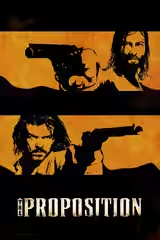
  2. The Proposition (2005) · not on Fi1m yetNick Cave’s script and John Hillcoat’s flies and heat; brutal, and better paced.

  3. Meek's Cutoff (2010, Fi1m 82)Kelly Reichardt’s wagon trail in the square frame, with a guide nobody trusts.

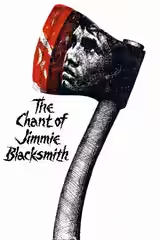
  4. The Chant of Jimmie Blacksmith (1978) · not on Fi1m yetFred Schepisi’s Australian revenge story, angrier than Kent’s and forty years earlier.

  5. Zama (2017) · not on Fi1m yetLucrecia Martel’s colonial officer waits for a transfer that never comes; dry where Kent is wet.