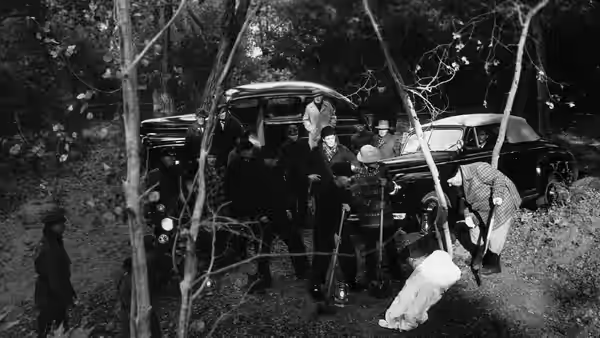
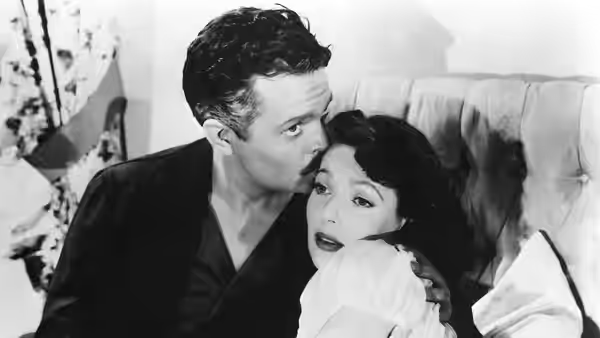
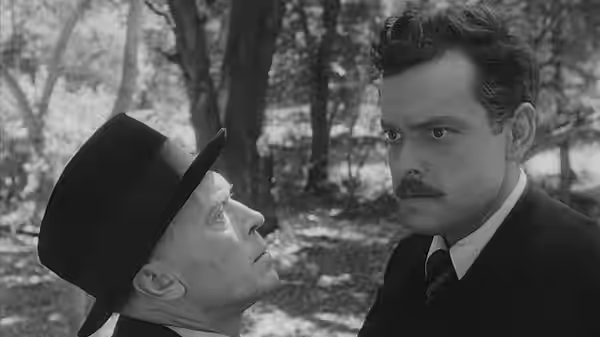
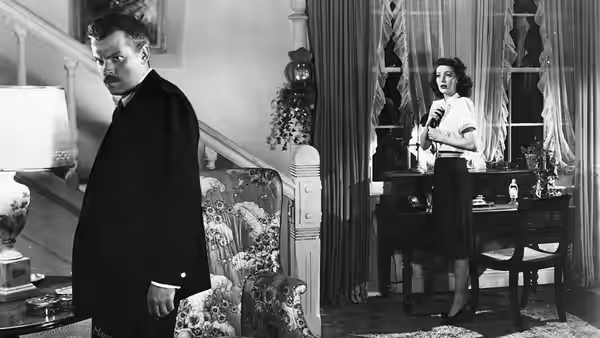
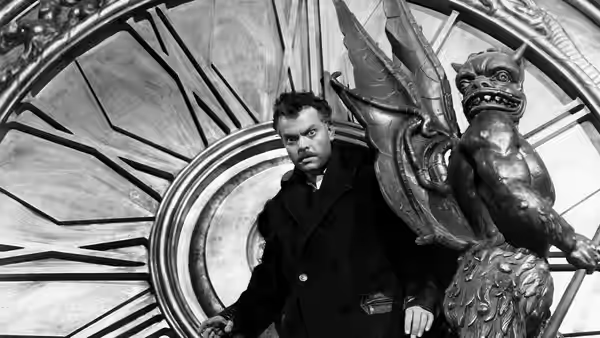
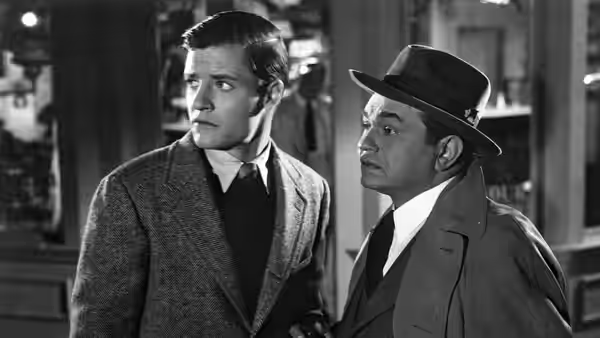
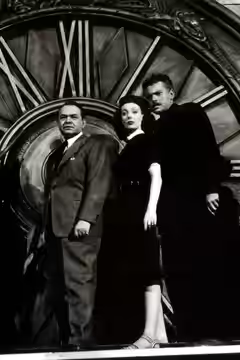
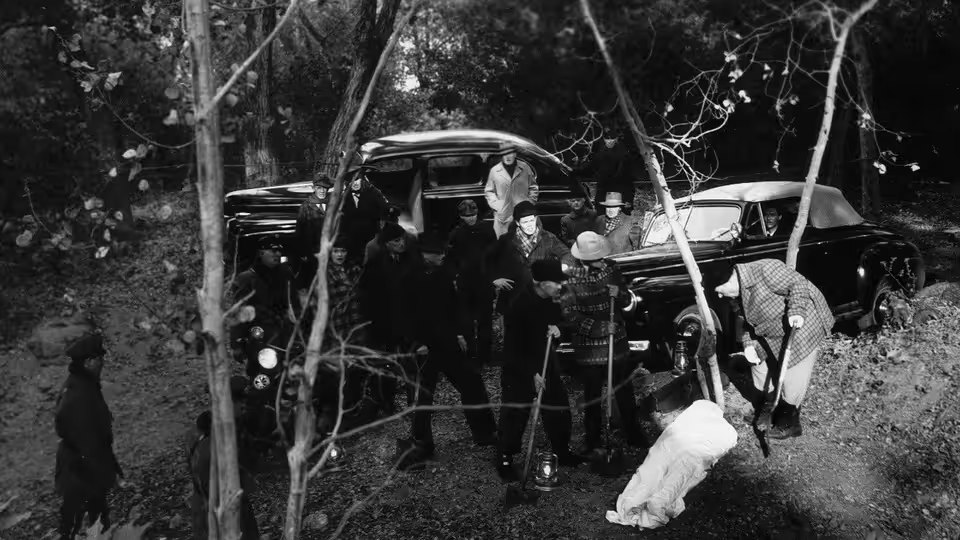
Several men gather beside a parked car as another figure crouches near a body on the ground
Film review

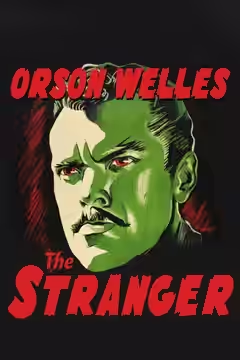
The Stranger

1946 · Directed by Orson Welles · 1h 35m · Statens medieråd 15

In a sentenceA federal agent looks prepared to wait until everyone else has made a mistake

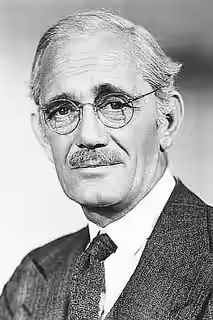
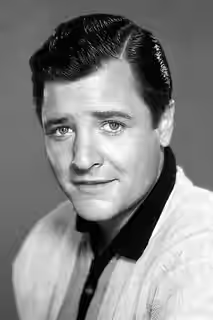
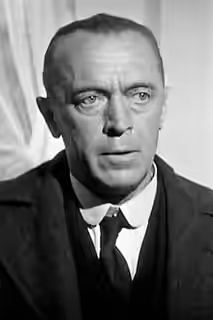
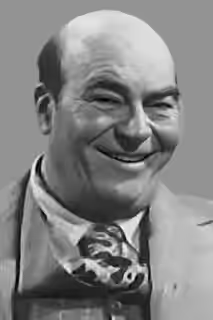
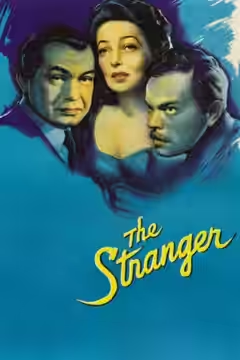
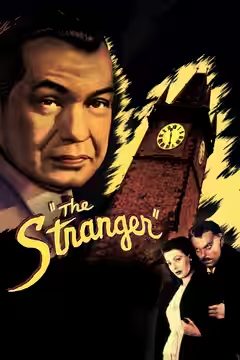
In small-town America, Federal Agent Wilson (Edward G. Robinson) patiently stalks his target. Prof. Charles Rankin (Orson Welles) and Mary Longstreet (Loretta Young) stand at the centre of the story, with Judge Adam Longstreet (Philip Merivale), Noah Longstreet (Richard Long) and Konrad Meinike (Konstantin Shayne) among the other figures involved. The pursuit puts the town’s complacency under scrutiny. Wilson watches and waits, bringing an investigator’s suspicion into surroundings where people have become comfortable with what they know, or believe they know, about those around them.

Fi1m review

Orson Welles directs a tense, carefully built thriller, and Edward G. Robinson gives it a quietly unsettling centre. The screenplay settles for familiar plotting, but the performances make it worth an evening.

The Stranger is a good crime thriller whose conventional story gives its actors something firm, if sometimes restrictive, to work with. Orson Welles directs with enough confidence to make the pursuit feel dangerous, without depending entirely on uncertainty about what happens next. The pleasure lies in watching people assess one another, especially when Edward G. Robinson is doing the assessing. We recommend it to anyone who enjoys suspense built around the way people behave under observation.

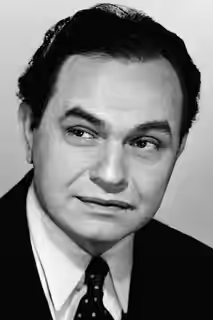
Edward G. Robinson plays Federal Agent Wilson with a patience that makes the pursuit uncomfortable. He does not need to seem the most forceful person in the film; his sustained attention makes everyone else appear increasingly exposed. We were unnerved by that patience, by the sense that the agent can afford to wait while someone else cannot. It is an economical performance, and the tension would be poorer for a more demonstrative investigator.

Orson Welles, as Prof. Charles Rankin, supplies a more emphatic presence, and the contrast is productive. His performance occasionally puts so much weight on an exchange that there seems little left for us to discover, but its force remains persuasive. Loretta Young’s Mary Longstreet gives the film a welcome change of emphasis from the two leading men. Her performance also makes us wish the writing allowed its people more room to be difficult to understand.

Russell Metty’s cinematography and Perry Ferguson’s production design contribute substantially to the unease. The photography keeps our attention on the actors without making their surroundings seem incidental, while the town feels sufficiently settled for its complacency to matter. That gives the pursuit a setting worth thinking about, rather than somewhere merely convenient for the plot. The direction is strongest when it lets us examine the people and the place without pressing too hard for a response.

Ernest J. Nims’s editing keeps the pursuit moving without making the investigator’s restraint feel like a delay. In a film running 95 minutes, that balance matters: waiting must remain interesting, and for the most part it does. Bronislau Kaper’s music is less discreet, sometimes giving the suspense an insistence it does not need. The actors have already supplied enough cause for concern, and the extra emphasis can make their work feel unnecessarily explained.

The chief reservation is Anthony Veiller’s screenplay, which follows a familiar thriller structure when the setting suggests possibilities for something sharper. Its criticism of small-town complacency is persuasive, though the people remain easier to understand as participants in a pursuit than as inhabitants of a community. This is hardly a fatal limitation in a crime film, but the care taken elsewhere encourages greater expectations. The story does its job, then leaves the performances to provide much of what makes it interesting.

There is enough control here to reward an evening, provided familiar plotting is not a barrier. The stronger passages make sustained attention exciting, which is a useful reminder that suspense need not mean constant activity. Watch it for Edward G. Robinson, and allow him to take his time.
Critical consensus AI synthesised

73
Positive
3
Mixed
2
Negative
0
The Hollywood Reporter
21 May 1946 · Jack D. Grant
85*

The critic praises the film as a tense, suspenseful melodrama that deserves acclaim. He singles out Welles’s performance and direction, along with the photography and production design, for particular praise.

Read the full review →
Slant Magazine
22 July 2007 · ★★★/4 · Fernando F. Croce
75

Croce argues that the film is more distinctively Wellesian than its reputation suggests, despite its conventional story. He praises its technical bravura and its sharp critique of complacent small-town America.

Read the full review →
Time Out
· TM
75*

The review describes the film as a hugely enjoyable thriller despite its reputation as Welles’s worst. It singles out Robinson’s character patiently stalking his target.

Read the full review →
RogerEbert.com
65*

The review’s verdict cannot be determined from the blocked page. No praise or complaint from the critic is visible.

Read the full review →
The New York Times
15 April 2024
64*

The page is blocked, so the critic’s verdict cannot be determined. The article’s specific praise or complaint is also unavailable.

Read the full review →

Straight answers AI written, from our review

Is The Stranger worth watching?
The Stranger is worth watching for its patient, performance-led suspense, and we score it 76 out of 100. Edward G. Robinson’s watchful federal agent makes the pursuit quietly unsettling; we recommend it to anyone who enjoys a crime thriller built around behaviour, provided familiar plotting is not a barrier.
How long is The Stranger, and what is it rated?
The Stranger runs 1h 35m and is rated 15 by the Statens medieråd in Sweden. It is a thriller and crime film.
Where can I watch The Stranger in Sweden?
The Stranger is not on any streaming or rental service in Sweden at the moment. It is available in 14 other countries; change your country at the top of the page to see where. Availability is checked daily.
How violent or frightening is The Stranger, and is it suitable for children?
The Stranger is an unsettling crime thriller, but no UK or US certificate is supplied here to establish its suitability for children. We find the investigator’s patient scrutiny unnerving rather than reassuring; that supports a caution about suspense, but we cannot give a firm age recommendation or assess the violence from the available detail.
How does The Stranger compare to Shadow of a Doubt?
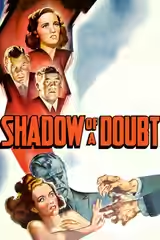
The Stranger offers patient investigative suspense, while Shadow of a Doubt makes danger more intimate through family affection; we favour the latter for its more troubling emotional stakes. Both question a comfortable town’s trust in respectability, but Robinson’s restrained scrutiny is the reason to choose The Stranger if watching an investigator work is the chief attraction.
What should I watch after The Stranger?
After The Stranger, try Shadow of a Doubt (1943, Fi1m 88): Another comfortable town finds that respectability offers remarkably little protection. Then M (1931, Fi1m 94): A patient pursuit grows more disturbing as the hunters reveal themselves; and Memories of Murder (2003, Fi1m 91): An investigation exposes the failures of the people trusted to conduct it.

Cast

Awards

Academy Awards, 1947

Nominated
Best Story

If you liked this, try…

  1. Shadow of a Doubt (1943, Fi1m 88)Another comfortable town finds that respectability offers remarkably little protection.

  2. M (1931, Fi1m 94)A patient pursuit grows more disturbing as the hunters reveal themselves.

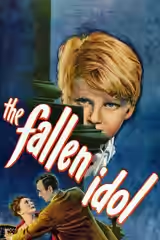
  3. The Fallen Idol (1948) · not on Fi1m yetAdult secrecy becomes suspense through a child’s imperfect understanding of it.

  4. Le Boucher (1970) · not on Fi1m yetQuiet provincial routines make the possibility of violence harder to dismiss.

  5. Memories of Murder (2003, Fi1m 91)An investigation exposes the failures of the people trusted to conduct it.