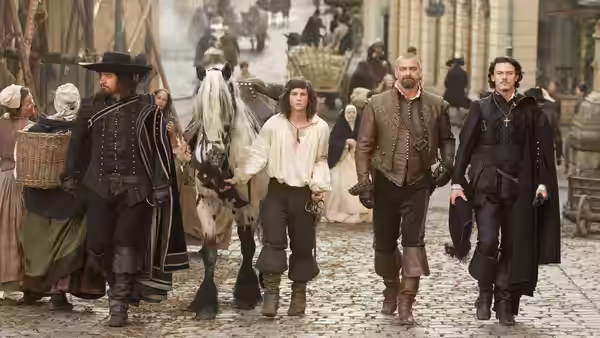
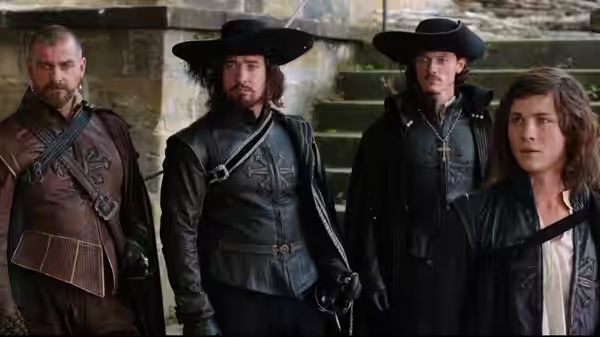
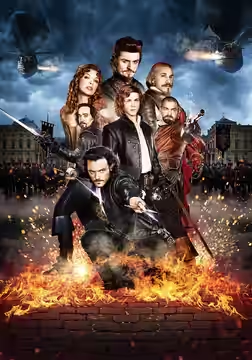
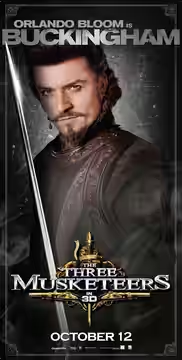
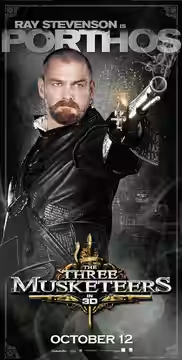
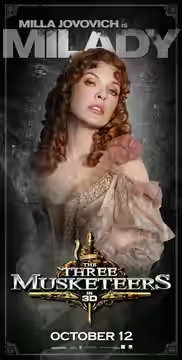
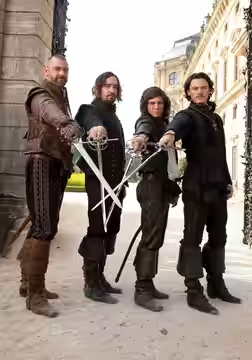
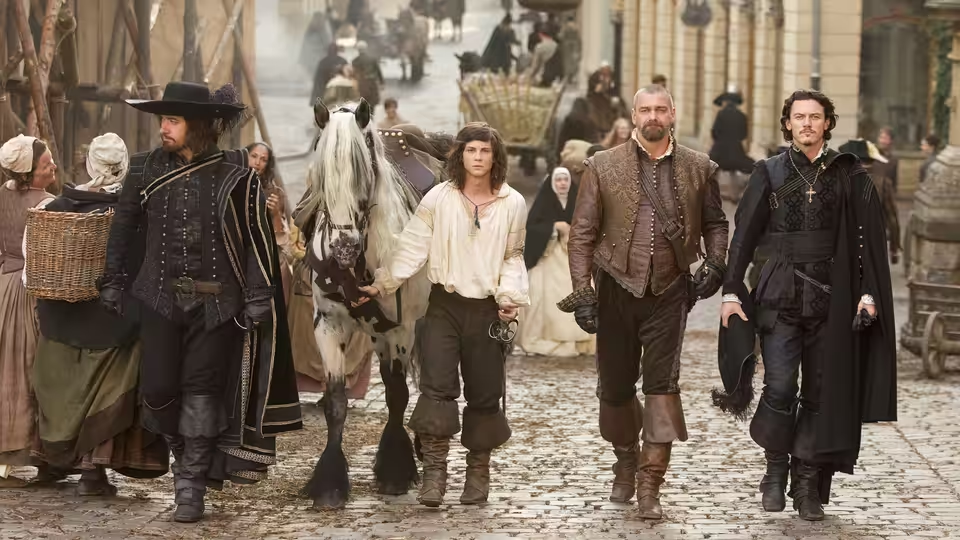
D’Artagnan walks through a crowded street with three musketeers and a horse
Film review

The Three Musketeers

2011 · Directed by Paul W. S. Anderson · 1h 50m

In a sentenceDumas with airships, and only the airships seem to be enjoying themselves

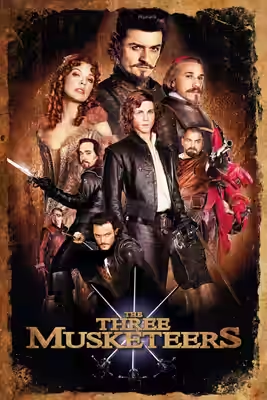
Paris, in the reign of a young king who does as he is told. D’Artagnan (Logan Lerman), a farm boy with his father’s sword and no manners, rides into the city, insults Rochefort (Mads Mikkelsen), the Cardinal’s captain, and picks a quarrel with Athos (Matthew Macfadyen), Porthos (Ray Stevenson) and Aramis (Luke Evans) in a single afternoon. The three are musketeers in name only, drinking off a humiliation handed to them a year earlier by Milady de Winter (Milla Jovovich). Cardinal Richelieu (Christoph Waltz) wants a war with England, and the Duke of Buckingham (Orlando Bloom) is happy to oblige. D’Artagnan wants Constance (Gabriella Wilde), who attends the Queen (Juno Temple), and a commission. What he gets is a servant, Planchet (James Corden), and a fight.

Plays from YouTube when you press play; nothing loads from them until then.

Fi1m review

Paul W. S. Anderson turns Dumas into a heist picture with flying galleons, and for a cheerful half hour it works. Then the script runs out of things for anyone but Christoph Waltz to say, and a film about four friends forgets to be about friendship.

Paul W. S. Anderson has made The Three Musketeers as if the novel were a treasure map he had been given permission to doodle on. Andrew Davies and Alex Litvak’s screenplay keeps the names, the Cardinal and the diamonds, and adds a heist, a double-cross and a pair of warships that fly. It is a 12A and it runs 110 minutes. Taken on those terms it is a bright, silly, forgettable afternoon, and the trouble is that the brightness comes in bursts, with a lot of corridor in between.

The airships are the reason to be here: wooden galleons slung under canvas bags, with cannon in the gunports and men on the rigging. The first time one of them swung into frame over the rooftops we laughed out loud, with the film rather than at it. It is a daft image and Anderson knows exactly how daft, which is more than can be said for a good deal of what follows. When two of them meet in the air and the fighting spills on to a cathedral roof, the picture briefly becomes the thing Anderson wanted it to be, a boys’ adventure annual that has learned to move.

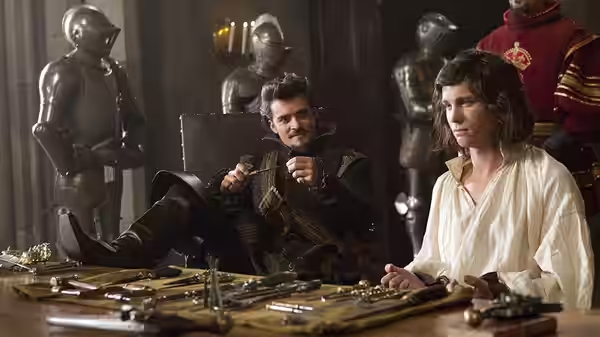
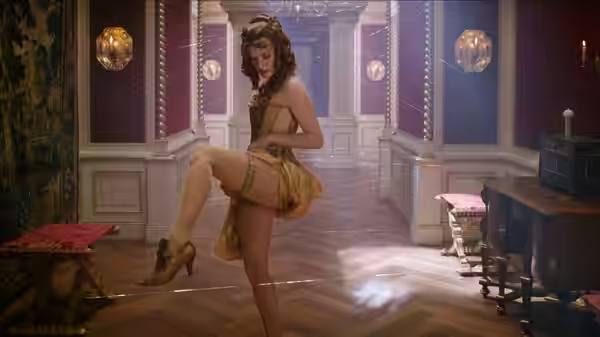
Milla Jovovich is the best thing in the film with a pulse, and she is barely in the middle hour. She plays Milady as a woman who finds everyone around her slightly slow, and the script gives her the only double-cross that is allowed to land. Christoph Waltz plays Richelieu as a man who would rather talk than fight and is a little bored by both; he lowers his voice when everyone else raises theirs, and each of his scenes is the quietest and the most watchable in the film. Mads Mikkelsen gets a sneer and not much else. Orlando Bloom’s Buckingham arrives by airship and plays it as a man who has been told the film is a comedy.

The musketeers themselves are the problem, and it is a structural one. Matthew Macfadyen does his best with Athos as a drunk nursing an old wound, Ray Stevenson is cheerfully loud as Porthos and Luke Evans gives Aramis a certain reserve, but the script never puts the three of them in a room long enough for us to believe they like each other. Logan Lerman’s D’Artagnan talks like a boy from a modern high school who has been dropped into a costume drama and decided to tough it out. He fences well enough. He does not, for one scene, seem to want anything badly, and the film is supposed to be about his wanting.

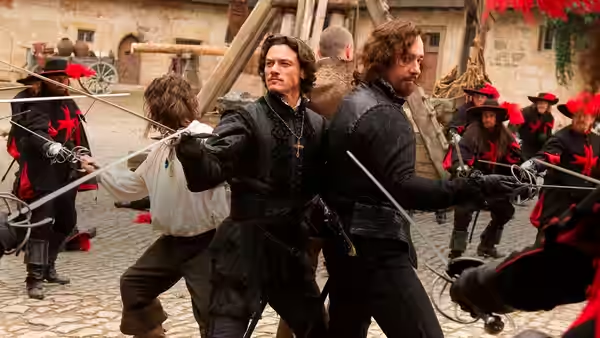
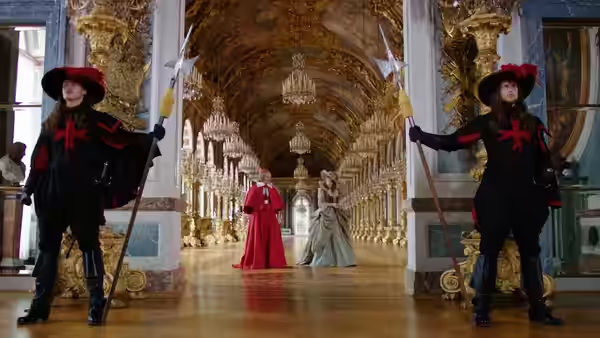
The craft around them is handsome and oddly anonymous. Paul Denham Austerberry’s palaces are vast and gilded, Pierre-Yves Gayraud dresses the court in silks that look as if they cost a fortune, and Glen MacPherson’s camera keeps gliding past both as though late for something. Claus Wehlisch and Alexander Berner cut the swordfights cleanly, so we can mostly tell who is standing where, which puts the film ahead of many of its contemporaries. Paul Haslinger’s score pounds along underneath without once producing a tune we could hum on the way out.

The second half takes turns we will not describe, except to say that the film is more interested in setting up a sequel than in finishing the story it has, and that we felt the pull of the exit ten minutes before the credits did.

As a Dumas adaptation it is a cartoon; as a Paul W. S. Anderson film it is one of his more good-natured, with the same taste for clean geometry in the action and the same indifference to what anyone is feeling while it happens. Most critics were colder than we are, and we can see why: the middle hour is slack and the lead is a blank. But the airships, Jovovich’s smirk and Waltz’s murmuring Cardinal are real pleasures, and a film that gives you three is not nothing.

For a rainy Sunday with children who have never heard of Dumas, it will do. Adults who have will find themselves reaching for the 1973 version afterwards, and that is probably the right instinct.
Critical consensus AI synthesised

45
Positive
2
Mixed
5
Negative
8

Most critics come down against it: eight of the fifteen reviews are negative and only two are in favour. Where there is praise, it clusters on the costumes and production design, the Bavarian scenery and the pace of the stuntwork. The supporting cast fares best. Christoph Waltz and Freddie Fox’s eccentric King Louis are named repeatedly as the performers who bring any life to it, and several reviewers grant that it is harmless, good-natured fun for anyone willing to forget Dumas.

The complaints gather around the script and the action: a muddled, noisy plot, bland leads, with Logan Lerman’s d’Artagnan singled out, and green-screen set pieces that lack the clarity of a properly staged swordfight. The spread is wide, from outright pans to a qualified recommendation. The dissenters are Slant Magazine, which finds the 3D immersive and the action spatially coherent, and Empire, which enjoys the traditionally choreographed fencing and the rooftop duel.

Slant Magazine
21 October 2011 · ★★★/4 · Jaime N. Christley
75

Christley gives the film a qualified positive verdict, finding its awkward dialogue and opening scenes outweighed by its visual spectacle. He particularly praises Anderson’s immersive use of 3D and the film’s spatially coherent action.

Read the full review →
Empire
11 May 2010 · Dan Jolin
70*

Jolin finds the film absurd and derivative but ultimately enjoyable, lively entertainment. He especially praises the traditionally choreographed fencing and the climactic duel on the cathedral roof.

Read the full review →
Screen Daily
23 September 2011 · Mark Adams
64*

The page identifies this as a review, but its verdict is unavailable in the accessible text. No specific praise or complaint can be verified because the article body is paywalled.

Read the full review →
The New York Times
64*

The page is blocked, so the critic’s verdict cannot be established. The review’s specific praise or complaint is also unavailable.

Read the full review →
Radio Times
★★★ · Karen Krizanovich
60

Krizanovich suggests the film may disappoint viewers seeking fidelity to Dumas, but says open-minded viewers can enjoy its liberties. She praises the costumes, Bavarian scenery and fast-paced stuntwork.

Read the full review →
Time Out
11 October 2011 · ★★ · Nigel Floyd
40

The review describes the film as an efficient digital reworking but suggests it has little to recommend it. It singles out the adaptation’s introduction as its only notable feature, though the available description cuts off before specifying what is introduced.

Read the full review →

Straight answers AI written, from our review

Is The Three Musketeers worth watching?
The Three Musketeers (2011) is worth watching only as a bright, silly afternoon for children who have never heard of Dumas, and we scored it 50. The flying galleons, Milla Jovovich's smirk and Christoph Waltz's murmuring Cardinal are real pleasures, but the middle hour is slack and Logan Lerman's D'Artagnan never seems to want anything. Adults who know the book will be reaching for the 1973 version afterwards.
How long is The Three Musketeers, and what is it rated?
The Three Musketeers runs 1h 50m. It is an adventure and action film.
Where can I watch The Three Musketeers in Romania?
The Three Musketeers is not on any streaming or rental service in Romania at the moment. It is available in 24 other countries; change your country at the top of the page to see where. Availability is checked daily.
How violent or frightening is The Three Musketeers, and is it suitable for children?
The Three Musketeers (2011) is a 12A, and its violence is swordfights and airship cannon, cut cleanly enough that you can tell who is standing where and played as boys'-annual adventure rather than anything grim. We saw nothing in it to frighten a child of ten or so, and the tone stays cheerful even when the plotting turns to double-crosses. The squeamish need not worry.
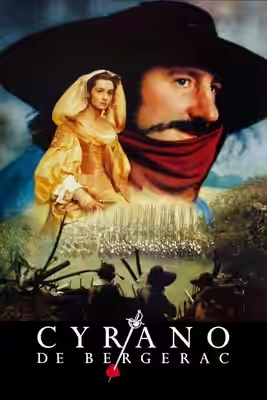
How does The Three Musketeers compare to Cyrano de Bergerac?
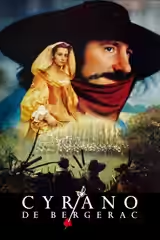
The Three Musketeers (2011) is a cartoon of its century with airships and a heist, while Cyrano de Bergerac (1990) is the French doing their own century properly, in verse, with Gérard Depardieu funny and painfully vulnerable at its centre. Cyrano is much the better film, and the one to choose if you want to feel something. Anderson's picture suits a rainy Sunday with children; Rappeneau's suits anyone who still believes in love.
Is The Three Musketeers based on a true story or a book?
The Three Musketeers (2011) is based on Alexandre Dumas's novel, not on a true story, and it treats the book as a map to doodle on. The screenplay keeps the names, the Cardinal and the diamonds, then adds a heist, a double-cross and two warships that fly. Knowing the novel does not help; if anything it makes the liberties harder to forgive.
What should I watch after The Three Musketeers?
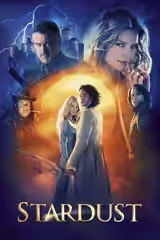
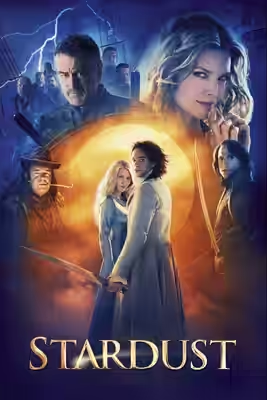
After The Three Musketeers, try Cyrano de Bergerac (1990, Fi1m 88): Depardieu in plumes and rhyme, the French doing their own century properly. Then Stardust (2007, Fi1m 75): Flying ships, a cheerfully silly tone and a cast that knows how to play it.

Cast

If you liked this, try…

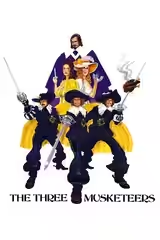
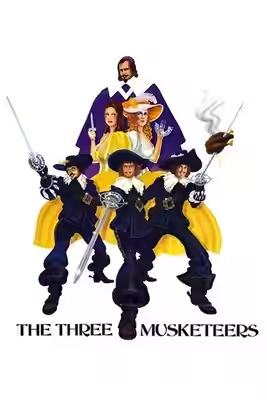
  1. The Three Musketeers (1973) · not reviewed yetRichard Lester’s version: muddy, funny, properly swashbuckling, and the one to see first.

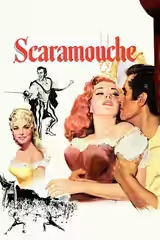
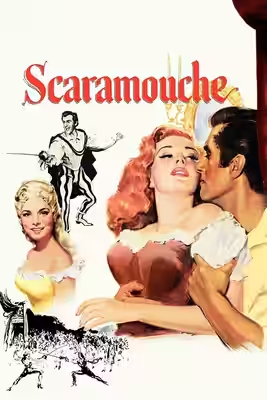
  2. Scaramouche (1952) · not reviewed yetStewart Granger and the longest sword duel in Hollywood, worth every minute.

  3. Cyrano de Bergerac (1990, Fi1m 88)Depardieu in plumes and rhyme, the French doing their own century properly.

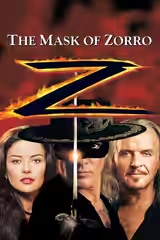
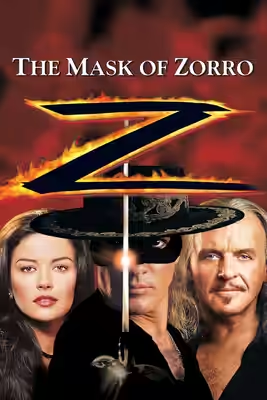
  4. The Mask of Zorro (1998) · not reviewed yetBanderas and Hopkins fence with wit; the last big swashbuckler to really work.

  5. Stardust (2007, Fi1m 75)Flying ships, a cheerfully silly tone and a cast that knows how to play it.

Free account

Know what to watch tonight

Two lists that know where things are streaming, collections you can share, your own score beside ours, and Discover that remembers what you have seen.

  • Want to see, sorted by what is streaming now
  • Seen, with your score out of ten
  • No adverts, ever