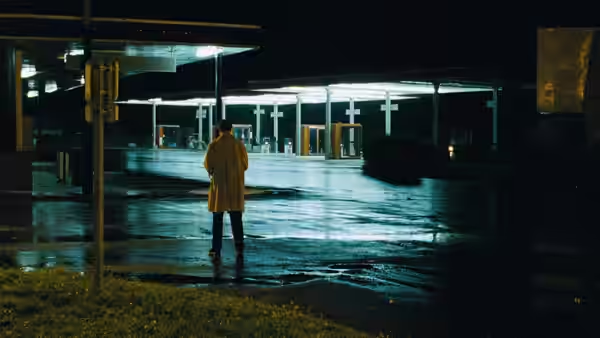
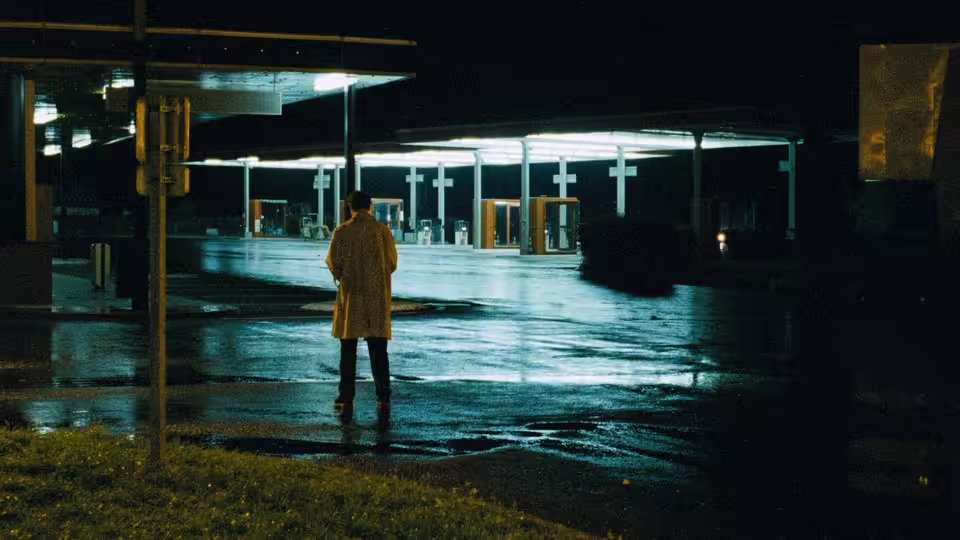
A man in a long coat stands alone at a brightly lit gas station at night
Film review

The Vanishing

1988 · Directed by George Sluizer · 1h 46m

In a sentenceA man practises kidnapping the way you would practise parallel parking, and that is the frightening part

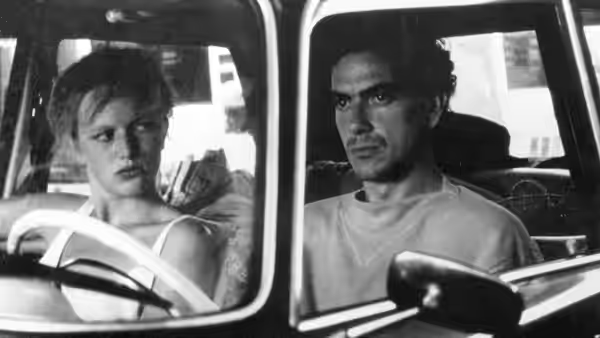
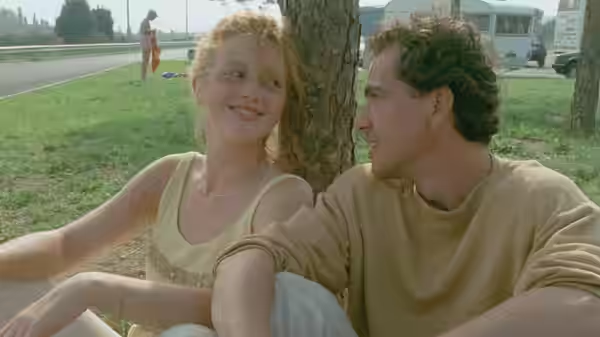
Rex Hofman (Gene Bervoets) and Saskia Wagter (Johanna ter Steege) are a young Dutch couple driving south through France on holiday. They quarrel, they make up, and they stop at a busy motorway service station in hard summer light. Saskia goes inside for drinks and does not come out. There is no scream and no witness; there is only Rex, standing by the car, watching the doors. The film has already introduced Raymond Lemorne (Bernard-Pierre Donnadieu), a married man with a wife, Simone (Bernadette Le Saché), and two daughters, who has been quietly rehearsing something in his car, and it lets us see what Rex cannot. Years later Rex is still searching, with posters and television appeals, and a new partner, Lieneke (Gwen Eckhaus), who is running out of patience.

Fi1m review

George Sluizer’s thriller tells you who took Saskia almost at once and lets you watch him rehearse. It is calm, exact and more frightening than any amount of shouting. The middle years drag; the last twenty minutes are not to be read about first.

George Sluizer’s The Vanishing tells you who did it inside the first twenty minutes, and that is the whole trick. Rex Hofman (Gene Bervoets) and Saskia Wagter (Johanna ter Steege) are driving down to France on holiday. They stop at a motorway service station, she goes into the shop for drinks and she does not come out. We are not asked to wonder who took her, because we have already met him. We have watched him rehearse. The question the film puts in place of the usual one is what a man like that thinks he is doing, and it is a far more frightening question.

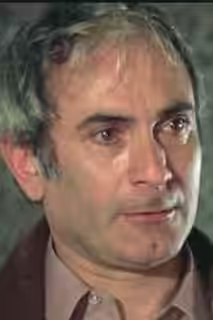
The man is Raymond Lemorne, and Bernard-Pierre Donnadieu plays him as an ordinary husband first and a monster a long way second. He has a wife, Simone (Bernadette Le Saché), two daughters (Tania Latarjet and Lucille Glenn) and a car he sits in and practises. He is not good at it to begin with, and he keeps at it. We were more horrified by the practising than by anything he does in earnest, because a man who practises has a method, and a man with a method will get there in the end.

Toni Kuhn shoots the service station in flat, hard summer light, with cars and coaches and families milling about, and nothing in the frame tells you anything is wrong. Sluizer, who edited with Lin Friedman, refuses the usual cut. There is no shot of a hand on a shoulder or a van door sliding shut. There is only Rex, waiting by the car, looking at the doors, then at his watch, then at the doors again. We watched those doors with him for what felt like a quarter of an hour, and by the end of it we had stopped breathing properly. It is the best scene of its kind we can think of, and it works because Sluizer does nothing.

Years pass. Bervoets plays Rex’s obsession as something dull and administrative: posters, television appeals, a new partner, Lieneke (Gwen Eckhaus), who is patient until she isn’t. This middle stretch is the film’s flattest. Rex is not an interesting man, which is the point, but it is a point that takes a while to make, and we found our attention drifting towards Raymond’s scenes and away from Rex’s. Henny Vrienten’s score does not help. It is thin electronic stuff of its period, and every so often it tells you that something is sinister when Kuhn’s pictures had already made that plain.

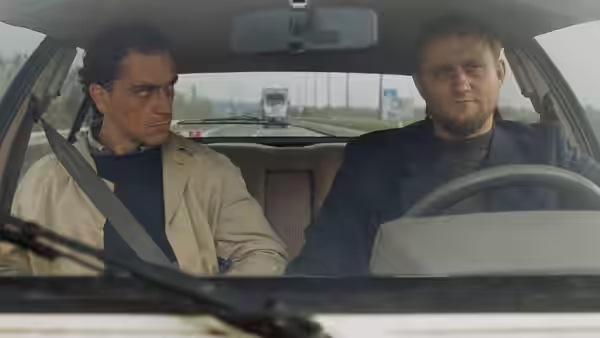
Sophie Dussaud dresses Raymond in cardigans and open collars, the clothes of a man nobody has ever looked at twice, and it matters, because the film wants you to see that this is what such a man looks like. Sluizer and Tim Krabbé, adapting Krabbé’s own novel, give him a long account of why he does it, delivered in a car on a long drive, and we will say only that Donnadieu makes every word of it sound reasonable and that we did not want him to stop.

The last twenty minutes we will not describe. They follow from everything before them with the logic of a proof, and they have been argued over since the film came out. Most critics rate the film highly and so do we. Where we part company with the warmest of them is on the middle hour, which does more waiting than a 106-minute film can quite afford.

Sluizer remade it in America in 1993 and changed the ending. Watch this one. Do not read about it first, and do not stop for petrol on the way home.

Critical consensus AI synthesised

82
Positive
6
Mixed
2
Negative
0

Most critics rate George Sluizer’s Dutch thriller highly, and the praise clusters in the same places. Reviewers call it chilling, hypnotic and disturbing, and several single out the way Sluizer stages the ordinary details of a holiday stop so that a kidnapping seems both plausible and inevitable. Bernard-Pierre Donnadieu’s performance as the abductor is repeatedly noted. The ending is the other point of agreement: critics describe it as devastating and unforgettable without, mostly, giving it away. Those who compare it with the American remake prefer the original for keeping its nerve.

The spread is narrow. Six of the eight reviews are firmly positive, and no critic dislikes the film. Of the two mixed verdicts, Slant Magazine gives it three stars while still calling it unsettling and praising the staging, so the reservation is one of degree rather than kind. The consensus is that the film’s bleakness is its strength, and almost nobody argues otherwise.

Empire
1 January 2000 · Ian Nathan
90*

Nathan finds the Dutch thriller gripping, disturbing, and more rewarding than its American adaptation. He praises its eerie atmosphere and devastating ending.

Read the full review →
Los Angeles Times
10 October 1990 · MICHAEL WILMINGTON
90*

Wilmington finds the film a potent, haunting thriller that builds an everyday nightmare into metaphysical horror. He especially praises its near-documentary realism and Bernard-Pierre Donnadieu’s chilling performance.

Read the full review →
The AV Club
29 October 2014 · A- · Mike D'Angelo
90

The critic praises the film as a brilliantly unsettling thriller that makes uncertainty more frightening than the killer. He singles out the ending as unforgettable and disturbing, contrasting its bleakness with the remake’s misplaced catharsis.

Read the full review →
Time Out
· MK
90*

The critic presents the film as an exceptionally chilling psychodrama. The review singles out how it turns a slender plot into an exploration of human potential.

Read the full review →
The New York Times
25 January 1991
64*

The URL identifies this as a review of the 1988 film, but the page content is unavailable. The critic’s verdict and any specific praise or complaint cannot be verified.

Read the full review →
Slant Magazine
28 October 2014 · ★★★ · Chuck Bowen
60

Bowen finds the film an unforgettably unsettling meditation on chance, obsession, and the absence of catharsis. He praises Sluizer’s precise staging of the ordinary details that make Saskia’s kidnapping possible.

Read the full review →

Straight answers AI written, from our review

Is The Vanishing worth watching?
The Vanishing is worth watching for anyone who prefers dread to shouting, and we scored it 88. George Sluizer tells you who took Saskia almost at once and lets you watch him rehearse, which is more frightening than any mystery. The middle hour drags, but the service station scene and the final twenty minutes are among the best of their kind.
How long is The Vanishing, and what is it rated?
The Vanishing runs 1h 46m. It is a thriller and mystery film.
Where can I watch The Vanishing in Romania?
The Vanishing is not on any streaming or rental service in Romania at the moment. It is available in 4 other countries; change your country at the top of the page to see where. Availability is checked daily.
How violent or frightening is The Vanishing, and is it suitable for children?
The Vanishing has no UK certificate and is not suitable for children: it is a film about a kidnapping, built on sustained dread rather than gore. Sluizer shows almost nothing directly, refusing the usual shot of a hand on a shoulder, and the fear comes from watching an ordinary man practise. The last twenty minutes are disturbing and best approached unread.
How does The Vanishing compare to Funny Games?
The Vanishing and Funny Games share a calm tormentor, but Sluizer's film is the more controlled and the easier to recommend. Haneke's is harder to watch and keeps stopping to lecture you on why you are watching; Sluizer simply lets you watch. Choose The Vanishing for a thriller that trusts its pictures, Funny Games if you want to be punished and argued with.
Is The Vanishing based on a true story or a book?
The Vanishing is based on a novel by Tim Krabbé, who adapted it for the screen with director George Sluizer; it is not presented as a true story. You do not need to know the book, and the film gives Raymond a long account of himself that stands on its own. We would advise against reading anything about how either version ends before you watch.
What should I watch after The Vanishing?
After The Vanishing, try Funny Games (1997, Fi1m 74): Haneke’s polite tormentors share Raymond’s calm; harder to watch, easier to argue with. Then Picnic at Hanging Rock (1975, Fi1m 88): Schoolgirls vanish on an Australian afternoon and the film never explains itself; and Memories of Murder (2003, Fi1m 91): Korean detectives chase a killer for years; the not knowing is the story.

Cast

Awards

International Submission to the Academy Awards, 1989

Nominated
International Submission to the Academy Awards

European Film Award for Best Supporting Actress, 1988

Won
European Film Award for Best Supporting Actress

If you liked this, try…

  1. Funny Games (1997, Fi1m 74)Haneke’s polite tormentors share Raymond’s calm; harder to watch, easier to argue with.

  2. Picnic at Hanging Rock (1975, Fi1m 88)Schoolgirls vanish on an Australian afternoon and the film never explains itself.

  3. Memories of Murder (2003, Fi1m 91)Korean detectives chase a killer for years; the not knowing is the story.

  4. L'Avventura (1960) · not on Fi1m yetA woman disappears on an island and her friends slowly stop looking.

  5. Prisoners (2013, Fi1m 81)A father’s search for a missing daughter, shot in rain and shown at length.